Kettlebell Value Guide: Cast Iron vs Competition & Push Day Dumbbells
Compare cast iron vs competition kettlebells for your home gym. We break down the budget, value, and how they stack up against push day dumbbells.

The Home Gym Pressing Dilemma: Offset Bells vs. Balanced Iron
Building a dedicated upper-body pressing station in a home gym requires a ruthless evaluation of cost-per-pound, spatial footprint, and biomechanical utility. As of 2026, lifters following a Push/Pull/Legs (PPL) split are increasingly questioning the traditional reliance on adjustable dumbbells. The modern budget breakdown now forces a three-way showdown: traditional cast iron kettlebells, standardized competition kettlebells, and a dedicated set of push day dumbbells.
While BarBend's comprehensive breakdown of kettlebell versus dumbbell training highlights the distinct neurological demands of each implement, the financial reality of outfitting a home gym demands a closer look at long-term value. Do you invest in the micro-loadable convenience of adjustable dumbbells, or do you build a modular, indestructible collection of kettlebells that can transition from heavy overhead presses to high-rep clean-and-jerk complexes? This guide dissects the exact pricing, failure modes, and pressing ergonomics to help you allocate your equipment budget effectively.
Cast Iron Kettlebells: The Traditionalist’s Budget Anchor
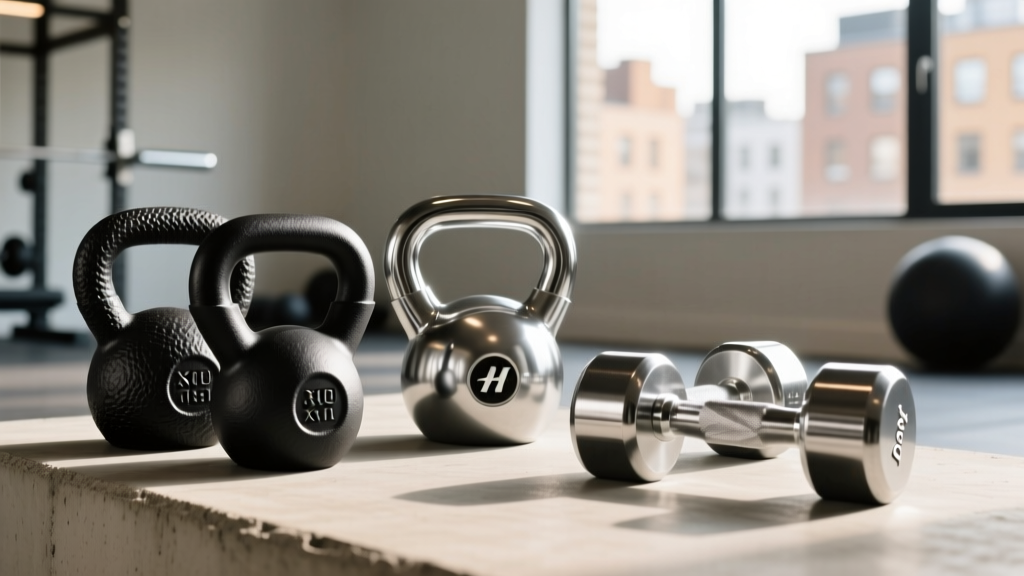
Cast iron kettlebells remain the most accessible entry point for offset pressing. Brands like Rogue Fitness and Rep Fitness dominate this space, offering single-cast bells with a matte powder-coat finish.
The Pricing Reality (2026 Market)
- Cost Per Pound: Typically ranges from $1.80 to $2.60 per pound. Lighter bells (12kg-16kg) sit at the higher end of this spectrum, while heavier bells (32kg+) drop closer to $1.80/lb.
- Handle Ergonomics: Handle diameters vary wildly by weight. A 16kg cast iron bell might feature a 32mm handle, while a 32kg bell can swell to 38mm or more. For strict overhead pressing, this inconsistency can alter your grip mechanics and wrist extension as you move up in weight.
- The Rack Position: Because the physical dimensions of the bell grow with the weight, the 'rack' position (resting the bell on your forearm/chest before a press) becomes increasingly punishing on the wrist and forearm with heavier cast iron models.
Competition Kettlebells: The Premium Pressing Investment
Competition kettlebells are engineered for one specific purpose: absolute dimensional consistency regardless of weight. Whether you are pressing a 12kg or a 32kg bell, the handle diameter is universally 35mm, and the bell's physical footprint remains identical. The weight difference is achieved by altering the thickness of the steel shell and the density of the internal filler.
Why They Excel for Push Day Complexes
According to StrongFirst's strict press guidelines, consistent grip mechanics are paramount for neurological adaptation and joint health. The 35mm handle of a competition bell is widely considered the gold standard for pressing, allowing for optimal grip engagement without overtaxing the flexors. Furthermore, the uniform bell size means the rack position remains identical across your entire set, eliminating wrist bruising and allowing for seamless transitions during high-volume push day circuits.
The Premium Price Tag
- Cost Per Pound: Expect to pay between $4.50 and $6.50 per pound for premium brands like Kettlebell Kings or Onnit.
- Value Proposition: While the upfront cost is nearly triple that of cast iron, competition bells boast a near-zero depreciation rate. Their steel-on-steel construction and standardized sizing make them highly sought after on the secondary market.
The Adjustable Push Day Dumbbells Alternative
No budget breakdown is complete without addressing the elephant in the room: adjustable push day dumbbells. For pure hypertrophy and traditional bodybuilding movements (flat bench presses, incline flyes, lateral raises), dumbbells offer symmetrical loading and superior micro-progression.
Top Contenders and Pricing
- Nuobell 80lb Pair: Retailing around $499 in 2026, these offer a genuine knurled steel handle that mimics a standard barbell or fixed dumbbell. The twist-lock mechanism allows for 5lb increments up to 80lbs per hand.
- Bowflex SelectTech 552: Priced around $429 per pair, these utilize a dial system ranging from 5 to 52.5 lbs. The handle is thicker and the overall footprint is bulky, making them less ideal for tight-grip floor presses but excellent for isolation work.
- PowerBlock Elite USA: Starting at $399, the blocky, urethane-encased design is incredibly durable for dropping, but the cage-like handle restricts natural wrist supination during pressing movements.
Head-to-Head Budget & Utility Matrix
| Equipment Type | Avg. Cost Per Pound | Handle Consistency | Best Push Day Application | Durability / Failure Risk |
|---|---|---|---|---|
| Cast Iron Kettlebells | $1.80 - $2.60 | Poor (Varies by weight) | Strict Press, Bottoms-Up Press | Indestructible (Paint chips) |
| Competition Kettlebells | $4.50 - $6.50 | Perfect (35mm Universal) | Clean & Press, High-Rep Circuits | Indestructible (Steel shell) |
| Adjustable Dumbbells | $3.10 - $4.20 (Effective) | Perfect (Fixed pair) | Incline Press, Flyes, Isolation | High Risk (Dial/Pin failure) |
Long-Term Value Depreciation and Failure Modes
When analyzing the budget breakdown, you must factor in the lifespan of the equipment. A $500 set of adjustable push day dumbbells offers incredible immediate utility, but it represents a depreciating asset. The urethane coatings on PowerBlocks can degrade and become sticky after 5-7 years of heavy use and exposure to sweat and UV light. Dial mechanisms on SelectTech models are notorious for accumulating dust and iron particulate, eventually causing the weight plates to jam or fail to lock.
Conversely, a 24kg competition kettlebell purchased today will functionally outlive you. If you chip the paint on a cast iron bell, a $5 can of Rust-Oleum matte black spray paint restores it to factory condition in twenty minutes. Competition bells don't even require this; a wire brush removes rust from the bare steel handle in seconds, maintaining the precise 35mm diameter without adding layers of paint that would alter your grip.
The $800 Push-Day Allocation Framework
How should you actually spend your money in 2026? If you have an $800 budget dedicated to upper-body pressing implements, avoid the trap of buying a massive, mismatched set of cheap fixed dumbbells or a single, overly heavy adjustable set. Instead, use this hybrid allocation framework:
Option A: The Hypertrophy Focus ($750)
- Nuobell 80lb Adjustable Pair ($499): Covers all incline, flat, and isolation movements with 5lb micro-loading.
- Single 24kg Cast Iron Kettlebell ($120): Dedicated strictly to heavy unilateral overhead presses and bottoms-up stabilizer work.
- Remaining Budget ($131): Allocated toward a high-quality incline bench or parallettes for deep floor presses.
Option B: The Functional Power Focus ($780)
- Pair of 16kg Competition Kettlebells ($320): Perfect for double-kettlebell clean and press complexes, and high-volume push day conditioning.
- Single 24kg Competition Kettlebell ($230): For heavy unilateral strict pressing and get-ups.
- Single 32kg Cast Iron Kettlebell ($130): For heavy rack holds, core stabilization, and low-rep strength testing.
- Remaining Budget ($100): Chalk, grip strengtheners, and wrist wraps to manage the heavy rack-position loads.
Final Verdict: Match the Tool to the Stimulus
The debate between cast iron bells, competition bells, and push day dumbbells is not about which is universally superior, but which provides the highest return on investment for your specific training stimuli. If your push day is defined by traditional bodybuilding hypertrophy—chasing the pump with incline presses, pec flyes, and triceps extensions—adjustable push day dumbbells are non-negotiable. The balanced load and easy micro-progression justify the premium price and mechanical fragility.
However, if your push day prioritizes functional shoulder health, core integration, and athletic power output, competition kettlebells offer an unmatched, standardized pressing experience that protects your wrists while demanding total-body tension. Cast iron remains the undisputed king of budget-friendly, heavy, unilateral grinding. Evaluate your programming, respect the cost-per-pound, and build an arsenal that will serve your pressing mechanics for decades to come.
More gear to consider
All reviews
Loadable Dumbbells for Low Dumbbell Flyes: Space-Saving Guide
2026 Adjustable Dumbbell Review: Which Dumbbell Bumpers Survive?

PewDiePie Dumbbells Trend: 2026 Loadable Plate Market Analysis

Best Dumbbell Racks to Store Weights for Dumbbell Sit-Ups (2026)
EZ Curl vs Straight Bar Care & 1 1 2 Dumbbell Bench Press
