Cable Lateral Raises vs Dumbbell Space: Rubber Hex vs Urethane Guide
Optimize your gym layout by comparing cable lateral raises vs dumbbell zones, and discover whether rubber hex or urethane dumbbells save the most space.

The Spatial Dilemma: Cable Lateral Raises vs Dumbbell Zones
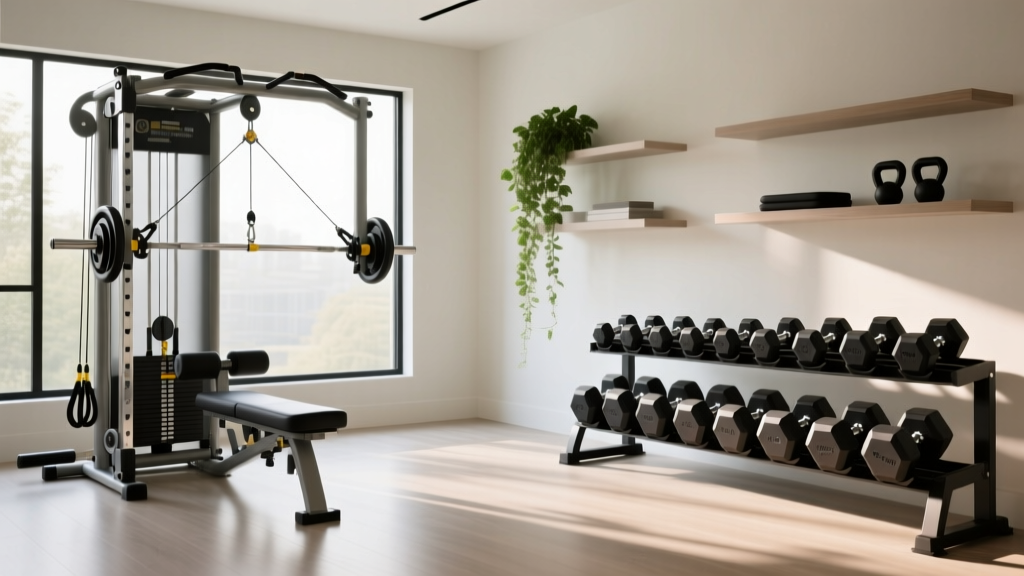
Designing a high-performance home or boutique commercial gym in 2026 requires ruthless spatial efficiency. One of the most common layout bottlenecks occurs when programming isolation movements, specifically when weighing the footprint of cable lateral raises vs dumbbell setups. While functional trainers and cable crossovers provide superior constant-tension mechanics for medial deltoid hypertrophy, their spatial demands are massive. A standard cable crossover, such as the Force USA G12 or a Rogue Monster RM-3 functional trainer, commands a minimum footprint of 71 inches by 53 inches—consuming roughly 26 square feet of floor space, not including the required user clearance zone.
Conversely, a dedicated dumbbell lateral raise zone requires only the user's wingspan (typically 70 to 75 inches) and a compact storage solution. By opting for free weights over cables for isolation work, you can reclaim up to 15 square feet of valuable floor plan. However, transitioning to a free-weight layout shifts the spatial optimization challenge from the machine footprint to the storage footprint. This is where the material science of your iron matters immensely. Choosing between a rubber hex dumbbell vs urethane dumbbell setup will dictate your rack density, shelf spacing, and overall layout efficiency.
Footprint Comparison: Cable Machine vs. Dumbbell Rack Zone
Before diving into dumbbell materials, it is crucial to quantify the spatial savings of a free-weight layout. The table below illustrates the real estate required for both setups, factoring in equipment dimensions and necessary safety clearances for a full range of motion.
| Layout Metric | Cable Crossover Zone | Dumbbell Rack Zone (5-50 lbs) |
|---|---|---|
| Equipment Footprint | ~26.0 sq ft (71" x 53") | ~7.3 sq ft (44" x 24" A-Frame) |
| User Clearance Required | ~12.0 sq ft (Front/Sides) | ~24.0 sq ft (360-degree wingspan) |
| Total Zone Area | ~38.0 sq ft | ~31.3 sq ft |
| Wall Placement Constraint | Must be anchored to studs/concrete | Freestanding; can be placed centrally |
While the total zone areas are somewhat comparable when accounting for human movement, the shape of the footprint is what matters. A cable machine forces a rigid, wall-adjacent layout, whereas a dumbbell rack can be positioned centrally or tucked into a corner, allowing for vastly superior traffic flow in tight rooms.
Choosing the Right Iron: Rubber Hex vs Urethane for Compact Racks
Once you commit to the space-saving dumbbell route, your next layout decision is the rack. To maximize vertical storage and minimize linear shelf space, you must evaluate the dimensional differences between rubber-coated cast iron and solid urethane. According to extensive durability and dimension testing by Garage Gym Reviews, the material composition directly impacts how tightly you can pack your storage tiers.
Dimensional Analysis & Rack Density
Rubber hex dumbbells, such as the popular REP Fitness Rubber Hex Dumbbells or CAP Barbell Pro Grade sets, are notorious for their bulky head profiles. Because rubber is less dense than urethane and requires a thicker casing to prevent tearing, the heads on heavier weights (40 lbs and above) flare out significantly. A 50 lb rubber hex dumbbell often features a head width of 7.5 to 8.0 inches. When placed on a standard 3-tier rack, these wide heads require 10 to 12 inches of horizontal shelf space per pair to prevent the rubber edges from grinding against one another when users pull them from the rack.
Urethane, on the other hand, is a high-density elastomer. Premium options like Rogue Fitness Urethane Dumbbells feature a much tighter dimensional profile. A 50 lb Rogue urethane dumbbell (round or 12-sided) typically measures around 6.2 to 6.5 inches in diameter. This 1.5-inch reduction per head translates to massive spatial savings across a full set. Urethane sets can be comfortably stored on narrower 8-inch shelf tiers, allowing gym owners to utilize compact 5-tier vertical racks or wall-mounted tray systems that would physically reject the wide footprint of rubber hex heads.
Layout Warning: The Knurling Clearance FactorWhen measuring your rack shelves, do not just measure the dumbbell heads. Standard ergonomic handles on urethane dumbbells often feature aggressive knurling that extends closer to the head. If your rack shelves are too narrow, the knurled shafts will scrape against the vertical steel uprights, degrading the zinc or chrome finish over time. Always add a minimum of 1.5 inches of lateral clearance to your longest handle measurement when designing custom wall-mounted shelves.
Material Degradation in High-Traffic, Tight-Space Gyms
Space optimization is not just about the initial footprint; it is about long-term spatial integrity. In compact home gyms or tightly packed boutique studios, equipment is frequently bumped, dragged, and exposed to environmental stressors.
The Off-Gassing and UV Factor
Rubber dumbbells are manufactured using recycled or virgin rubber compounds that emit volatile organic compounds (VOCs), commonly known as off-gassing. In a sprawling 2,000-square-foot commercial gym, this odor dissipates unnoticed. In a 200-square-foot basement or garage gym, the concentrated off-gassing from a 500-pound set of rubber hex dumbbells can make the space unusable without heavy ventilation. Furthermore, if your compact layout forces your dumbbell rack near a window, UV exposure will cause the rubber to dry rot, crack, and flake onto your flooring within 18 to 24 months.
Urethane is virtually odorless and highly resistant to UV degradation. For space-constrained rooms where the rack must sit adjacent to a living area, home office, or window, urethane is the only viable choice for maintaining air quality and material integrity.
Abrasion Resistance on Metal Shelves
When users are fatigued, they do not gently place dumbbells back on the rack; they drag them. Rubber hex coatings are prone to micro-tearing when dragged across unpowder-coated or textured steel rack shelves. Once the rubber tears, the internal cast iron core is exposed to humidity, leading to rust that stains the rack and floor. Urethane boasts an abrasion resistance rating up to 10 times higher than rubber. It will glide over steel tier pins and shelves for a decade without compromising its outer shell, preserving the clean aesthetic required in premium, multi-use spaces.
The Drop Zone & Layout Safety Factor
Spatial constraints inherently limit safe drop zones. When performing heavy dumbbell lateral raises or walking lunges in a tight room, the behavior of the dumbbell upon impact dictates your layout safety margins.
- Rubber Hex (The Anti-Roll Advantage): The flat edges of the hex shape prevent the dumbbell from rolling away after being set down or dropped. In a cramped layout where a rolling dumbbell could easily strike a nearby treadmill, mirror, or wall, the hex shape acts as a built-in safety brake. However, the hard cast-iron core transfers high impact forces directly to the floor, requiring thick 3/4-inch horse stall mats directly beneath the usage zone.
- Urethane (The Shock Absorber): Urethane has a durometer (hardness) rating typically between 85A and 90A, giving it a slight give upon impact. It absorbs shock far better than rubber-coated iron, protecting your subfloor. However, round urethane dumbbells will roll. If you opt for round urethane to save rack space, your layout must incorporate a dedicated, walled-off drop zone or utilize specialized tray-style racks to prevent tripping hazards in tight walkways. Alternatively, seek out 12-sided (dodecagonal) urethane models which offer a compromise between high-density storage and anti-roll geometry.
Cost-to-Space Ratio Breakdown
Budget inevitably influences layout decisions. Urethane is a premium investment, but its spatial efficiency often justifies the cost for high-end facilities.
| Material Type | Average Cost (2026) | Rack Type Required | Best Layout Application |
|---|---|---|---|
| Rubber Hex | $1.40 - $1.90 / lb | Wide 3-Tier A-Frame | Garage gyms, basement setups with ample width and high ventilation. |
| Urethane (Round) | $2.80 - $3.80 / lb | Compact 5-Tier Vertical | Boutique studios, luxury home gyms, tight footprints requiring max density. |
| Urethane (12-Sided) | $3.00 - $4.20 / lb | Standard 3-Tier or Tray | High-traffic commercial zones where rolling hazards must be eliminated. |
Final Layout Blueprint: Integrating Your Dumbbell Zone
To finalize your space optimization strategy, follow this layout blueprint for a dedicated dumbbell isolation zone:
- Ditch the Cable Crossover for Isolation: Reclaim the 26 square feet of wall space by utilizing dumbbells for lateral raises, tricep extensions, and flyes. Reserve cable machines strictly for heavy compound movements or specialized rehab stations if space permits.
- Centralize the Rack: Place a compact 5-tier urethane rack in the center of the room or floating 3 feet off a wall. This allows 360-degree access and prevents users from backing into walls while holding heavy iron.
- Define the Wingspan Perimeter: Use contrasting rubber flooring tiles to visually mark an 8x8 foot "active zone" around the rack. This ensures no other equipment (benches, plyo boxes) is placed within the lateral strike zone of a user performing raises.
- Select 12-Sided Urethane: For the ultimate balance of high-density racking and floor safety in tight spaces, invest in 12-sided urethane dumbbells. They offer the narrow head profile required for compact shelving while eliminating the rolling hazard of round heads in confined walkways.
By prioritizing material density and geometric safety over bulky, budget-friendly rubber, you can engineer a free-weight zone that maximizes every square inch of your facility without sacrificing performance or aesthetics.
More gear to consider
All reviews
Compact Gym Layouts: Loadable Dumbbells & Dumbbell Toe Taps

2026 Dumbbell Rack Trends: Protecting Dumbbell Bench Form

EZ Curl Bar vs Straight Bar Maintenance & Dumbbell PNG Layouts

Beyond the Best Beginner Dumbbell Workout: Barbell Knurling & Weight

Olympic vs Standard Weight Plates for Dumbbell Bars: Mistakes & Fixes
