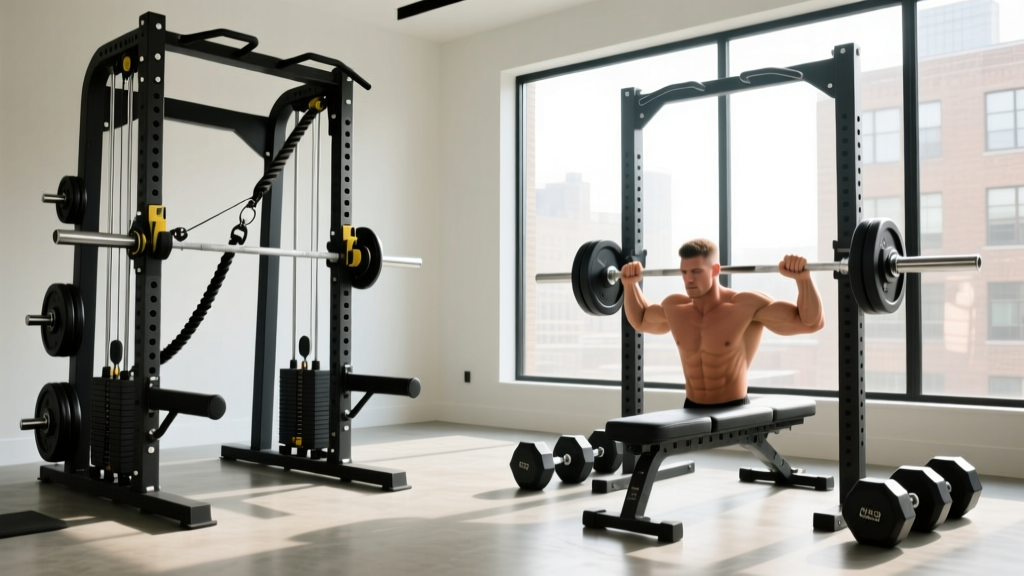
Cable Flys vs Dumbbell Flys: Power Rack vs Squat Rack Setup
Avoid critical home gym mistakes. We troubleshoot power rack vs squat rack vs squat stand choices for optimizing cable flys vs dumbbell flys.

Building a home gym in 2026 requires more than just buying the heaviest weight plates you can find; it demands a strategic understanding of biomechanics and equipment geometry. When programming for chest hypertrophy, the debate of cable flys vs dumbbell flys is a staple. Dumbbells offer an unparalleled deep eccentric stretch, while cables provide constant, joint-friendly tension throughout the entire range of motion. However, your ability to safely and effectively execute both variations is entirely dictated by your choice of racking system.
As a senior equipment reviewer, I see lifters make catastrophic purchasing errors every day. They buy a minimal squat stand hoping to rig DIY cable pulleys, or they invest in a half-rack only to realize they cannot perform bilateral crossovers. This troubleshooting guide breaks down the critical mistakes lifters make when evaluating a power rack vs squat rack vs squat stand specifically for chest isolation work, and provides exact measurements to fix your setup.
The Biomechanical Divide: Why Rack Geometry Matters
Before troubleshooting equipment, we must establish the physical requirements of the movements. According to ExRx.net's biomechanical breakdown of the cable chest fly, cable variations maintain a constant resistance vector that aligns with the pectoral fibers regardless of the arm's position. Dumbbell flys, conversely, rely on gravity, meaning tension drops to near-zero at the top of the concentric phase but peaks dangerously at the bottom eccentric stretch.
To accommodate the dumbbell fly, you need massive horizontal clearance for your elbows to drop below the torso. To accommodate the cable fly, you need a dual-pulley anchor point that can withstand lateral tension without shifting. Your rack is the foundation for both.
Mistake #1: The Squat Stand Pulley Delusion
The most dangerous mistake in home gym engineering is attempting to simulate cable flys on a standard squat stand (like the popular Titan Fitness T-2 Series or Fitness Reality 800XL). Squat stands consist of two independent 2x2-inch steel uprights connected only by a stabilizer bar.
WARNING: The Lateral Tension Tipping HazardIf you attach a DIY pulley or resistance band to the side of a 150 lb squat stand and pull 45 lbs of lateral force during a cable fly, you create a moment arm. The center of gravity shifts outside the base of support. Without bolting the stand to a concrete platform or loading the base with 200+ lbs of sandbags, the upright will tip toward you mid-rep, risking severe injury.
Troubleshooting the Squat Stand
If you already own a squat stand and want the constant tension of a cable fly, do not use the uprights as anchor points. Instead, utilize a heavy-duty resistance band wrapped around the rear base stabilizer, pulling forward while seated on an incline bench. This aligns the force vector with the base's longest dimension, preventing lateral tipping.
Mistake #2: The Half-Rack (Squat Rack) Bilateral Blindspot
A squat rack (often called a half-rack, such as the Rogue SML-1 Monster Lite) is a fantastic space-saver for heavy squats and bench pressing. However, it fails the bilateral cable fly test. Most half-racks accept lat-tower or functional trainer attachments on only one side of the rig.
You cannot perform a traditional dual-cable crossover or bilateral cable fly if both pulleys originate from the left side of your body; the resistance vector will pull you into torso rotation rather than isolating the sternal head of the pectoralis major. You are forced to perform single-arm cable flys, which is excellent for anti-rotation core stability but inefficient for pure bilateral chest hypertrophy.
Mistake #3: Power Rack Interior Clearance & Elbow Strikes
Power racks are the only true solution for safely integrating both heavy barbell work and dual-cable functional trainer attachments. But here is where lifters fail the dumbbell fly test: interior width clearance.
When you perform a dumbbell fly, a 6-foot-tall lifter with a 72-inch wingspan holding 35 lb dumbbells requires roughly 60 inches of clear horizontal space at the bottom of the eccentric phase. Many budget power racks are built with 48-inch exterior widths. Once you factor in 3x3-inch uprights and internal hardware, the clear interior space drops to 41 inches.
'If your elbows or dumbbells strike the uprights at the bottom of a fly, you are artificially cutting off the stretch-mediated hypertrophy response. The bottom 20% of the eccentric is where the most muscle damage and subsequent growth occurs.' - Hypertrophy Biomechanics Consensus, 2025.
The 49-Inch Rule
To perform dumbbell flys safely inside a power rack, you must purchase a rack with a minimum interior width of 49 inches. Models like the Rogue R-3 Power Rack (49-inch interior, 3x3 uprights, ~$1,350) or the REP Fitness PR-4000 (47.2-inch interior, but features flush-mounted hardware to maximize space, ~$1,099) are mandatory for unrestricted dumbbell arcs.
Equipment Matrix: Rack Types vs. Fly Variations
Use this troubleshooting matrix to diagnose your current setup or plan your 2026 equipment upgrade. Data reflects current market pricing and structural limitations.
| Equipment Type | Dumbbell Fly Suitability | Cable Fly Compatibility | Common Failure Mode | Est. 2026 Cost |
|---|---|---|---|---|
| Squat Stand (e.g., Titan T-2) | Excellent (Unrestricted space) | Dangerous / Not Recommended | Lateral tipping during cable pulls | $300 - $450 |
| Squat Rack / Half-Rack (e.g., Rogue SML-1) | Good (Open front end) | Unilateral Only | Asymmetrical pulley mounting limits bilateral crossovers | $850 - $1,200 |
| Standard Power Rack (48" wide) | Poor (Elbow strikes) | Excellent (with FT arms) | Uprights block deep eccentric stretch | $700 - $950 |
| Wide Power Rack (e.g., Rogue R-3, PR-4000) | Excellent (49"+ clearance) | Excellent (Dual FT arms) | High footprint and cost | $1,100 - $1,800+ |
Step-by-Step Troubleshooting: Fixing Your Current Setup
If you have already purchased the wrong rack for your preferred fly variation, use these expert workarounds to salvage your chest days without compromising safety or hypertrophy.
- For Squat Stand Owners (Craving Cable Tension): Abandon steel pulleys. Purchase a set of continuous loop resistance bands (15-35 lbs). Wrap the center of the band around the bottom rear crossmember of the stand. Lie on a flat bench positioned in front of the stand, grasping the loops. This mimics the ascending resistance curve of a cable fly while keeping the force vector grounded and safe. As noted in Garage Gym Reviews' comprehensive guide on power rack vs squat rack stability, ground-anchored bands are the only safe lateral pull for un-bolted stands.
- For Half-Rack Owners (Craving Bilateral Flys): Since you only have one pulley tower, switch to unilateral cable flys. Set the pulley to sternum height. Perform single-arm crossovers, using your non-working hand to stabilize against the rack upright. This actually increases core activation and allows for a deeper stretch across the midline.
- For Narrow Power Rack Owners (Craving Dumbbell Stretch): If your interior width is under 45 inches, do not perform flat dumbbell flys inside the cage. Instead, pull your adjustable bench completely out of the rack. Use the rack solely for heavy barbell benching and squats, and perform your dumbbell flys in the open floor space to allow unrestricted elbow drop.
Expert Verdict: Where to Put Your Money
The choice between cable flys and dumbbell flys shouldn't be an 'either/or' scenario; a complete hypertrophy program requires both to target the pectorals through varying resistance profiles. Therefore, your rack must support both modalities safely.
If your budget is under $500, buy a squat stand, use dumbbells for flys, and use floor-anchored bands for cable simulations. If your budget is $1,000+, bypass the half-rack and invest in a wide power rack (minimum 49-inch interior width) equipped with functional trainer cable arms. This guarantees the structural integrity required for heavy lateral cable pulls while providing the physical clearance necessary for deep, stretch-mediated dumbbell flys. Stop compromising your biomechanics for the sake of a smaller equipment footprint.
More gear to consider
All reviews
Budget Dumbbell Racks 2026: Safe Storage for Dumbbell Uppercuts
Barbell Guide: Weight, Knurling & Brachioradialis Dumbbell Exercises

Dumbbell Rack Storage & Dumbbell Bench to Barbell Bench Conversion

Beyond Lower Chest Exercises with Dumbbells: Olympic Barbell Setup

Beyond the 30 Pound Dumbbell Workout: Bumper vs Iron Plate Care
