Beyond Dumbbell Squats: Power Rack vs Squat Rack vs Squat Stand
Upgrade from dumbbell squats to heavy barbell training. Compare power racks, squat racks, and squat stands for space, safety, and 2026 pricing.

The Ceiling of Dumbbell Squats: Why You Need a Rack
Goblet squats and heavy dumbbell squats are foundational movements for building quad hypertrophy, ankle mobility, and core stability. However, as you progress, you will inevitably hit a biomechanical ceiling. Holding 100-pound dumbbells in each hand places immense strain on your grip, traps, and upper back long before your lower body reaches true muscular failure. According to exercise mechanics documented by ExRx.net, transitioning to barbell back or front squats removes the grip bottleneck, allowing for systemic overload and superior strength gains.
But making that leap requires a dedicated rig. In 2026, the home gym market is saturated with options, and choosing between a power rack, a squat rack (half rack), and squat stands can be paralyzing. This in-depth buying guide breaks down the exact dimensions, steel gauges, safety mechanisms, and pricing of each setup so you can build a rig that matches your space and lifting ambitions.
Quick-Glance Decision Matrix
| Feature | Power Rack (Full Cage) | Squat Rack (Half Rack) | Squat Stands |
|---|---|---|---|
| Footprint | 4x4 ft to 5x5 ft | 4x3 ft (often wall-mounted) | 2x2 ft (independent posts) |
| Avg. Price (2026) | $650 - $1,400+ | $400 - $900 | $180 - $350 |
| Safety Spotting | Excellent (Enclosed pins/straps) | Good (Extended spotter arms) | Poor (Requires human spotter) |
| Best For | Heavy solo lifting, kipping, bands | Garage gyms with limited depth | Minimalists, outdoor gyms, tight budgets |
Power Racks: The Enclosed Fortress
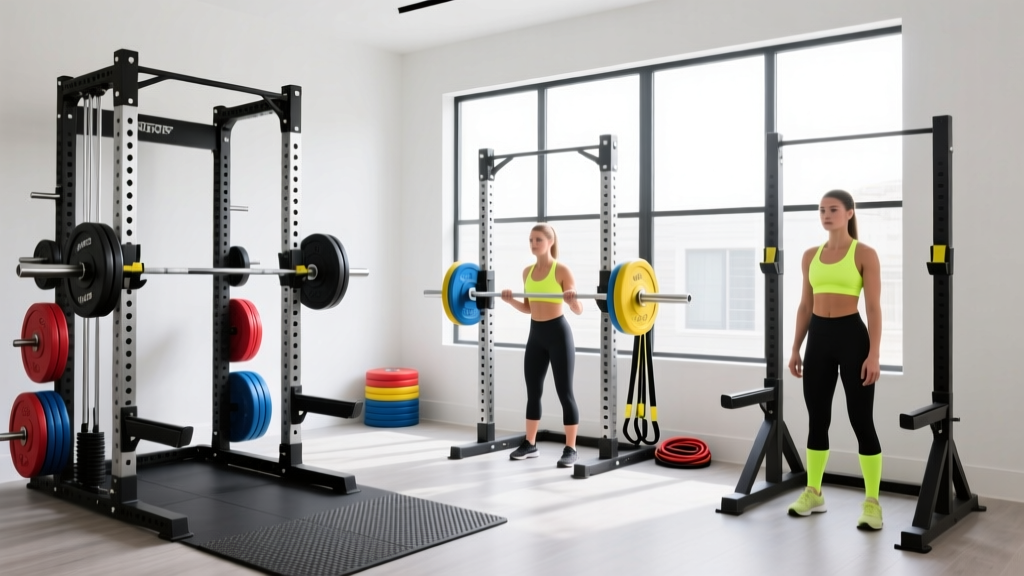
A power rack (or power cage) consists of four uprights connected by top and bottom crossmembers. It is the gold standard for solo lifters. Because you are inside the cage, you can fail a rep safely onto catch pins or straps without the barbell tipping forward or backward.
Top Models & Pricing
- Rep Fitness PR-4000 (v2): Starting around $699. Features 3x3" 11-gauge steel, 1-inch hardware, and color-coded attachment options. It is widely considered the best value-to-feature ratio in the industry.
- Rogue R-3 Power Rack: Priced at $1,050+. Built from 3x3" 11-gauge steel with Westside hole spacing (1-inch spacing in the bench/press zone). Rogue's UHMW plastic-lined J-cups protect your barbell knurling from wear.
Failure Modes & Safety Considerations
⚠️ Warning: Safety Strap Stretch vs. Pin-Pipe ShearingMany lifters default to sandwich-style safety straps because they are quieter and protect the barbell. However, under a sudden 500+ lb drop, nylon straps can stretch up to 2 inches, potentially allowing the bar to bottom out on the crossmember. For max-effort solo squats, steel pin-pipes or flip-down safeties offer zero-deflection stopping power. Always ensure your safeties are rated for the dynamic drop weight, not just the static load.
Squat Racks: The Open-Front Compromise
Squat racks, often called half racks, feature two front uprights and an extended rear base for weight storage and counterbalancing. They provide an open-front environment, which is ideal for lifters who feel claustrophobic inside a cage or need to perform exercises that require the barbell to start from the floor (like Olympic cleans).
Space & Counterbalance Dynamics
The primary advantage of a squat rack is depth. A standard power rack requires at least 6 feet of depth to allow you to step back, squat, and re-rack safely. A squat rack like the PRx Profile (Wall-Mounted) folds flat against the wall, requiring only 4 inches of depth when stored. For freestanding half racks like the Titan T-3 Half Rack (~$450), the rear storage horns act as a counterweight. If you load 400 lbs on the front J-cups but leave the rear storage empty, the center of gravity shifts dangerously forward. Rule of thumb: Always keep at least 150 lbs of bumper plates stored on the rear uprights to anchor the rig.
Squat Stands: The Minimalist Approach
Squat stands are two independent, freestanding posts. They are inexpensive, highly portable, and take up virtually zero visual space in a multi-purpose room. However, they demand strict lifting discipline.
"Squat stands eliminate the safety net. Without extended spotter arms—which are rare and often unstable on independent stands—a failed rep requires you to dump the bar backward or ride it down to the floor. For lifters training to failure, the Mayo Clinic and other sports medicine authorities strongly recommend enclosed spotting mechanisms to prevent catastrophic spinal or joint injuries."
Tipping Hazards and Base Plates
If you purchase squat stands like the Titan T-2 Series (~$250), you must bolt them to a concrete slab. The leverage created by re-racking a heavy barbell at shoulder height can easily tip a 150 lb stand forward. If bolting into concrete isn't an option, you must build a wooden platform that bridges the base plates, allowing you to stand on the platform and use your own body weight to anchor the rig.
Technical Deep Dive: Steel Gauges and Hole Spacing
When comparing rigs on Rogue Fitness or other premium manufacturers, you will see terms like "11-gauge" and "Westside spacing." Here is what those terms actually mean for your wallet and safety.
- 14-Gauge Steel (Budget Rigs): Typically found in sub-$200 Amazon rigs. The walls of the steel tubing are thinner. Under a 300 lb asymmetric load (e.g., uneven squats), 14-gauge uprights will visibly deflect and bow, eventually causing J-cups to bind or snap.
- 11-Gauge Steel (The Standard): The industry standard for commercial and serious home gyms. 3x3" 11-gauge steel can withstand well over 1,000 lbs of static load with virtually zero deflection.
- Standard vs. Westside Hole Spacing: Standard spacing places holes 2 inches apart throughout the entire upright. Westside spacing places holes 1 inch apart in the lower half (the bench press and squat zone). This 1-inch precision allows you to set safety pins exactly at your failure point, preventing you from getting pinned under a heavy barbell.
Integrating Your Dumbbell Storage
Just because you are upgrading to barbell training doesn't mean your dumbbells are obsolete. Dumbbell squats, lunges, and Bulgarian split squats remain vital accessory work. Here is how to integrate your free weights into your new rack footprint:
- Weight Storage Horns: Most power racks and half racks offer 2-inch or 3-inch diameter storage pegs. Use the lower horns to store your heaviest rubber hex dumbbells, which doubles as a counterweight for the rack.
- Saddle Peg Attachments: Brands like Rep Fitness sell specialized "saddle" attachments that mount to the uprights, allowing you to cradle adjustable dumbbells (like Nuobells or PowerBlocks) safely without them rolling off standard round pegs.
- Under-Bench Clearance: If space is at a premium, ensure your rack's bottom crossmember sits flush with the floor (or is designed with a cutout) so you can slide a low-profile, 3-tier dumbbell rack directly underneath the pull-up bar area.
Frequently Asked Questions
Can I use a power rack in a room with low ceilings?
Yes. Standard power racks are 82 to 90 inches tall. If you have standard 8-foot ceilings, you will not have room for pull-ups. Look for "Short" or "Compact" models (like the Rogue R-3 Short at 82" or the Rep PR-3000 at 82") which allow for full-height squats while leaving just enough clearance for chin-ups if you stand slightly forward of the bar.
Do I need to bolt my power rack to the floor?
While 11-gauge 4x4 power racks are incredibly heavy and stable on rubber matting, bolting is highly recommended if you plan to use band pegs for accommodating resistance, perform kipping pull-ups, or attach heavy lat-pulldown cable towers to the rear of the rig.
What size barbell do I need for a standard power rack?
Most standard power racks are 49 inches wide on the outside. You must use a standard 7-foot Olympic barbell (which has a 51.5-inch shaft length between the collars) to ensure the sleeves clear the uprights and the bar rests securely on the J-cups. Short "apartment" barbells will not work safely in a full-sized cage.
More gear to consider
All reviews
Cast Iron vs Competition Kettlebell Care & Plank Dumbbell Drags
Adjustable Dumbbell Review: Fix Your Dumbbell Chest Workout Routine

Barbell Collar and Clamp Types Comparison: Securing Heavy Shrugs Without a Dumbbell Shrug Machine

Bumper vs Iron Plates: Budgeting & Lying Dumbbell Lateral Raise
EZ Curl Bar vs Straight Bar: Budget Value & Dumbbell Lat Exercises
