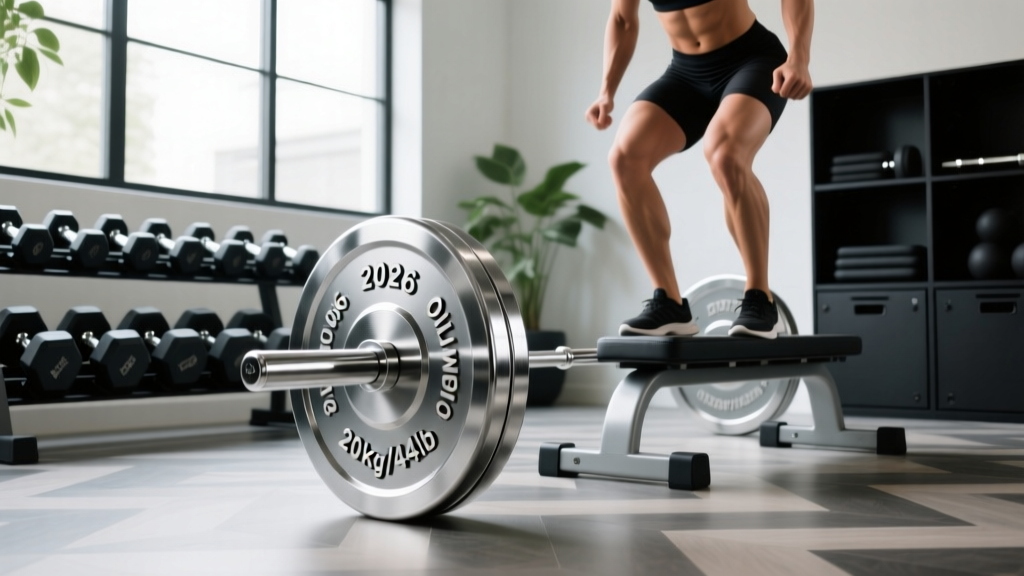
Bumper vs Iron Plates & Standing Ab Workout With Dumbbells Layouts
Compare bumper vs iron plates for compact gym layouts and design a space-saving zone for a standing ab workout with dumbbells.

The Spatial Economics of Free Weights: Bumper vs. Iron Plates
Designing a highly optimized home gym in 2026 requires treating your floor plan like premium real estate. Whether you are working with a 10x10 foot garage corner or a 12x12 dedicated spare room, every square inch must serve a dual purpose. The foundation of any strength space revolves around the barbell, which immediately forces a critical spatial decision: the bumper plate vs iron plate comparison. This choice dictates not just your storage footprint, but your flooring requirements, drop-zone clearance, and the remaining square footage available for functional accessory movements.
Diameter, Thickness, and Rack Real Estate
To optimize layout, we must look at the exact geometry of your weight plates. According to International Weightlifting Federation (IWF) standards, all bumper plates—regardless of weight—share a uniform diameter of 450mm (17.72 inches). A standard 45lb Rogue Echo Bumper Plate is 3.3 inches thick, while a 10lb bumper is roughly 2.1 inches thick. Because of this uniform width, bumpers stack perfectly flush on vertical A-frame storage racks or horizontal wall-mounted pegs. A standard 4-foot vertical tree can easily hold a 230lb set (two 45s, two 25s, two 10s) using only 4 square feet of floor space.
Iron plates, conversely, scale in both diameter and thickness. A 45lb Rogue Machined Iron Plate measures roughly 14.5 inches in diameter and a mere 1.3 inches thick. While iron plates are significantly thinner—allowing you to load more weight onto a barbell sleeve before hitting the collar limit—their varying diameters create a storage nightmare in compact spaces. Smaller iron plates (10lb and 15lb) will physically fall through the gaps of standard horizontal wall racks designed for 45s, forcing you to buy staggered, multi-tiered storage solutions that eat up valuable vertical and horizontal wall space.
The Drop Zone Footprint
The most significant spatial divergence between the two plate types is the required drop zone. Bumper plates are vulcanized rubber designed to absorb kinetic energy. You can safely drop a loaded barbell from overhead onto a standard 4x6 foot, 3/4-inch thick horse stall mat. This confines your deadlift and Olympic lifting footprint to exactly 24 square feet.
Iron plates transfer nearly 100% of their kinetic energy directly into the floor. Dropping iron plates requires a dedicated, heavily reinforced platform—typically an 8x8 foot footprint constructed with layered 3/4-inch plywood and high-density shock-absorption rubber tiles. Choosing iron plates effectively mandates a 64-square-foot drop zone, instantly consuming the space you might have otherwise allocated for functional training or accessory work.
Layout Pro-Tip: The Hybrid Approach
If your layout demands the space-saving drop zone of bumpers but you need the sleeve capacity of iron for heavy squat cycles, utilize "fractional iron". Buy a full set of rubber bumpers for your 25lb and 45lb plates to protect your floor, but use 2.5lb, 5lb, and 10lb iron plates for micro-loading. These small iron plates take up virtually zero storage space and can be kept in a small plastic bin tucked under your bench.
Designing the Standing Ab Workout With Dumbbells Zone
Once your barbell footprint and plate storage are locked in, the remaining floor space must be optimized for functional movement. Core training is often relegated to a yoga mat in the corner for endless supine crunches. However, biomechanics dictate that the core functions primarily as a stabilizer and force-transfer mechanism in an upright posture. Programming a standing ab workout with dumbbells targets the obliques, transverse abdominis, and erector spinae in a weight-bearing, functional stance. The challenge is designing a layout that accommodates the rotational and lateral clearance these movements require without expanding your gym's footprint.
Why Standing Core Work Demands Layout Strategy
Supine exercises isolate the rectus abdominis but ignore the core's primary evolutionary purpose: resisting unwanted spinal movement while the extremities are in motion. According to kinesiology databases like ExRx, standing lateral flexion and rotational movements recruit the deep stabilizers of the spine in ways floor work cannot replicate. However, executing a standing dumbbell woodchopper or a heavy dumbbell halo requires a minimum clearance radius of 3.5 feet around the lifter to prevent knuckle-strikes against power rack uprights or plate trees.
The 3x5 Foot Functional Corridor
To fit a standing ab workout with dumbbells into a compact layout, you must utilize the "dead space" directly in front of or immediately adjacent to your power rack. By positioning your rack against the primary wall, leave a 3-foot gap between the front uprights and your designated functional corridor. This creates a 3x5 foot lane specifically for standing accessory work.
Instead of dedicating 6 linear feet of wall space to a fixed dumbbell rack, invest in high-end adjustable dumbbells. The Nuobell 80lb adjustable set (retailing around $449 per pair in 2026) replaces 16 pairs of fixed dumbbells. Mount a heavy-duty 12x12 inch steel shelf directly on the wall at waist height within your 3x5 foot corridor. This allows you to grab your dumbbells, step back one pace, and immediately begin your standing core circuit without navigating around bulky equipment.
| Standing Core Movement | Primary Function | Required Clearance Radius | Optimal Dumbbell Weight Range |
|---|---|---|---|
| Dumbbell Woodchoppers | Anti-Rotation / Power | 3.5 ft (Diagonal swing) | 15 - 35 lbs |
| Standing Side Bends | Anti-Lateral Flexion | 2.0 ft (Vertical plane) | 25 - 60 lbs |
| Dumbbell Halos | Anti-Extension / Mobility | 2.5 ft (Sagittal plane) | 10 - 25 lbs |
| Suitcase Marches | Dynamic Stabilization | 4.0 ft (Linear walking) | 40 - 80 lbs |
Integrating the Zones: A 10x10 Garage Gym Blueprint
Merging heavy plate storage with a functional standing ab workout with dumbbells requires a unified blueprint. Here is how to arrange a standard 100-square-foot space for maximum efficiency:
- The Anchor (Back Wall): Mount your power rack flush against the back wall. If using bumper plates, place a vertical A-frame plate tree immediately to the right of the rack. This keeps the 17.7-inch bumpers off the floor and creates a flush, uniform storage wall.
- The Drop Zone (Center): Lay a single 4x6 foot, 3/4-inch rubber stall mat directly in front of the rack. This is your barbell zone. Because you chose bumpers, you do not need a massive 8x8 plywood platform, saving you 28 square feet of floor space.
- The Functional Corridor (Left Side): Utilize the remaining 4-foot wide lane to the left of your drop zone. Mount your adjustable dumbbell shelf on the left wall at 36 inches high. This is your dedicated standing ab and accessory zone.
- The Transition Flow: When moving from heavy barbell squats to your standing ab workout with dumbbells, you simply step off the 4x6 mat and into the left corridor. The physical boundary of the rubber mat acts as a psychological and physical divider between your heavy lifting zone and your functional movement zone.
Flooring Transition Warning
When performing standing dumbbell movements, avoid standing with one foot on the rubber mat and one foot on the bare concrete or subfloor. The 3/4-inch height differential creates an artificial leg-length discrepancy that will torque your pelvis and lumbar spine during heavy anti-lateral flexion exercises like suitcase marches or heavy side bends. Always ensure both feet are planted on the same surface material during standing core work.
Final Thoughts on Spatial Efficiency
Optimizing a home gym is an exercise in compromise, but understanding the exact spatial economics of your equipment removes the guesswork. By choosing bumper plates, you confine your drop zone to a manageable 24-square-foot footprint and utilize uniform vertical storage. Reinvesting the saved square footage into a dedicated 3x5 foot corridor equipped with adjustable dumbbells allows you to execute a highly effective standing ab workout with dumbbells without ever feeling cramped. Smart layout design isn't just about fitting equipment into a room; it's about engineering a space that naturally guides you through a complete, biomechanically sound training session.
More gear to consider
All reviews
Hex vs Urethane Dumbbells for Single Arm Neutral Grip Rows
EZ Curl Bar vs Straight Bar & Tricep Curls Dumbbell Value Analysis

Power Rack vs Squat Rack: How to Build Biceps Without Dumbbells

2026 Storage Trends: Racks for Seated Dumbbell Exercises for Seniors
Kettlebell Care: Cast Iron vs Competition & Dumbbell Reverse Crunch