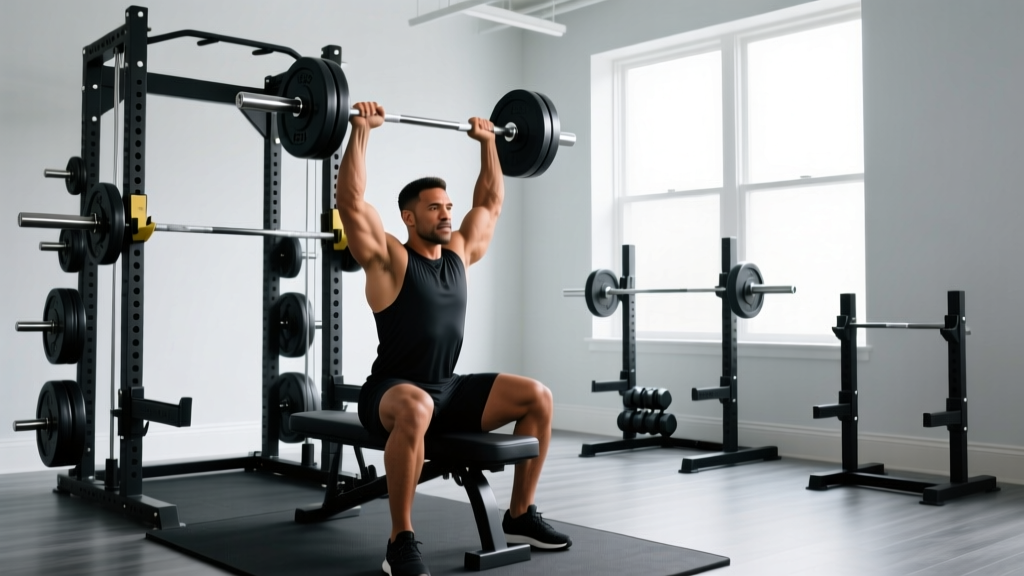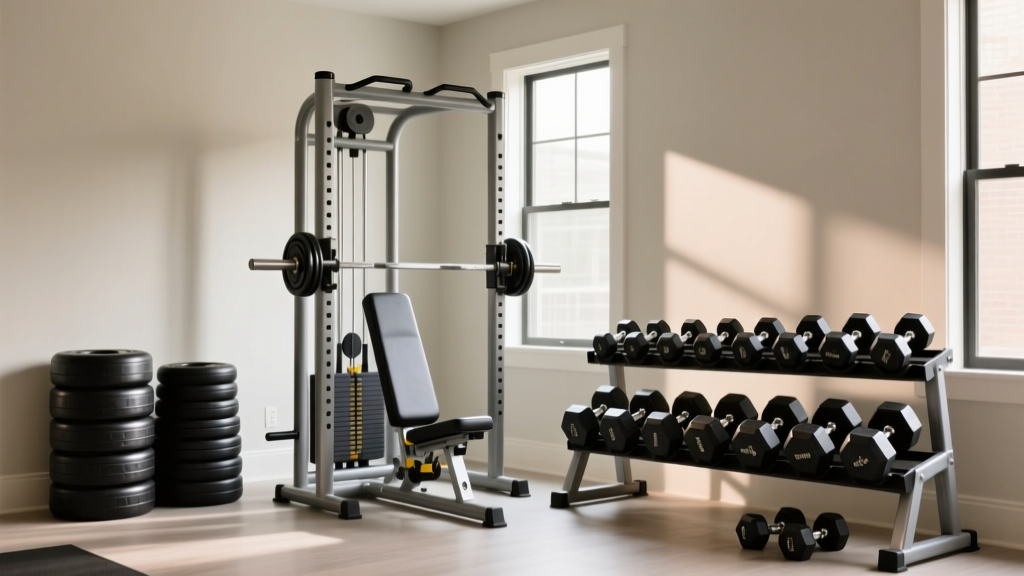
Bumper vs Iron Plates: Lateral Raises Machine or Dumbbell Layouts
Optimize your home gym layout. We compare bumper vs iron plates for storage and debate the lateral raises machine or dumbbell for tight spaces.

The Spatial Economics of the Modern Home Gym
As urban living spaces shrink and garage gym real estate becomes a premium commodity in 2026, spatial efficiency is no longer just a preference—it is a necessity. Designing a high-performance training environment in a 200 to 300-square-foot footprint requires ruthless prioritization. Every piece of steel must justify the square footage it occupies. Two of the most significant spatial dilemmas lifters face involve weight storage and isolation equipment. Specifically, the ongoing debate of bumper plate vs iron plate comparison dictates your floor plan, while the decision to utilize a dedicated lateral raises machine or dumbbell alternatives defines your isolation corner.
This guide breaks down the exact dimensions, storage requirements, and layout strategies to help you engineer a space-optimized free weight zone without sacrificing training quality.
Bumper Plate vs Iron Plate: The Storage Showdown
When outfitting your barbell, the choice between urethane or rubber bumpers and cast iron extends far beyond noise reduction. It fundamentally alters your sleeve real estate and your storage footprint. According to Garage Gym Reviews' comprehensive bumper plate guide, selecting the right plate type is one of the most critical equipment decisions for home gym owners.
The Case for Cast Iron: Maximizing Sleeve and Wall Space
Cast iron plates are the undisputed champions of space optimization. A standard 45lb Rogue Deep Dish Iron Plate is approximately 1.15 inches thick. If you load a barbell with 405 lbs (four 45s and a 25 on each side), the iron plates consume roughly 9.5 inches of sleeve space per side, leaving ample room for heavy band attachments or extra collars.
Storage Advantage: Iron plates can be stored vertically on wall-mounted racks. A 3-tier wall plate rack (such as the Titan Fitness Wall Mount Plate Rack, priced around $80) utilizes zero floor square footage. By mounting this on a stud-reinforced wall, you reclaim up to 6 square feet of floor space that would otherwise be consumed by a freestanding plate tree.
The Bumper Plate Reality: Floor Space and Drop Zones
Bumper plates are mandatory if your programming includes Olympic weightlifting or high-rep deadlift drops. However, they carry a heavy space tax. A standard 45lb Rogue Echo Bumper Plate is 3.25 inches thick, while cheaper hi-temp rubber bumpers can swell to 4.4 inches. Loading 405 lbs of Echo bumpers consumes over 18 inches of sleeve space—often maxing out standard Olympic sleeves.
Storage Disadvantage: Bumper plates cannot be safely stored on standard wall-mounted racks due to their sheer weight and leverage against the drywall and studs. They require a freestanding vertical plate tree or an A-frame rack. A Rogue Vertical Plate Tree 2.0 costs roughly $145 and occupies a 20x20 inch footprint. While seemingly small, in a tight garage layout, this creates a physical obstacle that disrupts the flow between your squat rack and dumbbell zone.
Layout Pro-Tip: If your space is severely limited, adopt a hybrid plate system. Purchase a set of calibrated steel plates for heavy squats and bench presses (saving sleeve space and wall storage), and keep only a pair of 45lb and 25lb bumpers strictly for Olympic variations and dropping.The Isolation Corner: Lateral Raises Machine or Dumbbell?
Once your primary barbell zone is established, you must address muscle isolation. For shoulder hypertrophy, the lateral deltoid requires targeted volume. This brings us to a major layout crossroads: should you invest in a lateral raises machine or dumbbell setups?
Biomechanically, the lateral raise is all about the resistance curve. As noted in the EXRX shoulder kinesiology directory, the dumbbell lateral raise provides zero tension on the medial deltoid at the bottom of the movement (when the arm is resting against the thigh) and maximum tension at the top. Conversely, a dedicated machine or cable provides constant tension throughout the entire range of motion.
Dedicated Machines: The Footprint Luxury
A dedicated lateral raises machine (like the Body-Solid ProClub S2LLR or similar plate-loaded isolation stations) offers superior biomechanical tension and strict form enforcement. However, it demands a 4-foot by 3-foot footprint (12 square feet) and costs between $800 and $1,200. In a 200-square-foot micro-gym, dedicating 6% of your total floor space to a single-joint isolation movement is a poor spatial investment.
The Dumbbell and Cable Compromise
If you are debating a lateral raises machine or dumbbell training for a compact layout, the modern solution is a hybrid approach utilizing adjustable dumbbells and rack-integrated cables.
- Adjustable Dumbbells: A pair of PowerBlock Elite EXP dumbbells (retailing around $359) replaces an entire 15-pair dumbbell rack, shrinking your dumbbell storage footprint from 10 square feet down to less than 2 square feet.
- Cable Pulley Attachments: To replicate the constant tension of a machine without the massive footprint, attach a single-handle lat pulldown cable to the low pulley of your power rack or functional trainer. Performing single-arm cable lateral raises provides the exact biomechanical tension profile of a $1,000 machine while occupying zero additional floor space.
For comprehensive programming strategies that maximize limited equipment, the ACE Fitness lifestyle and programming resources frequently highlight the efficacy of cable-band hybrids for home gym hypertrophy.
Space Optimization Matrix: Equipment Footprints
| Equipment Type | Average Floor Footprint | Estimated Cost (2026) | Space-Saving Alternative |
|---|---|---|---|
| 400+ lbs Bumper Plates (Tree) | 4.5 sq ft (inc. clearance) | $145 (Tree) + $800 (Plates) | Wall-Mounted Iron Plate Rack |
| 400+ lbs Iron Plates (Wall Rack) | 0 sq ft (Wall Space Only) | $80 (Rack) + $600 (Plates) | N/A (Optimal for Space) |
| Dedicated Lateral Raise Machine | 12 - 15 sq ft | $800 - $1,200 | Low-Pulley Cable Attachment |
| 15-Pair Hex Dumbbell Rack | 10 - 14 sq ft | $1,500+ (Rack + Weights) | Adjustable Dumbbells (2 sq ft) |
Designing the 200-Square-Foot Layout Flow
To seamlessly integrate your free weights and isolation tools, follow this step-by-step spatial flow for a standard single-car garage or basement gym:
- Anchor the Power Rack: Place your power rack flush against the primary load-bearing wall. This allows you to mount your iron plate storage directly on the adjacent wall, keeping the center of the room open.
- Establish the Drop Zone: If you use bumper plates for deadlifts, position your lifting platform in the center. Ensure there is a minimum 36-inch clearance on all sides of the barbell to prevent wall damage during heavy eccentrics.
- Mount the Cable Pulley: Install a low-row or lat pulldown attachment on the rack. This serves as your machine replacement station for lateral raises, tricep pushdowns, and cable crossovers.
- Create the Adjustable Dumbbell Nook: Place your adjustable dumbbell cradle inside the rack or on a small bench footprint nearby. This eliminates the need for a sprawling 3-tier commercial dumbbell rack.
Frequently Asked Questions
Can I store bumper plates on a wall-mounted rack?
It is highly discouraged. A set of 400+ lbs of bumper plates exerts massive leverage on wall studs. Unless you are bolting into reinforced concrete or commercial-grade steel framing, the sheer weight and thickness of bumpers will eventually pull standard drywall anchors or wood screws out of the wall. Stick to freestanding trees for bumpers and wall racks for iron.
Are adjustable dumbbells durable enough for heavy lateral raises?
Yes, provided you use proper form. Adjustable dumbbells like Nuobell or PowerBlock are engineered to withstand standard lifting forces. However, you should never drop them or use excessive momentum (cheat reps) during lateral raises, as the internal dial or pin mechanisms can be damaged by sudden impact.
In a space-constrained environment, versatility is the ultimate metric. A piece of equipment that serves only one biomechanical function is a luxury; a piece that serves three is a necessity.
Final Thoughts on Spatial Efficiency
Optimizing your gym layout in 2026 requires looking past the marketing hype and focusing on raw dimensions and biomechanical utility. By choosing cast iron plates for wall storage and leveraging adjustable dumbbells alongside rack-mounted cables instead of bulky isolation machines, you can build a world-class training facility in a fraction of the space. Evaluate your exact square footage, measure your sleeve clearance, and design a layout that moves with you, not against you.
More gear to consider
All reviews
Power Rack vs Squat Rack vs Stand: Setup for Workouts with 1 Dumbbell

Bench Press Dumbbells vs Barbell: Rubber Hex vs Urethane Care

What Does Dumbbell Press Work? 2026 Adjustable Dumbbell Guide

Power Rack vs Squat Rack: Best Dumbbell Workout Program Setups

Upgrading Your Dumbbell PPL: EZ Curl Bar vs Straight Bar Value Analysis