
How to Build Muscle Using Dumbbells: Standard vs Olympic Plates Guide
Learn how to build muscle using dumbbells and discover when to upgrade your home gym with our step-by-step guide to standard vs Olympic weight plates.

Step 1: Mastering Hypertrophy with Dumbbells
When starting your fitness journey, learning how to build muscle using dumbbells is the most efficient path to early gains. Dumbbells require unilateral stabilization, recruit secondary synergist muscles, and allow for a natural range of motion that fixed barbells cannot replicate. According to resistance training guidelines published by the National Institutes of Health (NIH), maximizing muscle hypertrophy requires mechanical tension, metabolic stress, and progressive overload. Dumbbells deliver all three, provided you are training in the 8-to-15 repetition range and pushing close to muscular failure.
Choosing Your Initial Dumbbell Setup
For beginners in 2026, adjustable dumbbells are the gold standard for home gyms. They save space and offer incremental weight jumps. Here are the top tier options to start your muscle-building phase:
- Nuobell 80lb Adjustable Dumbbells ($399): Featuring a smooth, knurled steel handle and a unique twisting mechanism, these feel exactly like traditional hex dumbbells. They max out at 80 lbs, which is sufficient for upper body hypertrophy for your first 12 to 18 months.
- PowerBlock Pro EXP ($349): The caged design alters the center of gravity slightly, but the expandable nature of the Pro EXP line means you can eventually upgrade the core set from 50 lbs up to 90 lbs with expansion kits.
- Bowflex SelectTech 552 ($329): A classic dial-adjustable option ranging from 5 to 52.5 lbs. Excellent for isolation movements like lateral raises and bicep curls, but you will outgrow these quickly on compound presses.
How do you know when to increase the weight? Use the NSCA's 2-for-2 rule: If you can complete two extra reps beyond your target rep range (e.g., you hit 14 reps instead of your target 12) for two consecutive workouts, it is time to increase the load by 5 to 10 pounds.
Step 2: Recognizing the Dumbbell Ceiling
While dumbbells are incredible for upper body development and unilateral leg work (like Bulgarian split squats), they eventually fail to provide adequate overload for heavy, bilateral compound movements. Once you can goblet squat an 80 lb dumbbell for 15 reps, or perform Romanian Deadlifts (RDLs) with 80 lb dumbbells per hand without grip failure, your leg and back development will stall. The limiting factor becomes your grip strength and the physical size of the dumbbells, not your target muscles.
This is the exact inflection point where you must transition to a barbell. And when you buy a barbell, you are immediately confronted with the most critical equipment decision in home gym construction: Standard vs. Olympic weight plates.
Step 3: Standard vs. Olympic Weight Plates Explained
Weight plates are categorized by the diameter of their center hole, which dictates the type of barbell sleeve they can slide onto. Choosing the wrong ecosystem early on will cost you hundreds of dollars in incompatible gear later.
Standard Plates (1-Inch Center Hole)
Standard plates feature a center hole measuring exactly 1 inch (25.4 mm). These are typically paired with budget-friendly, solid steel or hollow-core barbells found in big-box sporting goods stores. Standard cast iron plates are usually coated in a grey or black enamel paint.
- Pros: Highly affordable (often $1.00 to $1.50 per pound in 2026), lightweight bars are easier for absolute beginners to handle, and the plates themselves are slightly narrower, taking up less sleeve space.
- Cons: Severe load limitations. Standard 1-inch barbells will permanently bend (deform) if loaded past 200 to 250 lbs. Furthermore, standard bars lack rotating sleeves, meaning the plates transfer rotational torque to your wrists during Olympic lifts or heavy curls.
Olympic Plates (2-Inch Center Hole)
Olympic plates have a center hole measuring 50 mm (approximately 1.96 inches). As outlined by the International Weightlifting Federation (IWF), this 50mm standard is the universal specification for competitive and commercial gym equipment. Olympic plates come in cast iron, urethane-coated, and rubber bumper varieties.
- Pros: Virtually unlimited weight capacity (Olympic bars can hold 700 to 1,500+ lbs). The sleeves rotate via bushings or bearings, protecting your joints. Compatible with every commercial gym accessory, from landmine attachments to sleds.
- Cons: Higher initial investment. The bars are heavier (starting at 20kg/45lbs for men and 15kg/35lbs for women), and the plates cost between $2.00 and $4.50+ per pound depending on the material.
Step 4: The Head-to-Head Comparison Matrix
Use this data table to evaluate which plate ecosystem aligns with your long-term muscle-building goals.
| Feature | Standard Plates (1-Inch) | Olympic Plates (50mm) |
|---|---|---|
| Center Hole Diameter | 1 inch (25.4 mm) | 2 inches (50 mm) |
| Barbell Sleeve Rotation | None (Fixed solid steel) | Bushings or Needle Bearings |
| Max Safe Load Capacity | 200 - 250 lbs (Bar bends) | 700 - 1,500+ lbs |
| 2026 Average Cost (Per Lb) | $1.25 (Cast Iron) | $2.50 (Iron) to $4.00 (Urethane) |
| Drop Tolerance | Low (Chips paint, dents floors) | High (If using Bumper Plates) |
| Collar Type Required | Spinlock (Threaded sleeves) | Spring Clips or Lock-Jaws |
Step 5: Calculating Your First Plate Purchase
If you are serious about progressive overload, skip standard plates entirely. The money you save upfront will be wasted when you inevitably have to sell your standard barbell and plates to upgrade to an Olympic setup. According to equipment specialists at Rogue Fitness, investing in a high-quality Olympic barbell and calibrated or bumper plates ensures your gear will outlast your fitness journey.
The Ideal Beginner Olympic Plate Package
Do not just buy a 300 lb pre-packaged set from a generic marketplace. Build your plate tree intentionally to allow for micro-loading, which is essential for upper body lifts like the overhead press where adding 10 lbs is a massive jump.
- The Barbell: Start with a 20kg (45 lb) Olympic bar with a 190k PSI yield strength and dual knurl marks. (Budget: $150 - $220)
- The Bumper Plates: Buy a pair of 45 lb (20 kg) rubber bumper plates. Bumpers have a uniform 450mm diameter regardless of weight, allowing you to safely drop deadlifts without snapping the barbell. (Budget: $180 for a pair)
- The Iron Fractionals: Purchase cast iron or steel 10 lb, 5 lb, and 2.5 lb plates. These are cheaper than small bumper plates and take up less sleeve space. (Budget: $60)
- The Collars: Invest in heavy-duty aluminum lock-jaw collars. Cheap spring clips slip during heavy RDLs, creating a severe safety hazard. (Budget: $25)
Olympic plates are dense. A dropped 45 lb cast iron plate will easily crack concrete or shatter ceramic tile. If you are training in a garage or spare room, you must invest in 3/8-inch or 1/2-inch thick horse stall mats (typically $50-$70 each) to absorb kinetic energy. Furthermore, never leave heavy plates loaded on a barbell resting on the floor for weeks at a time; this can cause the barbell to take a permanent "set" (bend) over time. Always unload your bar or store it horizontally on a rack.
Frequently Asked Questions
Can I use an adapter to put Olympic plates on a standard bar?
No. While you can buy sleeves that adapt an Olympic bar to accept standard 1-inch plates, you cannot safely reduce a 2-inch Olympic plate to fit a 1-inch standard bar. The physical stress on the adapter creates a dangerous shear point that can snap during heavy lifts.
Are urethane plates worth the extra cost over rubber bumpers?
For a home gym in 2026, urethane is the premium choice if your budget allows. Unlike cheap rubber bumpers that off-gas a toxic, fishy odor and degrade in sunlight, urethane is odorless, UV-resistant, and highly resistant to scratching and chipping. Expect to pay around $3.50 to $4.50 per pound for high-grade urethane plates compared to $2.50 per pound for virgin rubber bumpers.
How do I know when to transition from dumbbells to the barbell?
Transition when your target muscles are no longer reaching failure before your grip or stabilizers give out. If you are holding 80 lb dumbbells for a Romanian Deadlift and your lower back and hamstrings feel fresh, but your hands are slipping, it is time to move to an Olympic barbell where the load is supported by your skeletal structure rather than your grip alone.
More gear to consider
All reviews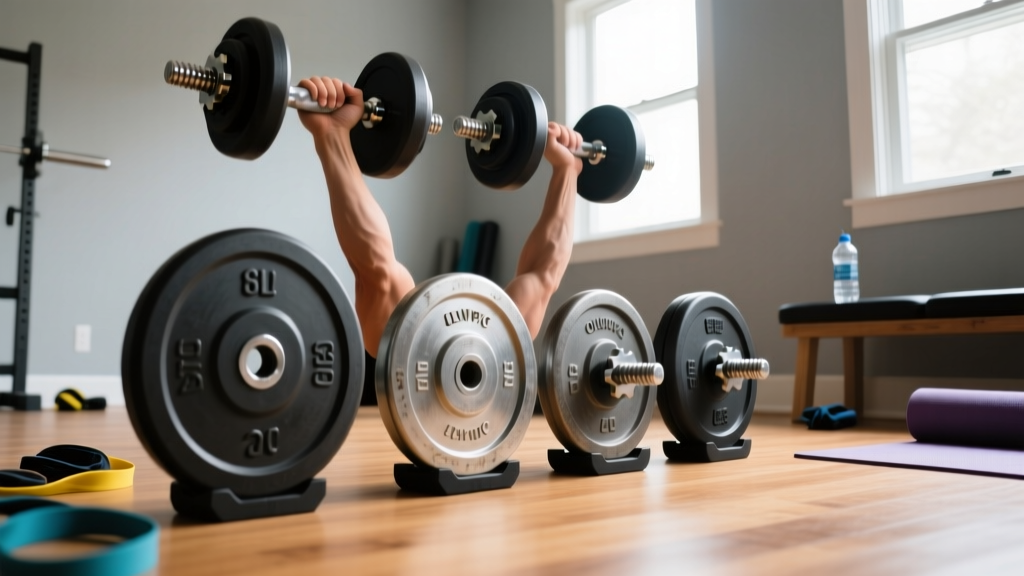
Olympic vs Standard Plates: Which is Best for the Dumbbell Tate Press?

Loadable Dumbbell Maintenance for a Perfect Static Dumbbell Hold

EZ Bar vs Straight Bar: Value & Back Workouts with Dumbbells

Olympic vs Standard Plates & the Decline Dumbbell Triceps Extension
Best Trap Exercises With Dumbbells: Top Loadable Picks 2026
