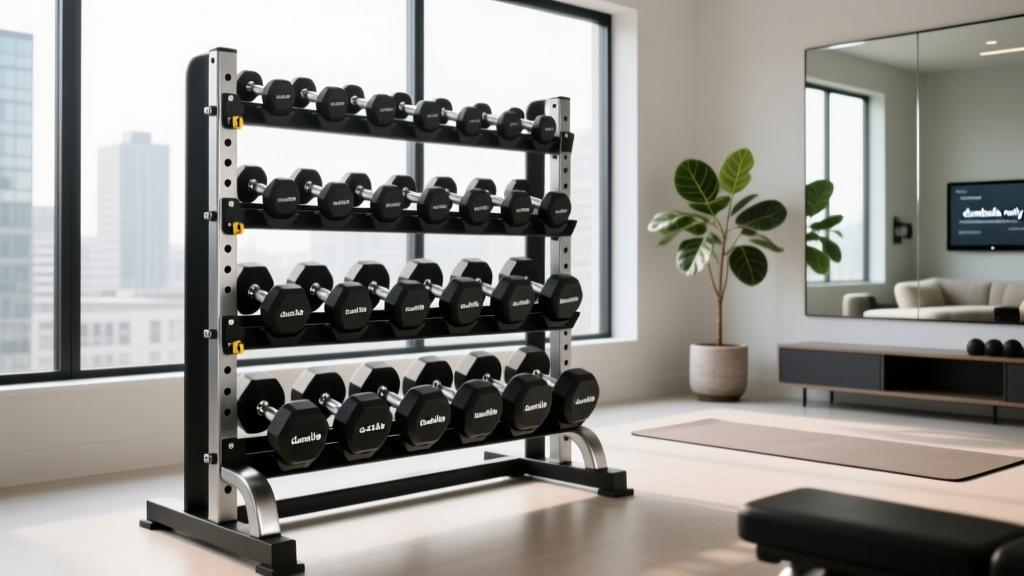
Budget Storage for a Back Workout at Home With Dumbbells
Maximize space and safety during your back workout at home with dumbbells. Our 2026 budget breakdown compares A-frames, 3-tier racks, and adjustable stands.

The Logistics of a Heavy Home Back Day
When programming a high-volume back workout at home with dumbbells, you rarely stick to a single weight. A comprehensive session involving single-arm rows, renegade rows, dumbbell pullovers, and Romanian deadlifts requires cycling through three or four different weight increments. If you are using fixed hex dumbbells, that means up to eight individual weights scattered across your floor. This creates a severe tripping hazard, damages flooring, and disrupts the flow of your superset transitions.
In 2026, the home gym equipment market offers more storage solutions than ever, but the price variance is staggering. You can spend anywhere from $60 on a basic wire A-frame to over $400 on a commercial-grade 3-tier rack. But how do you determine the actual value of these storage systems? This budget breakdown analyzes the cost-per-pound of storage, structural failure modes, and ergonomic benefits to help you optimize your training space without overspending.
The Floor-to-Rack Value Proposition
Dropping a 50 lb rubber hex dumbbell on standard laminate or engineered wood flooring can cause impact fractures requiring $250 to $500 in subfloor repairs. According to facility safety guidelines outlined by the National Strength and Conditioning Association (NSCA), designated weight storage zones are not just organizational tools; they are critical risk-mitigation assets that pay for themselves after a single prevented accident.
The Hidden Costs of Poor Dumbbell Storage
Many home gym owners attempt to bypass dedicated racks by using heavy-duty garage shelving or simply leaving weights on the floor. While this saves money upfront, it introduces hidden costs:
- Ergonomic Shear Force: Picking up 60 lb dumbbells from the floor repeatedly between sets of bent-over rows places immense shear force on the lumbar spine. The American Council on Exercise (ACE) emphasizes that storing heavy implements between knee and shoulder height significantly reduces lower back fatigue and injury risk.
- Coating Degradation: Leaving rubber or urethane dumbbells on concrete floors exposes the coating to moisture and temperature fluctuations, accelerating the breakdown of the rubber and leading to a foul odor in your gym space.
- Time Tax: Scavenging for the correct weight mid-workout breaks your heart rate zone and extends a standard 45-minute back workout into a 70-minute chore.
2026 Budget Breakdown: 3 Storage Tiers Analyzed
To determine the best value, we have categorized the current market into three distinct tiers based on structural integrity, footprint, and load capacity.
Tier 1: The Economy A-Frame (Under $100)
Representative Model: CAP Barbell 2-Tier A-Frame Rack
Estimated Cost: $79.99
Max Capacity: ~400 lbs
Footprint: 13" x 24"
The A-frame is the undisputed king of budget storage. It utilizes a vertical design that minimizes floor space, making it ideal for spare bedrooms or tight garage corners. However, the value proposition here is strictly tied to lighter weight ranges. The steel tubing is typically 16-gauge, which is sufficient for holding five pairs of neoprene or light rubber dumbbells (10 lbs to 30 lbs). If you attempt to load it with heavy 50 lb hex dumbbells, the center of gravity shifts dangerously high, creating a tipping hazard.
Tier 2: The 3-Tier Workhorse ($150 - $250)
Representative Model: Rogue Fitness 3-Tier Dumbbell Rack
Estimated Cost: $195.00
Max Capacity: 1,000+ lbs
Footprint: 22" x 32"
For serious lifters executing heavy back workouts at home with dumbbells, the 3-tier horizontal rack is the gold standard. Constructed from 11-gauge steel, these racks feature a slight backward incline on the shelves to prevent cylindrical or slightly worn hex dumbbells from rolling forward. The value here is longevity; a 3-tier Rogue rack will easily outlast multiple generations of dumbbells. The cost-per-pound of storage is exceptionally low when factoring in the 1,000 lb total capacity.
Tier 3: Adjustable Dumbbell Cradles ($100 - $200)
Representative Model: Nuobell / Core Home Fitness Adjustable Stand
Estimated Cost: $129.00
Max Capacity: 160 lbs (Cradles only)
Footprint: 18" x 22"
If your back workout relies on adjustable dumbbells (like Bowflex SelectTech or Nuobell), you do not need a massive steel rack. However, placing adjustable dumbbells on the floor risks damaging the intricate dial or magnetic pin mechanisms. Dedicated adjustable stands elevate the cradles to a 34-inch working height, allowing you to grab and rack the weights without bending over, preserving both your lower back and the delicate internal gearing of the dumbbells.
Comparison Matrix: Cost vs. Capacity
The table below illustrates the true financial efficiency of each storage tier based on 2026 market averages.
| Rack Tier | Model Example | Est. Cost | Max Load | Steel Gauge | Cost per 100lb Capacity |
|---|---|---|---|---|---|
| Economy | CAP A-Frame | $80 | 400 lbs | ~16-gauge | $20.00 |
| Mid-Tier | Rogue 3-Tier | $195 | 1,000 lbs | 11-gauge | $19.50 |
| Adjustable | Nuobell Stand | $129 | 160 lbs | N/A | $80.62 |
Note: While the adjustable stand has the highest cost-per-pound ratio, its value is derived from ergonomic height and mechanism protection, not raw load capacity.
Space-to-Weight Ratio: Configuring for Back Days
How you load your rack is just as important as the rack you buy. The CDC Physical Activity Guidelines emphasize the importance of seamless environmental setups to maintain consistency in home fitness routines. For a back workout at home with dumbbells, arrange your rack using the "Drop-Set Funnel" method:
- Top Tier (Shoulder Height): Place your lightest weights here (e.g., 20s and 25s). These are used for high-rep pullovers, reverse flyes, and rear delt work. Keeping them high prevents you from hinging at the waist with light loads.
- Middle Tier (Chest/Waist Height): Place your moderate weights (e.g., 35s and 40s). This is the sweet spot for single-arm rows and renegade rows, allowing you to grab and drop the weights rapidly during supersets without losing your core brace.
- Bottom Tier (Knee Height): Reserve the bottom tier exclusively for your heaviest dumbbells (e.g., 60s and 70s). Because these are used for deadlifts and heavy shrugs, starting them closer to the floor mimics the actual mechanics of the lift and prevents lower back strain during the pickup.
Edge Cases and Failure Modes to Avoid
When shopping for budget racks in 2026, be highly critical of manufacturing shortcuts. Here are the most common failure modes observed in sub-$100 storage units:
- The Lip Deficit: Many budget flat-shelf racks feature a front lip that is less than 0.5 inches high. Over time, the rubber coating on hex dumbbells compresses and smooths out. A shallow lip will result in dumbbells vibrating off the shelf during nearby treadmill use or heavy barbell drops.
- Spot-Welding Shear: Economy A-frames often use spot-welding rather than continuous MIG welds at the base joints. If you unevenly load one side of an A-frame with 40 lb dumbbells, the torsional stress can snap a spot-weld, causing the entire rack to collapse laterally.
- MDF Shelf Sag: Some multi-purpose garage racks use Medium-Density Fiberboard (MDF) for shelving. MDF has a terrible point-load tolerance. A pair of 50 lb dumbbells resting on a 2-inch width will eventually cause the MDF to bow and splinter, especially in humid garages.
"Never compromise on the steel gauge of a horizontal dumbbell rack. The dynamic load of slamming a 50 lb dumbbell onto a shelf generates upwards of 150 lbs of momentary downward force. 11-gauge or 12-gauge steel is the absolute minimum threshold for safe, long-term home gym storage."
The Verdict: Where to Put Your Money
If your primary focus is executing a demanding back workout at home with dumbbells, your storage solution must prioritize safety, ergonomics, and speed. For lifters utilizing fixed hex dumbbells up to 50 lbs, the CAP Barbell A-Frame offers the best spatial efficiency on a strict budget. However, if you regularly lift heavier than 50 lbs and own more than six pairs of dumbbells, the Rogue 3-Tier Rack is an indispensable investment that offers commercial-grade stability at a reasonable mid-tier price point. Finally, adjustable dumbbell users should bypass traditional racks entirely and invest in a dedicated ergonomic cradle stand to protect their equipment's internal mechanisms and preserve their lower back health.
Frequently Asked Questions
Can I use a standard bookshelf for dumbbell storage?
No. Standard residential bookshelves are engineered for static, evenly distributed loads (like paper). Dumbbells create intense point-loads that will snap wooden dowels and particleboard shelves, creating a severe crush hazard.
How far should my dumbbell rack be from my workout bench?
Maintain a minimum clearance of 36 inches between your rack and your bench. This provides enough space to safely hinge at the hips, pick up heavy dumbbells, and walk backward to your starting position without clipping your heels on the rack's base feet.
More gear to consider
All reviews
Power Rack vs Squat Rack vs Stand for Core Dumbbell Workouts

Dumbbell Quad Workouts: Power Rack vs Squat Rack vs Stand Mistakes

Power Rack vs Squat Stand: Space for a List of Dumbbell Exercises
Olympic vs Standard Plates: Plus, What Weight Dumbbells Should I Use?

2026 Dumbbell Rack Trends: Storage for Dumbbell Russian Twists