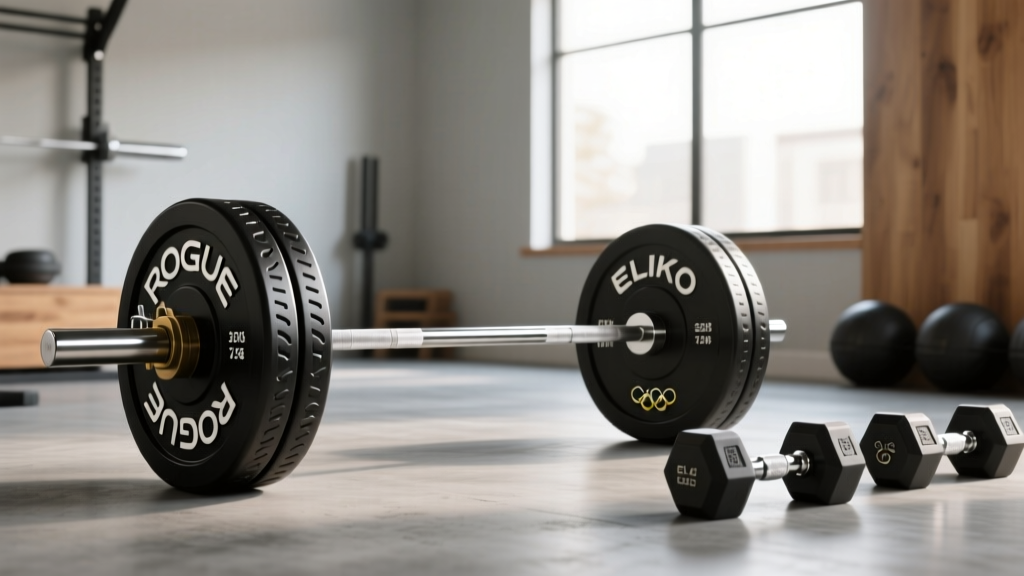
Barbell Knurling & Forearm Workouts with Dumbbells: Rogue vs Eleiko
Compare Rogue and Eleiko Olympic barbell knurling and weight specs, plus the best forearm workouts with dumbbells to build unbreakable grip strength.

The Grip Strength Dilemma: Barbell Knurling vs. Isolation
When building a home gym or upgrading a commercial facility in 2026, the Olympic barbell remains the centerpiece of heavy strength training. However, lifters quickly discover that grip failure often precedes muscular failure in the posterior chain. While premium barbell knurling provides the necessary friction for heavy pulls, it cannot replace targeted muscle hypertrophy. This is where integrating forearm workouts with dumbbells becomes a non-negotiable component of a complete strength program.
In this head-to-head comparison, we dissect the weight specifications and knurling profiles of two industry titans—the Rogue Ohio Bar V3 and the Eleiko Olympia WL Training Bar—and outline exactly how to supplement their isometric demands with dumbbell isolation.
Head-to-Head Matrix: Rogue Ohio V3 vs. Eleiko Olympia WL
Choosing the right barbell requires understanding how tensile strength, shaft diameter, and knurl depth interact. Below is a direct specification comparison based on current 2026 manufacturing standards.
| Specification | Rogue Ohio Bar V3 | Eleiko Olympia WL Training Bar |
|---|---|---|
| Shaft Weight | 20 kg (44 lbs) | 20 kg (44 lbs) |
| Tensile Strength | 190,000 PSI | 215,000+ PSI |
| Knurl Pattern | Volcano (Aggressive) | Refined/Mountain (Moderate) |
| Center Knurl | None | Present (IWF Standard) |
| Bushing/Bearing | Composite Bushings | Needle Bearings |
| Approx. Price (2026) | $295.00 | $1,150.00+ |
Deep Dive: Knurling Aggressiveness and Hand Tear Risk
The Rogue Ohio Bar utilizes a volcano knurl pattern. This design removes the sharp peak of a traditional mountain knurl, creating a crater-like rim that bites into the skin without acting like a cheese grater. It is exceptional for heavy, low-rep deadlifts where maximum friction is required.
Conversely, Eleiko's Olympia series employs a highly refined, less aggressive knurl. According to Olympic weightlifting standards, athletes perform high-volume snatches and cleans where an aggressive knurl would shred the palms during the hook grip release. Eleiko's knurl provides secure traction via sheer precision machining rather than raw depth, making it superior for dynamic lifts but slightly less sticky for max-effort static holds.
Shaft Diameter: 28mm vs 29mm and Grip Fatigue
The diameter of the barbell shaft directly impacts how hard your forearms must work to maintain a closed grip. The Eleiko Olympia WL features a 28mm shaft, which is the IWF standard for men's Olympic weightlifting bars. This slightly thinner profile allows lifters with smaller hands to secure a full hook grip around the thumb and fingers, reducing the premature forearm pump that occurs when trying to squeeze a thicker shaft.
The Rogue Ohio Bar V3 also utilizes a 28mm shaft, making it a versatile hybrid. However, if you were to upgrade to a dedicated powerlifting bar like the Rogue Ohio Power Bar, you would encounter a 29mm shaft. That single millimeter difference drastically increases the lever arm against your finger flexors. This is precisely why athletes transitioning from Oly lifting to powerlifting must increase the volume of their forearm workouts with dumbbells to adapt to the thicker shaft and stiffer knurling.
Why Barbell Knurling Isn't Enough: The Case for Dumbbell Isolation
Heavy barbell holds and deadlifts primarily train crush grip and isometric endurance. They largely neglect the wrist flexors, extensors, and the brachioradialis. The National Strength and Conditioning Association (NSCA) emphasizes that balanced forearm development requires multi-planar movements to prevent elbow tendinopathy and improve overall force transfer. This is why dedicated forearm workouts with dumbbells are essential for longevity and performance.
Top 3 Forearm Workouts with Dumbbells to Supplement Your Barbell Work
Pro-Tip: Perform these exercises at the end of your pulling sessions. Pre-fatiguing your grip will compromise your main barbell lifts and increase the risk of dropping heavy loads.- Dumbbell Wrist Flexion & Extension (3 x 15-20): Rest your forearms on a bench with wrists hanging off the edge. Using 15-25 lb dumbbells, curl the weight up into full flexion, then slowly lower into a deep stretch. Flip the arm over to train the extensors. This targets the flexor carpi radialis and ulnaris, building the meat of the inner forearm and balancing the joint.
- Zottman Curls (3 x 10-12): Curl the dumbbells up with a supinated (palms up) grip. At the top of the movement, rotate your wrists 180 degrees to a pronated (palms down) position, and lower the weight slowly over 3 seconds. This heavily recruits the brachioradialis, the thick muscle on the top of the forearm that bridges the elbow joint and stabilizes heavy pulls.
- Hex Dumbbell Pinch Holds (3 x Failure): Instead of holding the handle, grip the smooth, hexagonal heads of two heavy dumbbells (e.g., 35 lbs each) with your fingers and thumb. Hold for time. This builds thumb adductor strength and pinch grip, a weak link for many powerlifters handling thick Olympic barbell shafts.
Weight Specs & Tolerance: What the Manuals Don't Tell You
When evaluating Olympic barbell weight, the stated 20kg is only half the story. Manufacturing tolerances dictate how the bar feels and performs over a decade of use. The Eleiko Olympia WL is calibrated to IWF (International Weightlifting Federation) standards, meaning it guarantees a weight tolerance of +/- 10 grams. The Rogue Ohio Bar, while incredibly accurate, typically sits within a +/- 50 gram tolerance, which is more than sufficient for powerlifting and general strength but technically outside elite Oly competition specs.
Furthermore, the presence of a center knurl on the Eleiko aids in barbell tracking during front squats and cleans, catching on the back of the shirt. The Rogue Ohio V3 omits this, catering to cross-training athletes who find center knurls abrasive during high-rep front squats or overhead pressing variations.
Knurl Maintenance: Protecting Your Investment
An Olympic barbell's knurling is precision-machined steel. In 2026, with gym environments ranging from humid garage spaces to climate-controlled commercial facilities, oxidation is the enemy of grip. Chalk (magnesium carbonate) absorbs moisture but also packs into the knurling valleys, creating a smooth, slippery paste over time.
- Weekly Cleaning: Use a stiff nylon brush to scrub the knurling. Never use a wire brush on zinc or black oxide finishes, as it will strip the protective coating and expose bare steel to rust.
- Monthly Deep Clean: Apply a few drops of 3-in-One oil or specialized barbell oil to the shaft, scrub with the nylon brush, and wipe down with a microfiber cloth. This displaces trapped moisture and chalk.
- Dumbbell Parallels: Apply the exact same maintenance to the knurled handles of your iron dumbbells. A slippery dumbbell handle turns heavy wrist curls into a hazardous dropping risk.
'Grip strength is not just about holding onto the bar; it is about the neurological irradiation that stabilizes the shoulder girdle during heavy pulls. Train it isometrically with the barbell, and hypertrophically with dumbbells.'
Final Verdict: Building the Ultimate Grip Arsenal
If your primary focus is heavy powerlifting, static deadlifts, and general strength, the Rogue Ohio Bar V3 offers the aggressive volcano knurl and budget-friendly $295 price point you need. If you are an Olympic weightlifter requiring high-volume hook grip work and IWF-certified weight tolerances, the Eleiko Olympia WL is the undisputed champion, despite its $1,150+ premium.
Regardless of your barbell choice, the knurling alone will not bulletproof your joints or maximize forearm hypertrophy. By systematically integrating the outlined forearm workouts with dumbbells into your weekly programming, you will eliminate grip as a limiting factor and build the structural integrity required to handle elite loads in 2026 and beyond.
More gear to consider
All reviews
Barbell Collar Guide & Chest and Triceps Workout with Dumbbells

Gear Guide: Full Body Circuit Workout With Dumbbells (2026)

What Does Bent Over Dumbbell Row Work? 2026 Loadable Trends
Olympic Barbell Guide: Weight, Knurling & Standing Dumbbell Flys Chest
Olympic vs Standard Plates: Avoiding Bowflex Dumbbell Recall Failures
