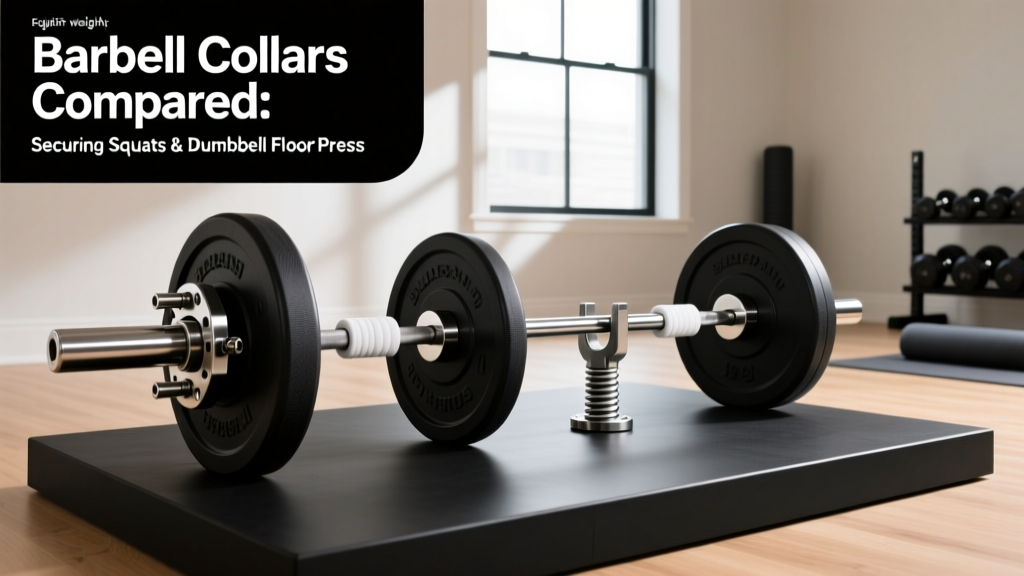
Barbell Collars Compared: Securing Squats & Dumbbell Floor Press
Compare top barbell collar types—clamp, lever, and spring. Learn which lock secures heavy lifts and complements your dumbbell floor press routine.

The Hidden Physics of Plate Shift and Gym Safety
When loading a barbell for a heavy squat or deadlift, the collar is the only barrier between a successful lift and a catastrophic plate shift. According to the United States Powerlifting Association (USAPL) Rulebook, collars are mandatory in competition not just for safety, but to ensure the exact weight of the barbell is maintained and balanced. But beyond competition, what happens in your home gym when a 45-pound plate shifts just two inches outward on one side?
The physics are unforgiving. A two-inch lateral shift of a 45lb plate alters the barbell's center of mass, creating a severe torsional force. During a heavy back squat, this asymmetrical load transfers directly into your wrists, thoracic spine, and hips, often resulting in a missed lift or acute injury. As we evaluate gym equipment standards in 2026, understanding the mechanical differences between barbell collar types is critical for both safety and workout efficiency.
⚠️ The Sleeve Tolerance Trap: Standard Olympic barbell sleeves are nominally 50mm in diameter. However, budget barbells often suffer from manufacturing variances, measuring anywhere from 50.2mm to 50.8mm. If you purchase strict 50.0mm IWF-spec collars for a 50.8mm sleeve, they will slide off under load. Always measure your barbell sleeve with digital calipers before buying high-end collars.The Four Primary Collar Mechanisms
Not all collars are created equal. The market is currently dominated by four distinct locking mechanisms, each engineered for a specific style of training.
1. Clamp Collars (The Powerlifting Standard)
Clamp collars, like the industry-standard Rogue HG 2.0 Collars (approx. $28/pair), utilize a cam-action lever to squeeze a thermoplastic or aluminum housing tightly against the barbell sleeve. They offer immense lateral grip force and are virtually immune to slipping during heavy, slow eccentric movements like squats and bench presses. The primary drawback is the physical effort required to snap the cam lever shut, which can be taxing on fatigued hands during high-volume sessions.
2. Lever & Spin-Lock Collars (The Olympic Standard)
Designed for the explosive, high-impact environment of weightlifting, lever and spin-lock collars—such as the Eleiko Olympic Weightlifting Collars (approx. $65/pair)—are engineered to absorb dropping forces. The International Weightlifting Federation (IWF) mandates that competition collars weigh exactly 2.5kg each and securely lock via a lever or screw mechanism. These collars excel at keeping plates flush during repeated overhead drops but can be slower to put on and take off compared to modern quick-release alternatives.
3. Spring Clips (The Budget Baseline)
Spring clips are the ubiquitous, low-cost option found in most commercial gyms (usually $10–$15/pair). They rely on the outward tension of heavy-gauge steel wire. While they are incredibly fast to apply, their grip force degrades rapidly over time as the metal fatigues. Never use spring clips for heavy squats, good mornings, or any lift where the barbell tilts vertically.
4. Magnetic & Latch Collars (The Modern Innovator)
The Lock-Jaw Pro (approx. $35/pair) revolutionized the market by combining a rigid plastic latch with high-strength neodymium magnets. The magnets snap the collar halves together around the sleeve, while the mechanical latch bears the lateral load. They are exceptionally fast to use and offer a grip force that rivals traditional clamps, making them a favorite for CrossFit athletes and high-intensity interval lifters who need to change loads in seconds.
Head-to-Head Collar Comparison Matrix
| Model / Type | Mechanism | Avg. Price (2026) | Grip Force | Best Application |
|---|---|---|---|---|
| Rogue HG 2.0 | Cam-Clamp | $28.00 | Very High | Powerlifting, Heavy Squats |
| Eleiko Olympic | Lever / Spin | $65.00 | High (Impact Resistant) | Olympic Drops, Snatch/C&J |
| Lock-Jaw Pro | Magnetic Latch | $35.00 | High | CrossFit, Fast Load Changes |
| Titan Spring Clips | Wire Tension | $12.00 | Low | Light Accessories, Landmines |
Real-World Failure Modes & Edge Cases
Even the best equipment fails if misapplied. According to facility safety guidelines outlined in the NSCA's Essentials of Strength Training and Conditioning, regular inspection of locking mechanisms is vital to prevent equipment degradation. Here are the most common failure modes we see in home and commercial gyms:
- Thermoplastic Warping: Leaving clamp collars clamped onto the barbell for weeks compresses the internal plastic lining, causing it to permanently deform. Over time, the collar will lose its bite on a 50mm sleeve.
- Chalk Buildup: In lever and spin-lock collars, magnesium carbonate (gym chalk) packs into the threading or lever hinge, preventing the collar from seating fully flush against the inner sleeve hub.
- Magnet Demagnetization: Dropping magnetic latch collars repeatedly on concrete flooring can fracture the internal neodymium magnets or weaken their magnetic field, causing the collar to pop open during lateral barbell movement.
Workflow Optimization: Barbell Bench vs. Dumbbell Floor Press
When designing a hypertrophy or strength program, lifters frequently transition between heavy bilateral barbell movements and unilateral or floor-based accessory work. A prime example is supersetting a heavy barbell bench press with the dumbbell floor press. This specific programming choice highlights why your collar selection dictates your workout flow.
The Transition Factor
If you are utilizing traditional screw-tight or heavy cam-clamp collars for your barbell bench press, stripping the bar to transition to your dumbbell floor press mat takes valuable time and grip energy. This downtime can cause your core temperature to drop and disrupt your rest intervals. Conversely, if you use quick-release magnetic collars, you can strip the barbell in three seconds, move to the floor, and execute your dumbbell floor press with optimal triceps isolation and shoulder safety, maintaining the density of your workout.
Furthermore, if you are using adjustable dumbbells (such as the Nuobell 80lb or PowerBlock Pro series) for your dumbbell floor press, you are already relying on integrated mechanical collars. The selector pin or dial mechanism acts as the collar, securing the internal weight stacks. Just as you wouldn't trust a worn-out barbell spring clip, you must regularly inspect the selector pins on your adjustable dumbbells to ensure they haven't bent, which could cause a plate to dislodge mid-press while your elbows are resting on the floor.
Final Buying Framework
Your choice of barbell collar should be dictated by your primary training modality, your barbell's exact sleeve diameter, and your tolerance for load-change friction.
"Invest in your collars with the same scrutiny you apply to your barbell bearings. A $1,000 barbell is rendered dangerous by a $10 pair of fatigued spring clips. Match the collar to the movement: clamps for slow, heavy eccentrics; levers for impact drops; and magnets for speed."
For the dedicated home gym owner in 2026, keeping a pair of Rogue HG 2.0 clamps for heavy squats and a pair of Lock-Jaws for rapid accessory transitions provides the ultimate balance of safety and efficiency. Secure your plates, respect the physics, and press with confidence.
More gear to consider
All reviews
Bumper Plate vs Iron Plate: Pairing Lifetime Fitness Dumbbells

Best Adjustable Dumbbells for a Heavy Dumbbell Workout: 2026 Matchup

2026 Trends: Urethane vs Rubber Hex for the Dumbbell Floor Fly

Barbell Buying Guide: Weight, Knurling & Split Squat With Dumbbells

Loadable Dumbbell Maintenance: Lateral Raise Dumbbell Side Care