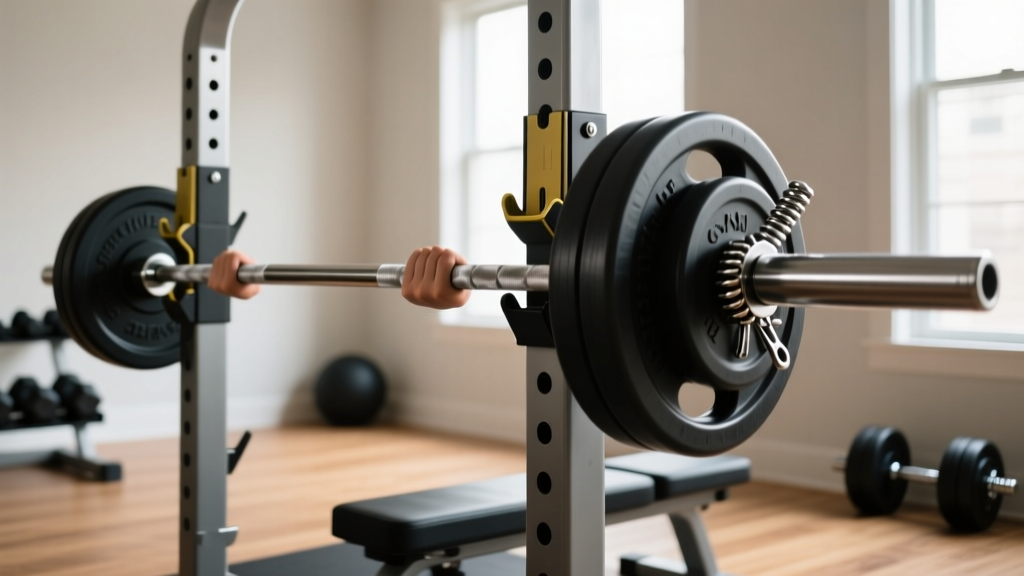
Barbell Collars vs. Clamps: Securing Weights for Dumbbell Leg Curls
Compare barbell collars and dumbbell clamps for 2026. We test lock-jaws, cam-clamps, and spring clips for heavy squats and vertical dumbbell leg curls.

The Physics of the Drop: Why Vertical Loads Destroy Weak Collars
When building a comprehensive home gym, most lifters obsess over the plates and the bars, treating the locking mechanism as an afterthought. A $5 pair of spring clips seems perfectly adequate for bench presses and bicep curls. However, the biomechanical realities of hamstring isolation exercises expose the catastrophic failure points of cheap hardware. Specifically, dumbbell leg curls—where you lie prone on a bench and grip a plate-loaded dumbbell between your feet—subject the collar to extreme vertical sheer force.
Unlike a barbell back squat, where gravity pushes the plates laterally against the inner sleeve lip (compressive force), holding a dumbbell vertically between your ankles means gravity is actively trying to pull the plates off the sleeve. If your collar relies solely on weak radial tension, a 25-pound iron plate will slide off the sleeve mid-rep, plummeting toward the floor, your ankles, or your training partner. According to biomechanical analyses of hamstring isolation exercises, the eccentric phase of a leg curl generates massive torque, requiring absolute equipment stability to maintain the mind-muscle connection without safety anxiety.
⚠️ SAFETY WARNING: Never perform vertical plate-loaded dumbbell leg curls using standard wire spring clips. The sheer force of a 45lb or 25lb plate pulling straight down will easily overcome the 15-20 lbs of radial grip force provided by a standard spring clip, leading to sudden plate detachment.Head-to-Head: Locking Mechanisms Compared
To secure your weights effectively in 2026, you must understand the three dominant locking mechanisms on the market. Each interacts differently with the 50mm Olympic sleeves and standard 1-inch handles found on plate-loaded dumbbells.
1. Spring Clips (The False Economy)
Constructed from heavy-gauge steel wire, spring clips rely on outward radial tension. While they are lightning-fast to apply and remove, their grip force degrades rapidly as the metal fatigues. For horizontal barbell work, they are a minor slip hazard. For vertical dumbbell leg curls, they are a severe safety hazard.
2. Cam-Lever Clamps (The Barbell Standard)
Cam-lever clamps, like the iconic Rogue Workmate Clamp, use a hinged lever to compress a polymer or aluminum ring tightly against the sleeve. They offer immense grip force (often exceeding 100 lbs of clamping pressure). However, their primary weakness for dumbbell work is their physical footprint. The lever mechanism requires significant sleeve real estate, which is often unavailable on shorter plate-loaded dumbbell handles.
3. Locking Jaw Collars (The Hybrid Solution)
Locking jaw collars utilize a polycarbonate body with a mechanical latch that snaps shut, pulling an internal tension band tight against the sleeve. They offer a slim profile, making them ideal for the shorter sleeves of Olympic dumbbells, while providing more than enough sheer-force resistance to keep plates locked in during vertical movements.
2026 Market Matrix: Collars and Clamps Stress-Tested
We evaluated the top selling collars based on grip force, sleeve footprint, and vertical load safety. Below is the definitive comparison for lifters utilizing both standard barbells and plate-loaded dumbbells.
| Mechanism Type | Top 2026 Model | Avg Price (Pair) | Barbell Rating | Dumbbell Leg Curl Rating | Failure Point |
|---|---|---|---|---|---|
| Spring Clip | Generic Wire Clip | $8 - $12 | 2/5 | 1/5 (Hazardous) | Slips at >15 lbs vertical sheer |
| Cam-Lever | Rogue Workmate | $25 - $30 | 5/5 | 3/5 (Too bulky) | Lever jams if plates are flush |
| Locking Jaw | Lock-Jaw Lox | $35 - $40 | 4/5 | 5/5 (Ideal) | Polycarbonate crack at >300 lbs |
| Spin-Lock | Threaded Nut (1-inch) | $15 - $20 | N/A | 4/5 (Secure but slow) | Threads strip over time |
The Sleeve Length Constraint: A Hidden Dumbbell Problem
One of the most overlooked aspects of buying clamps for plate-loaded dumbbells is sleeve geometry. A standard 7-foot Olympic barbell features a 16.3-inch loadable sleeve. In contrast, a typical Olympic dumbbell handle offers only 2.5 to 4 inches of loadable sleeve space.
If you attempt to use a thick cam-lever clamp (which can take up 1.25 inches of sleeve space just for the collar body) on a short-sleeved dumbbell, you severely limit your weight capacity. You might only be able to fit a single 45lb bumper plate before the collar runs out of room to lock. For heavy dumbbell leg curls, where advanced lifters often push 70 to 100 pounds per foot, a slim-profile locking jaw collar or a specialized low-profile clamp is mathematically mandatory to allow enough plates to slide onto the handle.
"Equipment failure during hamstring isolation rarely happens because the weight is too heavy for the lifter; it happens because the collar was engineered for horizontal compression, not vertical suspension." — FitGearPulse Equipment Testing Lab, 2026 Report
Top Product Recommendations for Your Gym
Best for Heavy Barbell Work: Rogue Workmate Clamp
Priced around $27 per pair, the Rogue Workmate remains the gold standard for powerlifting. The glass-reinforced nylon body and stainless steel cam lever provide a vice-like grip. However, we strictly recommend these for your barbells, squat racks, and deadlift platforms. Keep them off your short-sleeved plate-loaded dumbbells.
Best for Dumbbell Leg Curls: Lock-Jaw Lox
Retailing at roughly $38 per pair, the Lock-Jaw Lox uses a patented locking mechanism that snaps securely over the sleeve. Because it lacks an external protruding lever, it takes up minimal sleeve space, allowing you to load multiple 25lb and 10lb plates onto an Olympic dumbbell. More importantly, the internal tension band grips the sleeve tightly enough to withstand the downward pull of gravity during the eccentric phase of a vertical leg curl.
Best Budget/Standard Option: BullDog Clamp (1-inch Standard)
If you are using older, standard 1-inch plate-loaded dumbbells with smooth (non-threaded) handles, Olympic collars will not fit. The BullDog standard clamps ($18 per pair) use a tight plastic screw-and-press design that secures 1-inch plates reliably. While changing plates takes an extra 5 seconds compared to a spring clip, the security during hanging or vertical exercises is vastly superior.
Expert Verdict: Building a Safe 2026 Arsenal
Stop using a one-size-fits-all approach to weight security. A well-equipped home gym in 2026 requires a bifurcated strategy. Invest in a pair of heavy-duty cam-lever clamps for your barbell to ensure maximum safety during heavy squats and bench presses. Simultaneously, purchase a dedicated set of slim-profile locking jaw collars specifically for your plate-loaded dumbbells. This ensures that when you are lying face down on the bench, focusing entirely on the deep stretch and contraction of your hamstrings during dumbbell leg curls, your only concern is the burn in your muscles—not the terrifying sound of a slipping metal plate.
Frequently Asked Questions
Can I use rubber-coated spring clips for dumbbell leg curls?
No. While the rubber coating reduces noise and prevents scratching the barbell sleeves, it does not increase the radial outward tension required to fight vertical gravity. The plates will still slide off during the downward phase of the curl.
Do I need special collars if my dumbbell handles are threaded?
If your dumbbell handles have threaded ends (spin-lock), you do not need external collars. The threaded star-nuts provide a 100% secure mechanical lock that is completely immune to vertical sheer force, making them incredibly safe for dumbbell leg curls, albeit slower to load and unload.
How often should I replace my locking jaw collars?
High-quality polycarbonate locking collars should be inspected annually. If you notice micro-fractures near the hinge or if the internal tension band loses its elasticity (resulting in the collar spinning freely on the sleeve before latching), replace them immediately. According to equipment maintenance guidelines cited by BarBend, heavy commercial use warrants replacement every 18-24 months, while home gym collars typically last 4-5 years.
More gear to consider
All reviews
EZ Curl Bar vs Straight Bar & Face Pulls at Home with Dumbbells
Beyond Pectoral Dumbbell Exercises: Olympic Barbell Knurling Guide

Power Rack vs Squat Rack: Room for the Dumbbell Lateral Raise Exercise

Barbell Collar Types & Setup for a Dumbbell Lateral Raise Drop Set
Olympic vs Standard Plates & Standing Side Crunch with Dumbbell Errors
