
Standard vs Olympic Plates for the Dumbbell Bench Press Exercise
Compare standard vs Olympic weight plates for your dumbbell bench press exercise setup. Discover pricing, safety limits, and the best loadable handles.

Building the Ultimate Home Gym for Heavy Pressing
When outfitting a home gym, the choice between 1-inch standard weight plates and 2-inch Olympic plates is one of the most consequential decisions you will make. While this debate often centers around barbell squats and deadlifts, it profoundly impacts your ability to perform the dumbbell bench press exercise safely and effectively as you grow stronger. Many beginners start with budget-friendly standard plates and threaded spinlock dumbbell handles, only to hit a frustrating ceiling when their pressing strength outpaces their equipment's physical limitations.
In this comprehensive head-to-head comparison, we break down the exact specifications, pricing, failure modes, and biomechanical realities of using standard versus Olympic plates for loadable dumbbells. Whether you are chasing hypertrophy or building raw unilateral strength, understanding how plate dimensions dictate your dumbbell bench press exercise setup will save you hundreds of dollars in redundant equipment purchases.
The Biomechanical Demand of the Dumbbell Bench Press Exercise
Unlike the barbell bench press, which locks your hands into a fixed path, the dumbbell bench press exercise demands intense unilateral stabilization. According to biomechanical analyses documented by ExRx, the use of independent dumbbells allows for a deeper stretch at the bottom of the movement and greater adduction at the top, leading to superior pectoral activation. However, this freedom of movement requires a perfectly balanced center of gravity.
If your weight plates are bulky, unevenly distributed, or prone to shifting, the biomechanics of the lift break down. You spend more neural energy stabilizing a wobbling dumbbell than you do contracting your pecs. This is where the physical dimensions of standard versus Olympic plates—and the handles they mount to—become the critical bottleneck in your training.
1-Inch Standard Plates: The Budget Spinlock Setup
Standard weight plates feature a 1-inch (25mm) center hole and are typically paired with 14-inch threaded steel spinlock dumbbell handles. This setup is the undisputed king of budget home gyms, widely available at big-box sporting goods stores and online marketplaces.
The Pros of Standard Plates
- Cost-Effective: Standard cast iron or vinyl-cement plates typically cost between $1.00 and $1.50 per pound.
- Accessibility: Handles and replacement collars are cheap and universally available.
- Lightweight Starting Points: Standard plates often come in 2.5 lb and 5 lb increments, making micro-loading for rehabilitation or beginner progression easier.
The Cons and Limitations
The primary failure mode of the standard setup emerges during heavy dumbbell bench press exercise sets. A standard 14-inch handle has a sleeve length of roughly 6.5 inches. Because standard cast iron 10-pound plates are exceptionally thick (often over 1.2 inches wide), you can physically only fit about three 10-pound plates and one 5-pound plate on each side. This caps your maximum dumbbell weight at roughly 55 to 65 pounds per hand.
Once you can press 60-pound dumbbells for reps, the standard setup becomes obsolete. Furthermore, the stamped, shallow knurling on cheap spinlock handles often tears calluses and provides inadequate grip security when chalk and sweat are introduced.
2-Inch Olympic Plates: The Heavy-Duty Loadable Route
Olympic plates feature a 2-inch (50mm) center hole, designed to mount onto heavy-duty loadable dumbbell handles equipped with rotating sleeves and internal bushings or bearings. This is the standard for commercial gyms and serious garage gym athletes.
The Pros of Olympic Plates
- Massive Weight Capacity: Premium loadable handles, such as the Rogue Loadable Dumbbell Handles, feature machined steel sleeves that can hold well over 100 pounds per hand, depending on plate thickness.
- Superior Knurling: Olympic handles feature deep, volcano-style knurling that bites into the skin, ensuring the dumbbell does not slip during a heavy, sweat-drenched dumbbell bench press exercise set.
- Sleeve Rotation: Olympic handles spin independently of the grip. While rotation is more critical for Olympic lifts, a smooth-spinning sleeve reduces torque on the wrists during the concentric phase of a heavy press.
The Cons and Limitations
The barrier to entry is undeniably high. Olympic loadable dumbbell handles cost between $120 and $180 each. Furthermore, Olympic plates are more expensive, ranging from $1.75 per pound for basic cast iron to over $4.00 per pound for virgin rubber or urethane options.
Head-to-Head Comparison Matrix
| Feature | 1-Inch Standard Setup | 2-Inch Olympic Setup |
|---|---|---|
| Plate Hole Diameter | 1 inch (25mm) | 2 inches (50mm) |
| Avg. Cost Per Pound (Plates) | $1.00 - $1.50 | $1.75 - $4.50+ |
| Handle Cost (Pair) | $30 - $50 | $240 - $360 |
| Max Weight Per Dumbbell | ~65 lbs (Sleeve limited) | 100 - 140+ lbs |
| Handle Knurling Quality | Shallow, stamped, aggressive | Deep, machined, ergonomic |
| Collar Security | Threaded spinlock (prone to stripping) | Spring clips or machined screw-down |
Cost Analysis: Building a 100 lb Dumbbell Set
To truly understand the value proposition, let us look at the exact mathematics of building a setup capable of performing the dumbbell bench press exercise with 100-pound dumbbells in each hand (200 lbs total).
The Standard Plate Illusion: You cannot build a 100 lb standard dumbbell. The sleeves are simply not long enough to accommodate the necessary volume of 1-inch thick cast iron plates. You would need to buy a specialized, extra-long 1-inch handle (which are incredibly rare and dangerously unbalanced), making this a physical impossibility for 99% of home gyms.The Olympic Reality: To build two 100 lb Olympic dumbbells, you need to purchase 200 lbs of plates and two loadable handles. Using thin, machined steel Olympic plates (which are roughly 0.6 inches thick), you can easily fit five 20-pound plates on a 6.5-inch Rogue sleeve.
Total Cost Breakdown:
2x Loadable Handles @ $165 = $330
200 lbs of Machined Steel Plates @ $2.50/lb = $500
Total Investment: $830
While $830 is a steep investment, it yields a commercial-grade, lifetime-warranty setup that will never need to be upgraded, whereas the standard setup will require replacement the moment you break the 60-pound threshold.
Safety and Failure Modes During Heavy Pressing
When performing the dumbbell bench press exercise, the weights are suspended directly over your face, ribs, and vital organs. Equipment failure is not just an inconvenience; it is a severe safety hazard.
The Spinlock Thread Failure
Standard spinlock collars rely on coarse steel threads. Over time, repeated dropping of the dumbbells or overtightening strips these threads. If a stripped collar backs off during the eccentric (lowering) phase of a heavy press, the plates shift outward on the sleeve. This instantly alters the center of gravity, applying massive, unexpected torque to your wrist and rotator cuff, frequently resulting in dropped weights and torn labrums.
The Olympic Spring Clip Advantage
Olympic setups utilize high-tension spring clips or machined aluminum screw-down collars that clamp flush against the plate. Because 2-inch plates are thinner and denser, the weight distribution remains compact and close to the handle's center of mass. This compact profile prevents the "pendulum effect" that occurs when bulky standard plates shift, ensuring that the dumbbell tracks exactly where your neuromuscular system expects it to during the most vulnerable part of the lift.
The Verdict: Which Should You Buy?
Your choice between standard and Olympic plates for your dumbbell bench press exercise setup comes down to your current strength level and your long-term training horizon.
Choose 1-Inch Standard Plates If:
- You are a beginner or recovering from injury, and your pressing max is below 50 pounds per hand.
- You are on a strict sub-$300 budget and need to acquire a full range of light weights for isolation movements and physical therapy.
- You view your home gym as a temporary, 1-to-2-year solution before joining a commercial gym.
Choose 2-Inch Olympic Plates If:
- You can currently press 50-pound dumbbells for reps and plan to progressively overload into the 80-100+ pound range.
- You prioritize joint health, wrist stability, and equipment safety during heavy, over-the-face pressing movements.
- You want a unified ecosystem where your weight plates can seamlessly transition between your barbell, your loadable dumbbell handles, and your plate-loaded cable machines.
Ultimately, while standard plates offer a cheap entry point, the Olympic plate ecosystem is the only viable path for serious lifters dedicated to mastering the dumbbell bench press exercise. The superior knurling, rotational mechanics, and limitless weight capacity of Olympic loadable handles transform a frustrating, limited movement into a premier chest-building tool that will serve you for decades.
More gear to consider
All reviews
Bumper vs Iron Plates: Space & Dumbbell Exercises for Belly Fat
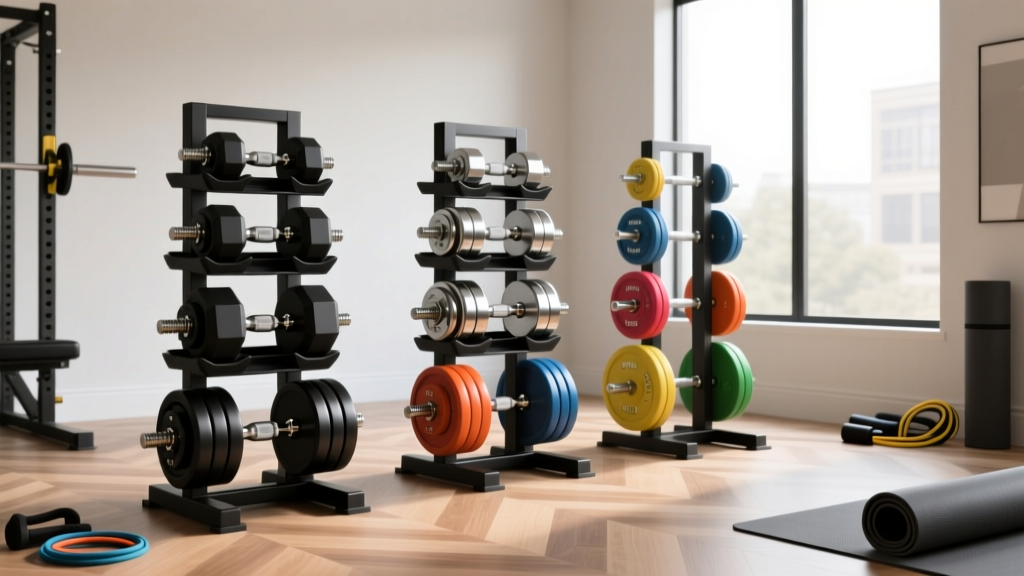
Best Dumbbell Racks: Organize Gear and Your Dumbbell Workouts Chart

Space-Saving Racks For Your Chest Press Dumbbell Workouts

EZ Curl Bar vs Straight Bar: Best Arm Tools After Dumbbell Lifts for Chest
Beyond the Black and White Dumbbell Icon: Kettlebell Value Guide
