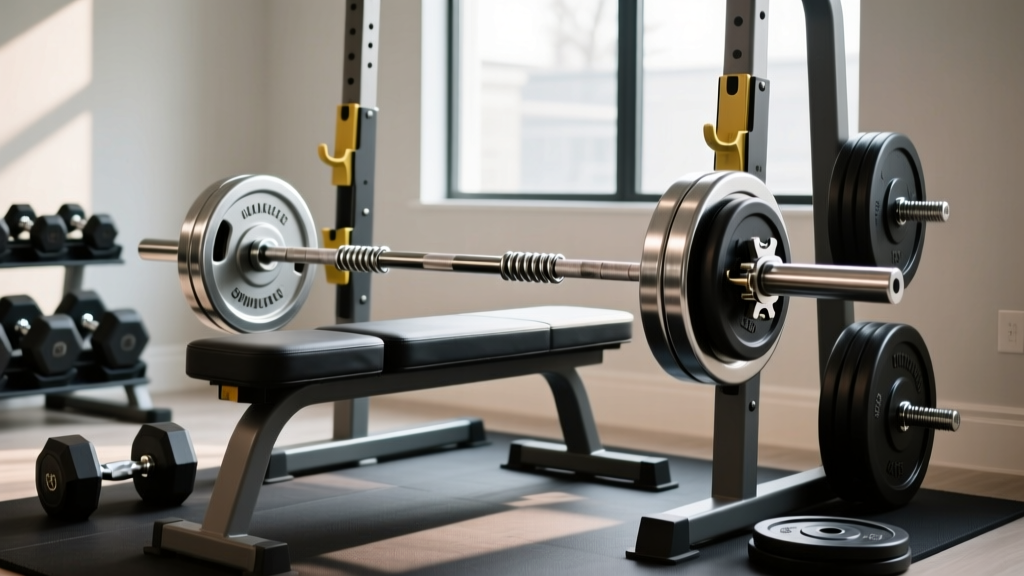
Barbell Collars For Your Workout With Bench And Dumbbells Setup
Compare spring, lever, and spinlock barbell collars. Secure your home gym setup beyond the basic workout with bench and dumbbells with our 2026 guide.

The Evolution of Your Home Gym: From Dumbbells to Barbells
Most home gym owners begin their fitness journey with a simple workout with bench and dumbbells. It is accessible, highly versatile, and inherently safer for solo training. However, as your strength progresses and you seek progressive overload, the natural next step is introducing a barbell for heavy compound lifts like squats, deadlifts, and bench presses. When you make this transition, the safety dynamics of your gym change entirely.
Unlike dumbbells, where a slipped grip simply means a dropped weight, an unsecured barbell can lead to catastrophic asymmetric loading. If plates shift outward on one side of the barbell during a heavy back squat, the center of gravity instantly violently shifts, often resulting in severe injury or dropped lifts. According to safety guidelines published by the National Strength and Conditioning Association (NSCA), securing weight plates with appropriate collars is a non-negotiable standard for both commercial and home gym environments.
In this 2026 in-depth buying guide, we break down the exact engineering, failure modes, and pricing of the top barbell collar and clamp types to ensure your heavy lifting is as safe as your foundational dumbbell work.
The Physics of Plate Shift and Barbell Whip
To understand why a $15 pair of spring collars might fail you during a heavy deadlift, you must understand barbell whip and rotational inertia. When a barbell bends under heavy loads (typically 315+ lbs), the sleeves vibrate. Without adequate clamping force, these micro-vibrations cause bumper plates to 'walk' outward away from the inner sleeve hub.
Furthermore, dynamic movements like the clean and jerk or high-rep CrossFit thrusters generate immense rotational torque. The International Weightlifting Federation (IWF) strictly mandates collars weighing exactly 2.5 kg in competition not just for safety, but to standardize the total weight and stabilize the sleeve dynamics. While you do not need competition-grade collars for your home gym, you do need equipment that can withstand lateral G-forces.
2026 Barbell Collar Comparison Matrix
| Collar Type | Best Application | Avg. Price (2026) | Clamping Mechanism | Speed of Use | Sleeve Wear Risk |
|---|---|---|---|---|---|
| Spring Collars | Light/Moderate Lifts, WODs | $12 - $18 | Coiled Steel Tension | Very Fast (2 sec) | None |
| Lever / Clamp | Powerlifting, Heavy Compounds | $28 - $45 | Cam-Lever / Resin Snap | Fast (4 sec) | Low (Resin) / Med (Metal) |
| Spinlock (Threaded) | Olympic Weightlifting | $50 - $85 | Threaded Steel / Brass | Slow (15+ sec) | None |
| Magnetic Quick-Release | High-Rep Functional Fitness | $60 - $90 | Neodymium Magnets + Cam | Instant (1 sec) | None |
Deep Dive: Spring Collars (The Budget Standard)
Spring collars are the most ubiquitous collars in the world, often included for free with budget barbell sets. They rely on the tension of coiled spring steel to grip the sleeve.
Pros & Cons
- Pros: Inexpensive, universally compatible with slightly undersized sleeves, zero learning curve.
- Cons: Prone to tension loss over time, difficult to squeeze for users with weak grip strength or hand injuries, prone to slipping on chalky sleeves.
If you use magnesium carbonate (gym chalk) during your lifts, chalk dust will inevitably coat your barbell sleeves. Spring collars rely entirely on surface friction. A chalk-coated sleeve reduces the friction coefficient by up to 40%, meaning spring collars will slide off during heavy deadlifts or cleans, regardless of how tight they felt when applied.
Deep Dive: Lever & Clamp Collars (The Powerlifter's Choice)
For anyone moving past a basic workout with bench and dumbbells and into heavy barbell territory, lever and clamp collars are the gold standard. They utilize a cam-lever mechanism to create immense inward clamping force.
Top Models & Specifications
- Rogue HG 2.0 Collars ($33.00): Constructed from glass-filled nylon resin. They feature a patented snap-fit design that delivers roughly 500 lbs of inward clamping force. The Rogue Fitness HG 2.0 remains the benchmark for durability, as the resin will not scratch or scar zinc or chrome barbell sleeves.
- Lock-Jaw Pro ($30.00): Known for an aggressive bite. The Lock-Jaw utilizes a slightly harder plastic compound that grips tenaciously but can leave micro-abrasions on softer, uncoated steel sleeves over years of use.
- OSPRO Aluminum Collars ($45.00): CNC-machined from aircraft-grade aluminum. These are heavier, incredibly durable, and favored in competitive CrossFit environments, though the metal-on-metal contact requires occasional sleeve wiping to prevent oxidation transfer.
Standard Olympic barbell sleeves measure exactly 50mm in diameter. However, many budget import barbells sold online feature sleeves that measure 49.5mm or even 49mm. While spring collars will stretch to accommodate this, rigid lever and clamp collars (like the Rogue HG 2.0) may fail to latch securely or will sit loosely, creating a severe slipping hazard. Always measure your barbell sleeve with digital calipers before purchasing rigid clamps.
Deep Dive: Spinlock Collars (The Olympic Standard)
Spinlock collars thread directly onto the barbell sleeve. They are the heaviest and most secure option available, entirely immune to the rotational forces of Olympic weightlifting.
Brands like Eleiko and IVANKO manufacture precision-machined spinlock collars that weigh exactly 2.5 kg each. The primary failure mode of spinlock collars is not mechanical, but logistical: threading them on and off takes 15 to 20 seconds per side. If your programming involves rapid weight changes or high-intensity interval training, spinlocks will severely disrupt your workout flow.
Real-World Failure Modes & Edge Cases
When evaluating collars, it is critical to look beyond the manufacturer's marketing and examine how they fail in the real world:
- Nylon Hinge Fatigue: Lever collars made from cheap, non-glass-filled plastics will develop micro-fractures at the hinge point if repeatedly dropped from overhead during missed snatches. By year two, the hinge will snap under tension.
- Urethane Dust Buildup: If you use crumb rubber or cheap urethane bumper plates, they shed microscopic dust that coats the barbell sleeve. This dust acts like a dry lubricant, causing clamp collars to slide during heavy Romanian Deadlifts (RDLs). Wipe sleeves with a damp microfiber cloth weekly.
- Temperature Extremes: If your home gym is in an unheated garage, standard plastic clamp collars can become brittle in sub-40°F (4°C) temperatures. Aluminum or steel collars are required for cold-climate garage gyms.
The 2026 Buying Decision Framework
How do you choose the right collar for your specific training style? Use this framework to make your purchase:
1. The Powerlifter & Strength Athlete
Recommendation: Rogue HG 2.0 or OSPRO Aluminum.
Why: You need maximum clamping force to prevent plate shift during heavy, grinding squats and deadlifts. Speed of removal is secondary to absolute security.
2. The Functional Fitness & CrossFit Athlete
Recommendation: Lock-Jaw Pro or ALBS Magnetic Quick-Release.
Why: You need a balance of security for barbell cycling (cleans, thrusters) and speed for rapid weight transitions during WODs. The emerging magnetic quick-release collars of 2026 offer instant on/off capabilities without sacrificing lateral grip.
3. The Olympic Weightlifter
Recommendation: Eleiko Training Spinlocks.
Why: The extreme rotational torque of the snatch and clean & jerk demands the threaded security of spinlocks. Furthermore, training with 2.5 kg collars acclimates you to competition conditions.
Frequently Asked Questions (FAQ)
Can I use standard 1-inch collars on an Olympic barbell?
No. Standard collars are designed for 1-inch (25.4mm) sleeves, commonly found on budget beginner sets. Olympic barbells require 2-inch (50mm) collars. Attempting to force a 1-inch spring collar onto a 50mm sleeve will permanently deform the spring and ruin the collar.
Do I need collars if I am only doing bench press?
Yes. Even on a bench press, if you fail a rep and tilt the bar to dump the weights, the sudden shift in momentum can cause the plates on the opposite side to slide outward, potentially causing the bar to flip and drop onto your chest or neck. Always secure both sides.
How often should I replace my spring collars?
Spring collars should be replaced every 12 to 18 months of regular use. The coiled steel loses its memory and tension over time, drastically reducing the clamping force and friction against the sleeve.
Conclusion
Upgrading from a basic workout with bench and dumbbells to a fully equipped barbell station is a massive milestone in your fitness journey. However, with heavier loads comes a greater responsibility to secure your equipment. By understanding the mechanical differences between spring, lever, and spinlock collars, and by verifying your barbell sleeve dimensions, you can invest in a clamping system that guarantees your safety, protects your equipment, and allows you to lift with absolute confidence.
More gear to consider
All reviews
Power Rack vs Squat Rack: Hexagon Shape Dumbbell Troubleshooting

Best Adjustable Dumbbells for the Jump Squat With Dumbbells

Best Loadable Dumbbells for the Dumbbell Crush Press (2026)

Power Rack vs Squat Stand: Bench Dumbbell Workout Routine Setups
Good Shoulder Exercises With Dumbbells: Loadable Plate Layouts
