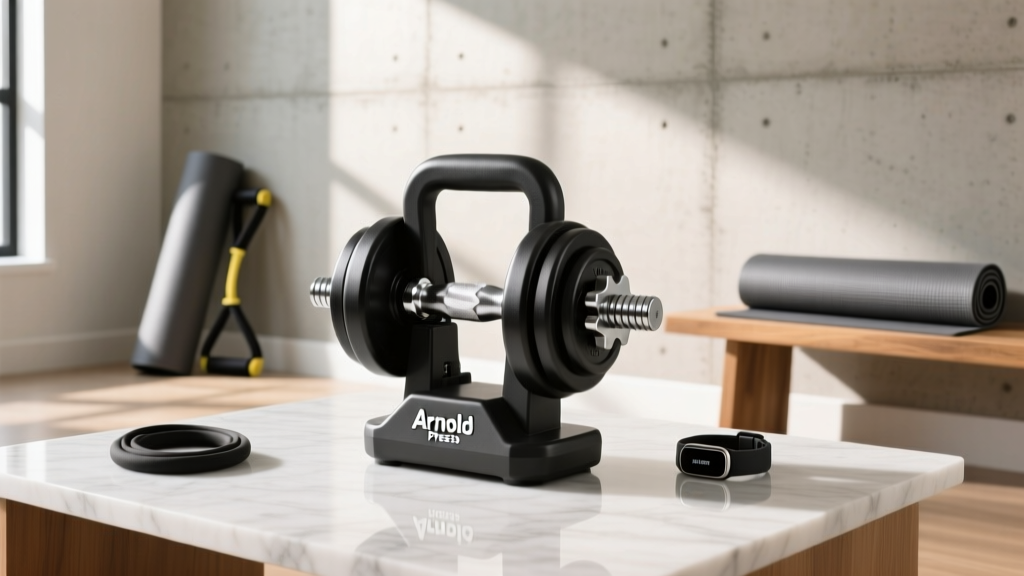
Arnold Press Dumbbells: Adjustable Sets Reviewed for Beginners
Master the Arnold press with our step-by-step beginner guide. We compare the best adjustable dumbbells for smooth rotational movements.

The Ultimate Beginner's Guide to the Arnold Press
If you are looking to build boulder shoulders, the Arnold press is a non-negotiable staple. Popularized by Arnold Schwarzenegger, this movement increases the range of motion and time under tension for the anterior and medial deltoids compared to a standard overhead press. However, executing this rotational movement requires specific equipment geometry. When shopping for arnold press dumbbells, beginners often overlook handle length and weight distribution, leading to awkward wrist angles or clanking weights at the top of the movement.
In this 2026 guide, we break down the exact biomechanics of the lift, provide a step-by-step execution guide, and review the top adjustable dumbbells on the market to find the perfect set for rotational shoulder work.
Why Adjustable Dumbbells for the Arnold Press?
The shoulder joint is highly mobile but inherently unstable. According to Mayo Clinic's strength training guidelines, progressive overload is vital, but jumping from 15 lb to 25 lb fixed dumbbells is a massive 66% load increase that can easily strain the rotator cuff. Adjustable dumbbells allow for 2.5 lb to 5 lb micro-loading, which is critical for safely mastering the Arnold press.
Step-by-Step: How to Perform the Arnold Press
Before we review the equipment, you must master the movement pattern. The Arnold press combines a bicep curl-like tuck with an overhead press and a wrist rotation.
- The Setup (Supinated Grip): Sit on a bench with a backrest. Hold a dumbbell in each hand at shoulder height. Your palms must face your body (supinated), and your elbows should be tucked tightly in front of your torso, almost touching.
- The Initiation: Engage your core and squeeze your glutes. This prevents your lower back from arching excessively as the weight moves overhead.
- The Rotation and Press: As you begin to press the weights upward, simultaneously rotate your wrists outward. By the time your arms are halfway extended, your palms should be transitioning to face forward.
- The Lockout: Finish the press with your arms fully extended overhead, palms facing completely forward (pronated). Do not shrug your traps at the top; keep your shoulder blades depressed.
- The Descent: Reverse the motion exactly. Lower the weights while rotating your wrists back inward, finishing with your elbows tucked in front and palms facing you again.
Expert Tip: According to the exercise database at ExRx.net, the primary error beginners make is flaring their elbows out too early. Keep the elbows pinned to your ribs during the bottom half of the movement to maximize anterior deltoid activation.
Adjustable Dumbbell Comparison Matrix (2026 Market)
Not all adjustable dumbbells are created equal. The rotational nature of the Arnold press exposes the flaws in bulky or overly long dumbbell designs. Below is a comparison of the top three selectorized dumbbells for this specific exercise.
| Brand & Model | Handle Design | Overall Length | Rotation Feel | Approx. Price (2026) |
|---|---|---|---|---|
| Nuobell 80 lb | Traditional Knurled Bar | 14.5 inches | Excellent (Natural) | $429 / pair |
| Bowflex SelectTech 552 | Smooth Steel w/ Dials | 15.75 inches | Poor (Clunky) | $349 / pair |
| PowerBlock Sport 24 | Caged Box Grip | 12 inches | Fair (Altered CoM) | $249 / pair |
Deep Dive: Which Adjustable Set is Best for Rotational Pressing?
1. Nuobell 80 lb: The Gold Standard for the Arnold Press
If your primary goal is to perform arnold press dumbbells movements with perfect form, the Nuobell 80 is the undisputed champion. Unlike dial-based systems, Nuobell uses a sliding collar mechanism on a traditional, straight barbell-style handle. The usable grip space is roughly 6.5 inches, which perfectly mimics a standard fixed hex dumbbell.
- Pros: Natural center of mass; authentic knurled grip prevents slipping when hands get sweaty during high-rep sets; weight plates stack tightly, keeping the overall profile compact.
- Cons: The sliding collar mechanism can be finicky if you drop the dumbbells. You must set them down gently to avoid knocking the weight selector out of alignment.
- Verdict: The best choice for purists who want the exact feel of a commercial gym dumbbell during complex rotational lifts.
2. Bowflex SelectTech 552: The Bulky Beginner Option
The Bowflex 552 remains one of the most popular adjustable dumbbells in home gyms due to its intuitive dial system and widespread availability. However, for the Arnold press, it presents distinct mechanical disadvantages. The overall length of the 552 is nearly 16 inches. When you bring the dumbbells to the starting position (elbows tucked, palms facing you), the plastic weight housings will likely clack together or hit your forearms if you have a narrow shoulder biacromial width.
- Pros: Extremely easy weight changes; widely available; great for standard lateral raises and curls.
- Cons: Excessive length causes interference at the bottom of the Arnold press; the smooth metal handle can slip during the pronation/supination twist.
- Verdict: Only recommended if you already own them. If you are buying specifically for shoulder pressing, look elsewhere.
3. PowerBlock Sport 24: The Compact Cage
PowerBlock's signature boxy, caged design makes them incredibly compact. The Sport 24 model is only 12 inches long, meaning you will never experience the 'clanking' issue at the bottom of the press. However, the handle is enclosed within a steel cage, and the weight is distributed in a block rather than along a central axis.
- Pros: Indestructible build quality; ultra-compact footprint; very secure weight selection via the pin mechanism.
- Cons: The cage restricts wrist movement. During the twist of the Arnold press, the top of the cage can dig into the back of your wrist or forearm, forcing you to alter your natural grip width.
- Verdict: Great for floor presses and squats, but the cage geometry fights against the fluid wrist rotation required for the Arnold press.
⚠️ Warning: Wrist Strain and Equipment Selection
Performing rotational presses with improperly balanced equipment can lead to ulnar or radial wrist deviation under load. If you experience sharp pain on the outside of your wrist during the lockout phase, your dumbbell's center of mass is likely pulling your hand outward. Switching to a traditional-handle adjustable dumbbell (like the Nuobell) or a fixed urethane dumbbell will immediately correct this biomechanical leak.
Troubleshooting Common Arnold Press Mistakes
Even with the perfect adjustable dumbbells, beginners frequently make form errors that limit muscle growth and increase injury risk. Use this checklist to audit your technique:
- Mistake 1: Incomplete Rotation. The Fix: Many beginners press the weight up before fully rotating the wrist. Think 'rotate, then press' in a fluid, continuous motion. The rotation should lead the press.
- Mistake 2: Arching the Lower Back. The Fix: If you find yourself leaning back excessively to get the weight overhead, the load is too heavy. Drop the weight by 5 lbs on your adjustable set and focus on keeping your ribcage pulled down.
- Mistake 3: Rushing the Eccentric. The Fix: The Arnold press is highly effective because of the extended time under tension. Take a full 3 seconds to lower the weights and reverse the rotation. Do not let gravity do the work.
Frequently Asked Questions
Can I do the Arnold press standing up?
Yes, but as a beginner, the seated variation is highly recommended. Standing requires significant core stabilization, which can distract from isolating the deltoids. Once you have mastered the movement pattern and built baseline shoulder stability, standing Arnold presses are an excellent functional progression.
What weight should a beginner start with?
Most male beginners should start with 10 to 15 lb dumbbells, while most female beginners should start with 5 to 8 lb dumbbells. Because the Arnold press involves a longer range of motion and a mechanical disadvantage at the bottom (due to the tucked elbows), you will need to use roughly 20% to 30% less weight than you would on a standard seated dumbbell shoulder press.
How often should I train shoulders with the Arnold press?
The anterior deltoids receive heavy stimulation during all chest pressing movements (bench press, push-ups). Therefore, direct shoulder work should be limited to 2 times per week. Aim for 3 sets of 8-12 repetitions, focusing on a controlled tempo and a deep stretch at the bottom of the movement.
For more comprehensive data on shoulder joint health and rotational mechanics, refer to the American Council on Exercise (ACE) Exercise Library, which provides excellent visual breakdowns of joint angles during overhead pressing variations.
Final Thoughts on Equipping Your Home Gym
Mastering the Arnold press requires patience, strict form, and the right tools. While fixed hex dumbbells are always a great option, the space-saving and micro-loading benefits of adjustable dumbbells make them ideal for home gyms. By prioritizing handle geometry and avoiding overly bulky designs, you can ensure that your equipment supports your biomechanics rather than fighting against them. Invest in a set that feels like a natural extension of your arm, and watch your shoulder development transform in 2026 and beyond.
More gear to consider
All reviews
Iron Grip Dumbbells & Barbell Budgets: EZ vs Straight Bar Value
Cast Iron vs Competition Kettlebells: Hamstring Curl Dumbbell Shift

Best Adjustable Dumbbells for 30 Day Dumbbell Workout Before and After
Triceps Kickbacks with Dumbbells: 2026 Neoprene Picks Compared

EZ Curl Bar vs Straight Bar: Upgrading Dumbbell Forearm Exercises
