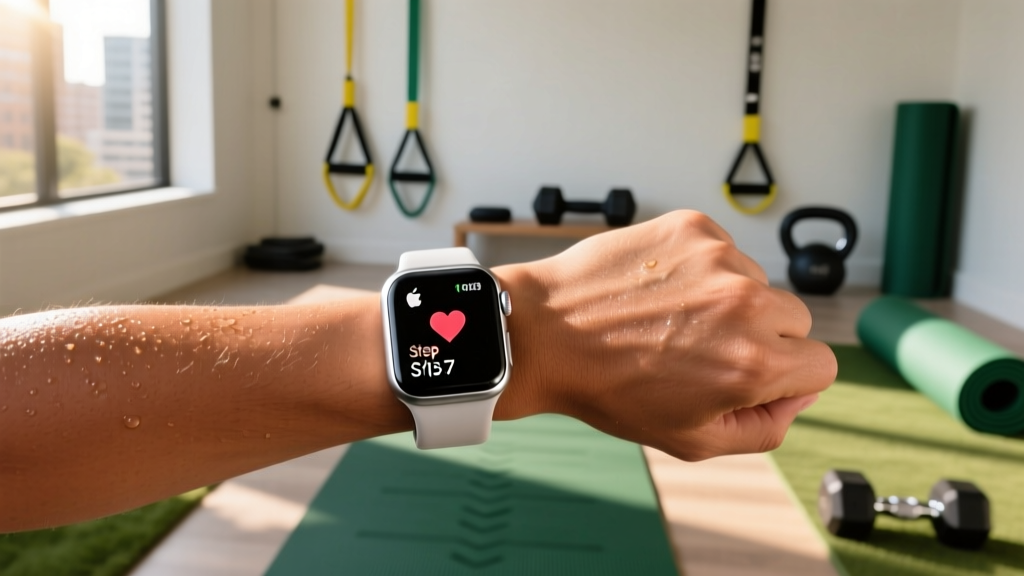
Apple Watch Series 7 Fitness Tracking: 2026 Value & Budget Guide
Is the Apple Watch Series 7 still worth it in 2026? We break down fitness tracking accuracy, refurbished pricing, and total cost of ownership.

As we navigate the 2026 wearable market, the secondary market for legacy smartwatches has exploded. For budget-conscious athletes and casual gym-goers alike, the secondary and refurbished markets offer incredible opportunities to acquire premium hardware at a fraction of the original MSRP. However, when evaluating Apple Watch Series 7 fitness tracking capabilities against modern budget alternatives like the Apple Watch SE (3rd Gen) or entry-level Garmins, the math requires a deeper look than just the upfront sticker price.
Released in 2021, the Series 7 introduced a 20% larger display, faster charging, and a robust sensor suite. But how does a five-year-old smartwatch hold up to today's rigorous fitness demands? This comprehensive budget breakdown and value analysis will help you decide if the Series 7 is a hidden gem or a depreciating liability.
💡 2026 Budget Snapshot: Series 7 Refurbished
- Average Market Price: $130 - $160 (41mm/45mm GPS models)
- Key Advantage over SE 3: Always-On Display, ECG, Blood Oxygen, Fast Charging
- Primary Risk Factor: Battery degradation (expect 75-82% maximum capacity on unrefurbished units)
- Best For: Lifters, casual runners, and sleep trackers who need an Always-On display on a strict sub-$200 budget.
Core Sensor Suite: Does the Hardware Still Compete?
The crux of any wearable purchase is sensor accuracy. The Apple Watch Series 7 utilizes Apple's 3rd-generation optical heart rate sensor, the electrical heart sensor (for ECG), and the blood oxygen sensor. According to extensive historical testing documented by The Verge's hardware evaluation, the 3rd-generation optical sensor represented a meaningful leap in accuracy over the Series 6, particularly in challenging conditions like cold weather or high-cadence cycling.
Compared to the 2026 baseline Apple Watch SE (3rd Gen), the Series 7 actually retains a distinct hardware advantage. The SE line still omits the electrical sensor required for FDA-cleared AFib history and on-demand ECGs. For athletes with a family history of cardiac issues, or those training at high altitudes where blood oxygen saturation monitoring is vital, the Series 7 offers premium health metrics that modern budget Apple watches intentionally lock behind higher paywalls.
2026 Smartwatch Comparison Matrix
To understand the true value proposition, we must place the Series 7 side-by-side with the current budget champions in the $150–$250 tier.
| Feature / Metric | Apple Watch Series 7 (Refurb) | Apple Watch SE 3 (2025) | Garmin Forerunner 165 |
|---|---|---|---|
| Current Price | $130 - $160 | $249 | $249 |
| HR Sensor Gen | 3rd Gen Optical | 3rd Gen Optical | Elevate V4 |
| GPS Architecture | Standard L1 | Standard L1 | Multi-Band (L1/L5) |
| Always-On Display | Yes (LTPO OLED) | No | Yes (AMOLED) |
| ECG & SpO2 | Yes / Yes | No / No | No / Yes |
| Battery Reality (2026) | 12-15 Hours (Degraded) | 18-24 Hours (Fresh) | 11 Days (Fresh) |
Total Cost of Ownership (TCO): The Battery Degradation Factor
The most critical mistake buyers make in the secondary smartwatch market is ignoring the Total Cost of Ownership. A lithium-ion battery degrades chemically over time. A Series 7 purchased in 2026 has likely endured hundreds of charge cycles. If you buy a used unit from a private seller on eBay or Swappa for $120, you are almost certainly looking at a battery health metric between 74% and 82%.
What does this mean for Apple Watch Series 7 fitness tracking in the real world? It means your 18-hour rated battery will realistically yield about 11 to 13 hours of mixed use. If you attempt to track a 4-hour marathon or a long gravel cycling event with GPS and Always-On display enabled, the watch will likely die before you cross the finish line.
"When budgeting for a legacy wearable, always price in a factory battery replacement. According to Apple's official out-of-warranty battery service pricing, a battery replacement for the Series 7 costs $99. Therefore, a $130 used watch is actually a $229 investment if you want reliable, all-day tracking longevity."
The Fast-Charging Lifeline for Sleep Tracking
Despite battery degradation, the Series 7 retains a massive advantage over the SE lineup: the fast-charging architecture. The Series 7 can charge from 0% to 80% in just 45 minutes using the included USB-C magnetic fast charger. This specific hardware feature makes the Series 7 vastly superior for sleep tracking. You can wear it to bed, wake up, plug it in while you shower and make coffee, and leave for work with an 80% charge. The SE models, lacking this rapid-charge hardware, require much longer dock times, often forcing users to choose between daytime tracking and nighttime sleep analysis.
Edge Cases: GPS Drift and HIIT Heart Rate Lag
No sensor is perfect, and understanding the failure modes of the Series 7 is vital for serious athletes. The Series 7 relies on standard L1 GPS. In 2026, dual-frequency (L1/L5) GPS is standard on mid-range Garmins and Apple's Ultra line. If your running routes take you through dense urban canyons (like downtown Chicago or Manhattan) or heavy forest canopy, the Series 7 will exhibit GPS drift, artificially inflating your distance and pace metrics.
Furthermore, while the 3rd-generation optical HR sensor is excellent for steady-state cardio (Zone 2 running, cycling), it exhibits a 3-to-5-second lag during High-Intensity Interval Training (HIIT) or heavy Olympic weightlifting. During rapid heart rate spikes, the optical sensor struggles to keep up with the vascular changes in your wrist. For these specific edge cases, pairing the Series 7 via Bluetooth to a Polar H10 chest strap remains the gold standard workaround.
Final Decision Framework: Who Should Buy the Series 7?
To determine if the Apple Watch Series 7 is the right allocation of your fitness budget, use this decision matrix:
- Buy the Series 7 if: You are a gym-goer, lifter, or casual runner who demands an Always-On display for mid-set metric checking, requires ECG/Blood Oxygen sensors for health peace of mind, and can secure a refurbished model with a guaranteed battery health above 85%.
- Buy the Apple Watch SE 3 instead if: You prioritize a brand-new battery, drop-resistance peace of mind, and do not care about the Always-On display or advanced cardiac metrics.
- Buy the Garmin Forerunner 165 instead if: You are a dedicated runner who trains in heavily wooded areas, despises daily charging, and values multi-band GPS accuracy and native training load metrics over smartwatch ecosystem integration.
Frequently Asked Questions
Will the Series 7 still receive watchOS updates in 2026?
Yes. Apple historically supports Apple Watch hardware with software updates for 5 to 6 years. The Series 7, powered by the S7 SiP, is expected to support the latest watchOS iterations through at least late 2026 or 2027, ensuring your fitness tracking algorithms and third-party app compatibility remain current.
Is the Blood Oxygen sensor still functional on used models?
Due to international patent disputes that emerged in 2024, Apple was forced to disable the Blood Oxygen (SpO2) sensor on newly manufactured and sold Apple Watches in certain regions, primarily the United States. However, devices manufactured and activated prior to the injunction, including all Series 7 models on the secondary market, retain fully functional SpO2 capabilities.
Does the larger 45mm Series 7 offer better battery life than the 41mm?
Physically, the 45mm chassis houses a slightly larger battery (approx. 303 mAh vs 284 mAh). However, it also powers a larger display. In real-world 2026 testing with degraded battery health, the difference in daily runtime between the two sizes is negligible—usually less than 45 minutes. Choose the size that fits your wrist and aesthetic preference rather than basing the decision on battery capacity alone.
More gear to consider
All reviews
Polar Fitness Tracker A360 vs Garmin Venu 3: Strength Training

Body Composition Scale Accuracy & Non-EMF Fitness Tracker Fixes

Lintelek Fitness Tracker App Setup: Wrist vs Chest Strap HR Guide

Apple Watch Series 9 Fitness Tracker vs 2026 Budget Picks Under $100

Apple Watch Series 8 Fitness Tracker: 2026 Budget Breakdown
