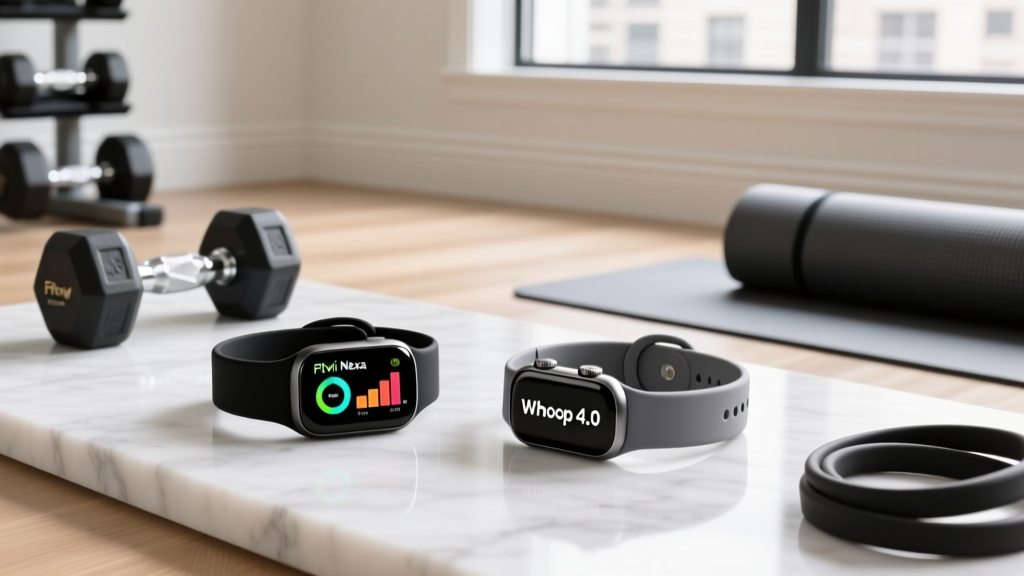
Fitvii Nexa Fitness Tracker vs Whoop 4.0 for Strength Training
We compare the budget-friendly Fitvii Nexa fitness tracker against the premium Whoop 4.0 to see which wearable tech truly wins for strength training.

The Biomechanical Challenge of Wearables in the Weight Room
Strength training presents a unique physiological and biomechanical challenge for wearable technology. Unlike the rhythmic, steady-state arm swings of running or cycling, lifting weights involves isometric holds, erratic heart rate spikes, and severe wrist flexion. When you grip a heavy barbell or dumbbell, the flexor muscles in your forearm contract intensely. This pulls the skin taut, shifts the wearable away from the radial artery, and restricts capillary blood flow. Because optical sensors (PPG) rely on light reflection to measure blood volume changes, this 'grip issue' frequently blinds wrist-based trackers.
In 2026, the fitness wearable market is sharply divided between ultra-budget standalone devices and premium, subscription-based biometric ecosystems. Today, we are putting the highly affordable Fitvii Nexa fitness tracker head-to-head against the premium Whoop 4.0 to determine which device actually delivers actionable value for the dedicated strength athlete.
⚠️ The Wrist-Flexion Blindspot: No wrist-based optical sensor on the market—including premium $800 smartwatches—can accurately read heart rate during heavy barbell gripping. If your strength program relies on heart-rate-based autoregulation, a chest strap or armband is mandatory.Fitvii Nexa Fitness Tracker: The Budget Contender
Retailing for roughly $49.99, the Fitvii Nexa fitness tracker is a darling of the budget wearable category. It features a vibrant AMOLED display, basic step tracking, SpO2 monitoring, and a standard single-path green LED optical heart rate sensor. For machine-based hypertrophy work (like leg presses, chest flys, or lat pulldowns) or moderate dumbbell movements, the Nexa performs adequately. It captures active heart rate zones and estimates caloric expenditure within a 10-15% margin of error compared to clinical-grade equipment.
Where the Fitvii Nexa Struggles
The limitations of the Fitvii Nexa become glaringly obvious during heavy compound movements. During conventional deadlifts, barbell rows, or Olympic cleans, the Nexa’s sensor frequently drops out or spikes erroneously due to the aforementioned wrist flexion and arm movement artifacts. Furthermore, the Fitvii Nexa lacks a Bluetooth antenna capable of connecting to external chest straps (like the Polar H10). You are entirely reliant on the wrist sensor, meaning your heavy lifting data will inevitably feature gaps. Additionally, the companion app provides only surface-level data—basic charts and graphs—without the advanced periodization metrics required for serious strength programming.
Whoop 4.0: The Premium Biometric Ecosystem
At the opposite end of the spectrum is the Whoop 4.0, a screenless biometric strap that operates on a subscription model (approximately $30 per month). Whoop utilizes a multi-path optical array featuring green, red, and infrared LEDs, allowing it to penetrate deeper into the tissue for more robust blood flow readings. While it still suffers from wrist-flexion dropouts during heavy gripping, Whoop solves this hardware limitation by offering a specialized, highly accurate bicep band and seamless integration with Bluetooth chest straps.
The CNS Recovery Advantage
The true value of Whoop for strength athletes lies in its continuous Heart Rate Variability (HRV) tracking. According to the Cleveland Clinic, HRV is a primary indicator of autonomic nervous system balance and systemic stress. Heavy squats and deadlifts tax the Central Nervous System (CNS) far more than steady-state cardio. Whoop’s morning recovery score analyzes your overnight HRV (specifically the RMSSD metric), respiratory rate, and skin temperature to tell you if your CNS is primed for a 1-rep max attempt, or if you should pivot to active recovery and mobility work to avoid overtraining.
Head-to-Head Specification Matrix
| Feature | Fitvii Nexa | Whoop 4.0 |
|---|---|---|
| Retail Price | $49.99 (One-time) | $30/month (Subscription) |
| HR Sensor Tech | Basic Green LED | Multi-path (Green/Red/IR) |
| HRV Tracking | No (Basic Sleep only) | Yes (Continuous RMSSD) |
| Form Factor | Wristband w/ AMOLED Screen | Screenless Fabric Strap |
| Chest Strap Sync | No | Yes (Bluetooth) |
| Battery Life | 5-7 Days | 4-5 Days (Charge-anywhere) |
Sleep Staging and Muscle Protein Synthesis
As any seasoned powerlifter or bodybuilder knows, you do not build muscle in the gym; you build it in bed. Sleep tracking is arguably the most critical feature for strength athletes monitoring their recovery.
- Fitvii Nexa Sleep Tracking: The Nexa provides basic 3-stage sleep tracking (Light, Deep, REM) based on actigraphy (movement) and basic heart rate dips. As noted by the Mayo Clinic, consumer wearables are generally reliable for tracking total sleep duration and broad sleep phases, making the Nexa a solid baseline tool to ensure you are hitting your mandatory 7-9 hours of sleep for optimal muscle protein synthesis.
- Whoop 4.0 Sleep Tracking: Whoop goes significantly deeper. It tracks respiratory rate, continuous HRV, and skin temperature deviations during sleep. This provides a granular view of systemic inflammation and recovery from the heavy micro-tears inflicted on muscle tissue during a high-volume leg day. Furthermore, the 'Whoop Journal' allows you to log specific variables like creatine intake, pre-workout consumption, magnesium supplementation, and late-night meals, correlating them directly with your next-day CNS recovery score.
The 2026 Financial Reality Check
When evaluating wearable technology for strength training, the financial commitment is drastically different between these two devices. Let us break down the real-world cost over a standard 24-month lifecycle:
Fitvii Nexa (24 Months): $49.99 upfront + $0 subscriptions = $49.99 Total
Whoop 4.0 (24 Months): $0 upfront (hardware included) + ($30 x 24 months) = $720.00 Total
For the casual lifter who hits the gym three times a week for general health and hypertrophy, spending $720 to track recovery is difficult to justify when the Fitvii Nexa fitness tracker provides adequate calorie burn estimates and basic sleep assurance for the price of a single month's gym membership. However, for competitive strength athletes, the cost of Whoop is comparable to hiring a remote conditioning coach to manage your fatigue.
Final Verdict: Which Device Belongs on Your Wrist?
The 'best' wearable for strength training is entirely dependent on your training age, goals, and budget. Both devices serve distinctly different demographics within the iron community.
Buy the Fitvii Nexa Fitness Tracker If:
- You are a recreational lifter focused on general hypertrophy, machine circuits, or CrossFit-style metcons where a screen is helpful for interval timing.
- You want a one-and-done purchase without being locked into a monthly subscription ecosystem.
- You primarily need a device to track daily step counts, active calories, and basic sleep duration to ensure you are moving enough outside the gym.
Buy the Whoop 4.0 If:
- You are a competitive powerlifter, Olympic weightlifter, or advanced bodybuilder following strict periodization blocks where CNS fatigue management dictates your daily training volume.
- You are willing to wear a chest strap or bicep band during heavy compound lifts to bypass the optical sensor grip issue.
- You want to rigorously track how your diet, supplementation, and alcohol intake impact your physical recovery and nervous system readiness.
For deeper hardware analysis and sensor teardowns of both budget and premium wearables, industry-standard testing platforms like DC Rainmaker remain an invaluable resource for verifying optical sensor accuracy under extreme physical stress. Ultimately, the Fitvii Nexa is a phenomenal budget tool for general fitness, but Whoop 4.0 remains the undisputed king of biometric recovery for the serious strength athlete.
More gear to consider
All reviews
Garmin Vivosmart 3 Fitness Tracker: Sport Care & Longevity Guide

Cloudpoem Fitness Tracker vs Budget Smartwatches: 2026 Value Analysis

Medibio Health and Fitness Tracker vs Sleep Rings 2026

Longest Battery Life Fitness Tracker vs Smartwatch Value Breakdown

Polar Fitness Tracker A360 vs Garmin Venu 3: Strength Training
