
Space-Saving Recovery: Massage Gun Stroke Length & Trigger Tools
Design the ultimate compact recovery space. We analyze how massage gun stroke length impacts storage alongside essential trigger point tools.

Designing an efficient home recovery zone in 2026 requires balancing high-tech percussive devices with low-tech manual implements. When square footage is at a premium, understanding the physical footprint of your equipment is just as critical as understanding its biomechanical benefits. One of the most overlooked spatial factors in percussive therapy is massage gun stroke length—the exact distance the attachment head travels back and forth. This mechanical specification not only dictates the depth of tissue penetration but also directly determines the size of the internal motor housing, the weight of the device, and ultimately, the storage layout of your recovery space.
Conversely, manual trigger point therapy tools and balls offer targeted myofascial release with a fraction of the spatial footprint. According to the Mayo Clinic, applying sustained pressure to myofascial trigger points is a foundational method for relieving chronic muscle tension. By strategically integrating both modalities, you can build a highly effective, space-optimized recovery nook. Here is how to design your layout based on the physics of your gear.
The Physics of Percussion: How Stroke Length Dictates Storage
Stroke length (or amplitude) is the defining characteristic that separates a superficial warm-up tool from a deep-tissue recovery device. In the current market, percussive guns generally fall into two amplitude categories: 10mm to 12mm for surface-level blood flow, and 14mm to 16mm for deep fascial manipulation.
From a spatial design perspective, accommodating a 16mm stroke length requires significant layout planning. To achieve a 16mm amplitude without stalling under heavy pressure, manufacturers must install a larger, heavier brushless motor and a longer internal crankshaft. For example, a professional-grade 16mm device like the Theragun PRO weighs approximately 2.8 pounds and requires a carrying case measuring roughly 11 x 9 x 3 inches. In contrast, a 10mm stroke device like the Theragun Mini utilizes a compact micro-motor, weighing just 1.1 pounds with a footprint closer to 6 x 5 x 2 inches.
Spatial Rule of Thumb: Every 4mm increase in massage gun stroke length increases the required motor housing volume by roughly 35%. If your recovery space features shallow shelving (under 8 inches deep), you must either wall-mount your 16mm devices or rely on 10mm compact guns paired with manual trigger tools for deep work.Zoning the 4x4 Recovery Nook: The 'Reach vs. Roll' Layout
When designing a compact 4-foot by 4-foot recovery corner, you must divide the space into two distinct operational zones: the 'Reach Zone' for percussive and lever-based tools, and the 'Roll Zone' for floor-based spherical tools.
1. The Reach Zone (Vertical Storage)
Percussive guns and long-handled trigger point hooks require vertical clearance. Install a metal pegboard system, such as the Wall Control 32-WGL-200GVB (approx. $45), on the primary wall. Use heavy-duty steel hooks rated for at least 5 pounds to hold 16mm stroke guns by their ergonomic handles. This keeps the charging docks clear on the floating shelf below and prevents the delicate attachment heads from being crushed in a drawer.
2. The Roll Zone (Floor and Low-Drawer Storage)
Trigger point balls, peanuts, and short rollers do not require vertical swing space. Dedicate a shallow, 16-inch deep floating shelf or a multi-drawer rolling cart (like the IKEA RÅSKOG, $39.99) to these items. Because tools like lacrosse balls and cork spheres roll unpredictably, use silicone drawer dividers or small EVA foam bins to corral them, ensuring your floor space remains clear for actual stretching and rolling.
Essential Trigger Point Tools for Compact Layouts
To compensate for the spatial limitations of large 16mm percussive guns, a well-designed recovery space relies on specialized manual tools that offer deep tissue access without the bulky motor housing. Research highlighted by Examine.com confirms that localized pressure application effectively reduces delayed onset muscle soreness (DOMS) by modulating pain receptors and increasing local circulation.
- The TheraCane ($39.95): Measuring 24 inches long and weighing 1.5 pounds, this fiberglass cane features multiple trigger point knobs. Its hooked design allows you to apply up to 40 pounds of leverage to the rhomboids and levator scapulae. Storage: Hang vertically on the outer edge of your pegboard.
- Armaid Sport ($34.95): A 14-inch adjustable lever tool designed specifically for forearm and brachioradialis trigger points. It folds down to a 7-inch footprint, making it perfect for shallow drawers.
- 5BILLION Peanut Roller ($12.99): At 5 inches long, this dual-sphere EVA foam tool is engineered to straddle the spine, targeting the erector spinae without pressing on the vertebrae. Storage: Small basket on the lowest shelf.
- Kiefer Creek Cork Massage Ball ($14.99): A 2.5-inch solid cork sphere. Unlike rubber lacrosse balls that can slip on hardwood floors, cork provides high-friction grip, allowing for precise, sustained pressure on the gluteus medius or plantar fascia.
Comparison Matrix: Percussive Guns vs. Manual Trigger Tools
| Feature | 16mm Stroke Percussive Gun | Manual Trigger Tools (Balls/Canes) |
|---|---|---|
| Average Cost | $350 - $599 | $10 - $45 |
| Storage Footprint | Large (Requires 9x11 inch case/dock) | Minimal (Fits in palm or shallow drawer) |
| Deep Tissue Access | Excellent (Motor-driven 16mm amplitude) | Variable (Depends on user leverage/strength) |
| Spinal Safety | High Risk (Avoid direct bone contact) | Safe (Peanut tools straddle the spine) |
| Power Requirement | Lithium-ion battery (Requires charging zone) | None (100% mechanical) |
Expert Troubleshooting: When Stroke Length Fails the Trigger Point
A common mistake in modern recovery spaces is over-relying on high-amplitude percussive guns for highly specific, superficial trigger points. While a 16mm stroke length is phenomenal for flushing lactic acid from the quadriceps or breaking up dense adhesions in the hamstring, it is often the wrong tool for delicate areas.
Consider the suboccipital muscles at the base of the skull or the intricate trigger points along the sternocleidomastoid (SCM) in the neck. Applying a 16mm percussive stroke to these areas can easily bruise superficial nerves or cause micro-trauma to the cervical fascia. In these edge cases, the spatial layout of your recovery room should force you to put the massage gun down and pick up a manual tool.
'Percussive amplitude is a blunt instrument. When targeting a trigger point the size of a pea near a major nerve cluster, the precision of a $15 cork ball or the controlled leverage of a TheraCane is biomechanically superior to a 16mm motorized stroke.' — Sports Biomechanics Principle
Step-by-Step: The Hybrid Release Protocol
- Flush (Percussive): Use a 10mm or 16mm stroke gun with a dampener attachment on a low setting (1750 RPM) for 60 seconds over the general muscle belly to increase local blood flow.
- Isolate (Manual): Transition to a lacrosse ball or cork sphere. Pin the tool against a wall or the floor directly over the palpable trigger point nodule.
- Sustain (Time-under-tension): Apply 60% of your maximum tolerable pressure and hold statically for 45 to 90 seconds. Do not roll. Wait for the Golgi tendon organ reflex to signal the muscle spindle to release.
- Stretch (Mobility): Immediately follow the release with a 30-second active stretch of the targeted muscle fiber.
Final Layout Recommendations for 2026
Optimizing your recovery space is not about hiding your equipment; it is about arranging it in a way that encourages proper usage sequencing. Place your charging docks for 16mm stroke massage guns on a waist-high floating shelf to prevent bending and dropping. Mount your TheraCane and Armaid on a vertical pegboard directly adjacent to the shelf. Finally, keep your trigger point balls and peanuts in an open-top, divided tray on the lowest shelf or a rolling cart, ensuring they are immediately accessible when you drop to the floor for targeted myofascial release. By respecting the physical dimensions dictated by massage gun stroke length and embracing the compact efficiency of manual tools, you can transform even the smallest spare room into a world-class recovery sanctuary.
More gear to consider
All reviews
Tyiaus Massage Gun vs Theragun: 2026 Budget Recovery Showdown

Infrared Sauna Blankets & Trakk Hot and Cold Massage Gun Guide

Theragun vs Hyperice vs Profit Elite Massage Gun: 2026 Space Guide
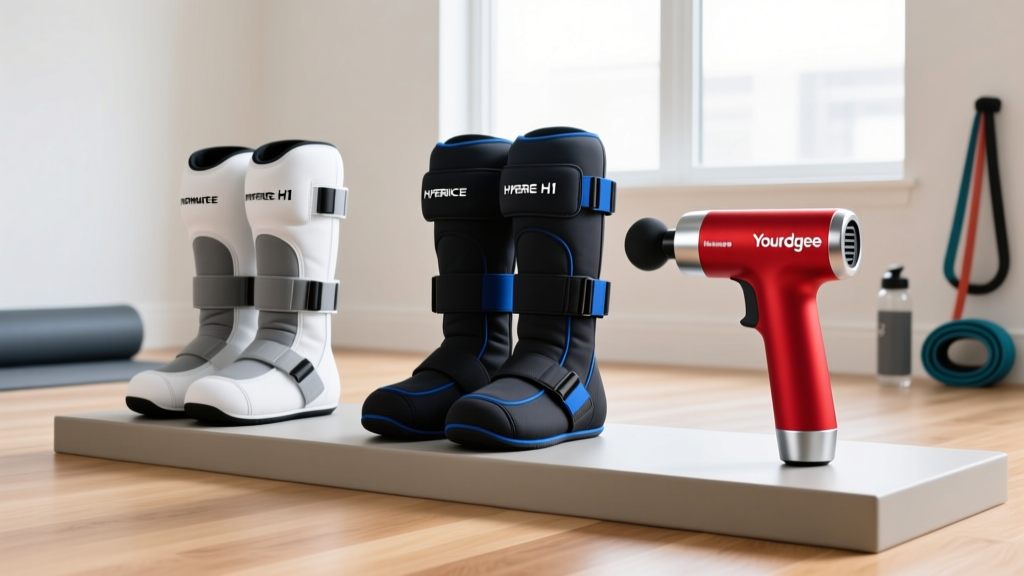
Normatec vs Hyperice Boots vs Youdgee Massage Gun 2026

Heat Pad vs Wrap Troubleshooting & Massage Gun Tips and Uses
