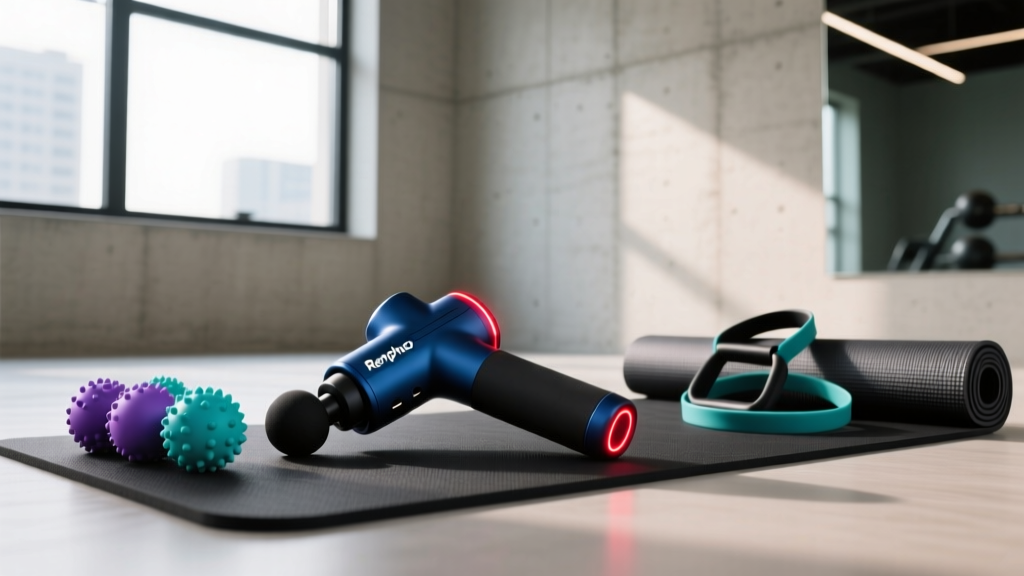
Massage Gun Head Uses With Stretching Equipment For Flexibility
Discover the best massage gun head uses to pair with stretching equipment. Maximize flexibility and ROM with our expert percussive therapy guide.

The Neurological Bridge: Percussive Therapy Meets Mechanical Stretching
In the modern recovery landscape of 2026, achieving elite flexibility requires more than just passive holding. The integration of percussive therapy devices—like the $599 Theragun PRO Plus or the $399 Hyperice Hypervolt 2 Pro—with dedicated stretching equipment has revolutionized how athletes and physical therapists approach range of motion (ROM). Understanding the specific massage gun head uses in conjunction with tools like mechanical leg stretchers, PNF (Proprioceptive Neuromuscular Facilitation) straps, and inversion tables is the key to unlocking deep fascial release and neurological relaxation.
According to the American Council on Exercise (ACE), targeted myofascial release helps stimulate the Golgi tendon organ, triggering autogenic inhibition. This neurological reflex essentially tells your muscle to relax, overriding the stretch reflex that normally limits your flexibility. When you apply the correct percussive attachment to a muscle belly immediately before strapping into a stretching machine, you can safely increase your ROM by 10% to 15% in a single session.
Decoding Massage Gun Head Uses for Pre-Stretch Prep
Not all attachments are created equal. Using a hard plastic cone head on a sensitive muscle belly before an intense stretch can cause micro-trauma and defensive guarding. Here is how to select the right attachment for your flexibility tools.
The Dampener Head: Protecting Bony Landmarks
The dampener (or soft-cushion) head is your best friend when working near joints. If you are using a doorway stretch strap like the Tumbl Trak Stretch Strap ($35) to open up your pectorals, the anterior deltoid and clavicle area are highly vulnerable. The dampener head provides a softer impact, allowing you to safely treat the pec major insertion points at 1750 RPM for 45 seconds without bruising the sternum or collarbone.
The Large Ball Head: Sweeping Fascial Planes
For large muscle groups like the hamstrings, glutes, and quadriceps, the standard EVA foam large ball head is mandatory. Before loading your leg into a mechanical stretcher like the Century VersaFlex ($149), use the large ball head to perform broad, sweeping passes along the muscle grain. This increases local blood flow and warms the fascia, making the tissue more pliable for the mechanical tension to follow.
The Fork / U-Shape Head: Paraspinal Targeting
The fork attachment is specifically engineered to straddle the spine. If your flexibility routine involves an inversion table like the Teeter FitSpine X3 ($399), using the fork head on your erector spinae muscles prior to inversion helps decompress the thoracolumbar fascia, allowing for a deeper, safer spinal stretch once you tip upside down.
Equipment-to-Attachment Matrix
To eliminate guesswork, we have developed this quick-reference matrix mapping common stretching equipment to the optimal percussive attachment, RPM setting, and application time.
| Stretching Equipment | Target Muscle Group | Ideal Massage Gun Head | Recommended RPM | Pre-Stretch Duration |
|---|---|---|---|---|
| Mechanical Leg Stretcher (e.g., Century VersaFlex) | Hamstrings & Adductors | Large Ball (EVA Foam) | 1750 - 2100 RPM | 60 sec per leg |
| Slant Board / Calf Stretcher | Gastrocnemius & Soleus | Dampener or Flat Head | 1750 RPM | 45 sec per calf |
| Inversion Table (e.g., Teeter) | Spinal Erectors & Lats | Fork / U-Shape Head | 2100 RPM | 90 sec total back |
| Doorway PNF Stretch Strap | Pectorals & Anterior Delt | Dampener (Soft Cushion) | 1750 RPM | 30 sec per side |
| Yoga Block (for Hip Flexor PNF) | Psoas & Rectus Femoris | Thumb / Wedge Head | 2400 RPM | 45 sec per hip |
Step-by-Step Integration Protocols
Protocol 1: The Hamstring & Mechanical Leg Stretcher Synergy
- Locate the Trigger Point: While seated, palpate the mid-belly of your hamstring. Identify the densest knot or fascial adhesion.
- Percussive Application: Attach the Large Ball head to your Theragun or Hyperice. Set the device to 2100 RPM. Apply moderate pressure directly to the adhesion for 15 seconds, then sweep proximally and distally for 45 seconds.
- Immediate Loading: Within 30 seconds of finishing the percussive therapy, strap your leg into the mechanical leg stretcher.
- Contract-Relax PNF: Pull the lever to your first point of tension. Contract your hamstring against the machine for 5 seconds, relax, and pull the lever one notch further. Repeat 3 times.
Protocol 2: Spinal Decompression via Inversion Table
Spinal flexibility and decompression require careful handling of the paraspinal muscles. The Mayo Clinic emphasizes that stretching the back requires controlled, supported movements to avoid ligament strain.
- Fork Attachment Setup: Equip the U-shape fork head. Set amplitude to a lower setting (12mm-16mm) and speed to 1750 RPM.
- Straddle the Spine: Run the fork head vertically along the left and right erector spinae, from the base of the skull down to the sacrum. Never apply the fork directly over the spinous processes (the bony bumps of the vertebrae).
- Inversion Phase: Secure your ankles in the inversion table. Invert to a 45-degree angle for 2 minutes, allowing gravity to stretch the now-relaxed fascial planes.
Edge Cases and Contraindications
Expert Warning: Never use the Bullet/Cone head attachment on the Iliotibial (IT) Band prior to using a foam roller or stretching strap. The IT band is a thick fascial tract, not a muscle. High-frequency, pinpoint percussive therapy on the IT band can inflame the underlying bursa and exacerbate IT band syndrome. Stick to the Dampener head on the surrounding TFL and gluteus medius muscles instead.
Furthermore, individuals with hypermobility spectrum disorders (such as Ehlers-Danlos Syndrome) should consult a physical therapist before combining percussive therapy with mechanical stretching. As noted by the Cleveland Clinic, joint stability is just as crucial as flexibility; overly relaxing the muscle spindles with a massage gun before applying mechanical leverage can lead to joint subluxation or capsular strain.
Frequently Asked Questions
Can I use the massage gun while actively strapped into the stretching equipment?
Yes, but with caution. This is known as 'concurrent percussive stretching.' If you are locked into a leg stretcher, you can use the Dampener head on low speed (1750 RPM) to gently tap the belly of the stretching muscle. This further fatigues the stretch reflex, allowing for a deeper stretch. However, avoid using high-amplitude devices (like the Theragun PRO's 16mm amplitude) while under heavy mechanical tension, as the combined force can cause muscle cramping.
Which is better for flexibility: using the massage gun before or after stretching?
Both serve distinct purposes. Use the massage gun before stretching to down-regulate the nervous system, increase tissue temperature, and prep the fascia for elongation. Use it after stretching (specifically with the Flat or Wedge head) to flush metabolic waste, realign the newly stretched fascial fibers, and reduce delayed onset muscle soreness (DOMS).
Do cheaper massage guns work with these stretching protocols?
Budget percussive devices (under $100) often lack the amplitude (stall force and depth) required to reach deep fascial layers like the soleus or psoas. For mechanical stretching synergy, you need a device with at least 12mm of amplitude and a stall force of 40+ lbs to prevent the motor from dying when you apply pressure against a stretching strap. Mid-tier options like the Bob and Brad Q2 ($99) offer decent utility, but premium models remain the gold standard for clinical flexibility protocols.
More gear to consider
All reviews
Ice Bath Maintenance: Cold Plunge Care & Massage Guns for Cellulite

Your Body's Flash Drive Recovery Tool: Infrared Sauna Blanket Guide

Compression Boot Setup & Massage Gun Fingering Techniques for Deep Recovery
Ekrin Athletics Kestrel Massage Gun vs. Pro Rivals (2026)

Foam Roller Size Guide: Space Layouts & Renpho Massage Gun RP GM171