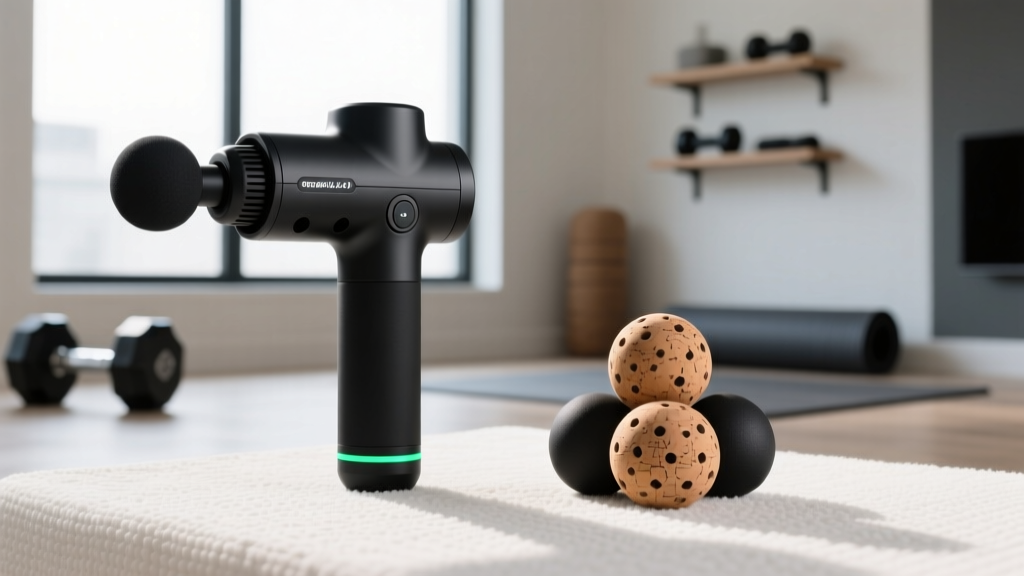
Massage Gun Disadvantages vs Trigger Point Balls: Value Analysis
We analyze massage gun disadvantages versus trigger point balls, comparing hidden costs, battery failure modes, and ROI for your recovery budget.

When building a comprehensive recovery toolkit, athletes and weekend warriors alike often face a critical financial crossroads: should you invest hundreds of dollars into high-end percussive therapy devices, or allocate your budget toward manual trigger point therapy tools and balls? While the marketing behind flagship percussive devices is undeniably compelling, a rigorous financial and biomechanical analysis reveals a different story. In this guide, we break down the true cost of ownership, explore the most prominent massage gun disadvantages, and demonstrate why manual trigger point tools often deliver a vastly superior return on investment (ROI) for targeted myofascial release.
Unpacking Massage Gun Disadvantages: Beyond the Upfront Price
When evaluating massage gun disadvantages, the financial and biomechanical limitations become glaringly apparent once you look past the initial unboxing. Flagship models like the Theragun PRO Plus ($599) or the Hyperice Hypervolt 2 ($249) represent a massive upfront capital expenditure. However, the hidden costs of percussive technology are where the budget truly suffers.
⚠️ The Lithium-Ion Degradation FactorMost premium percussive devices rely on internal 18650 lithium-ion battery cells. These cells begin experiencing measurable capacity degradation after 300 to 500 full charge cycles. If you use your device daily for post-workout recovery, you will hit this threshold in under 18 months. Because manufacturers tightly integrate these batteries to maintain sleek housings, replacing a degraded battery often costs between $80 and $150, and frequently requires proprietary pentalobe screwdrivers and technical expertise. Furthermore, losing the proprietary charging cable (which costs $45-$60 to replace) renders a $500 device completely useless.
Beyond the financial drain, there are distinct physical disadvantages. A device like the Theragun PRO weighs 2.8 pounds. Attempting to self-administer percussive therapy to the thoracic spine, posterior deltoids, or quadratus lumborum (QL) requires awkward shoulder contortions that often induce secondary grip and rotator cuff fatigue. According to recovery experts at the Cleveland Clinic, while percussive therapy is excellent for transient neurological down-regulation and increasing local blood flow, it cannot physically break down deep, chronic fascial adhesions the way sustained manual pressure can.
The Trigger Point Arsenal: Budget Breakdown & Value Matrix
Trigger point balls and manual leverage tools operate on the principle of ischemic compression. By applying sustained, targeted pressure to a myofascial trigger point for 45 to 90 seconds, you restrict local blood flow temporarily. Upon release, a reactive hyperemia occurs, flushing the area with oxygenated blood and forcing the Golgi tendon organ to reset the muscle's resting tension. This biomechanical response costs a fraction of percussive technology and requires zero electricity.
| Tool / Device | Avg. Price (2026) | Lifespan & Maintenance | Best Target Area | Value Score |
|---|---|---|---|---|
| Standard Lacrosse Ball | $6.00 | 5+ Years / Zero | Glutes, Piriformis, T-Spine | 10/10 |
| TheraCane Massager | $39.95 | Lifetime / Zero | Levator Scapulae, Rhomboids | 9/10 |
| RAD Helix / RAD Roller | $85.00 | 10+ Years / Wipe clean | Spinal Erectors, Calves | 8.5/10 |
| 5BILLION Dual Peanut Ball | $24.99 | 3-5 Years / Wipe clean | Suboccipitals, Cervical Spine | 9.5/10 |
| Flagship Massage Gun | $249 - $599 | 2-4 Years / Battery swaps | Quads, Lats, Hamstrings | 5/10 |
As highlighted by the Mayo Clinic's research on myofascial release, tools that allow for sustained, localized pressure are often more effective for chronic knot resolution than broad, vibrating modalities. A $6 lacrosse ball (Shore A 90 durometer) provides unyielding feedback that forces the central nervous system to release deep piriformis trigger points—a feat a $600 massage gun cannot safely achieve without risking sciatic nerve irritation.
Ischemic Compression vs. Neurological Gating
To truly understand the value proposition, you must understand the biophysics. Massage guns operate at frequencies between 30Hz and 40Hz. This rapid percussive stimulus overwhelms the brain's pain receptors via the Gate Control Theory of pain, providing immediate, albeit temporary, relief. It masks the pain but does not necessarily alter the structural integrity of a dense fascial adhesion. Conversely, a manual trigger point tool like the TheraCane allows you to apply exact, sustained pressure (ischemic compression) directly into a localized nodule, physically encouraging the sarcomeres to unlock. For athletes dealing with chronic, recurring knots, the manual tool offers a structural fix, whereas the massage gun offers a temporary neurological distraction.
Hidden Failure Modes of Percussive Devices
When calculating your recovery budget, you must account for the mechanical failure modes inherent to motorized devices. Budget-tier massage guns (often priced between $49 and $99) suffer from severe stalling issues. If you apply more than 20 to 30 pounds of pressure, the internal motor's torque is overwhelmed, and the device halts. To get genuine deep-tissue penetration without stalling, you are forced into the premium tier ($300+).
"The true cost of a massage gun isn't just the retail price; it's the planned obsolescence of the battery and the proprietary nature of the chargers. A solid piece of injection-molded plastic or vulcanized rubber will outlive your fitness career."
— Biomechanics & Recovery Equipment Analysis, FitGearPulse Labs
Furthermore, percussive devices carry a distinct risk of user error. Striking a bony prominence like the spine of the scapula or the tibial tuberosity with a hard plastic attachment moving at 2,400 percussions per minute can cause micro-fractures or severe periosteal bruising. Trigger point balls, by contrast, offer real-time somatosensory feedback; if you press too hard into a bone, your body's natural pain reflex forces you to adjust immediately, making manual tools inherently safer for unsupervised home use.
The Optimal Recovery Budget: A Decision Framework
If you have a $150 budget to optimize your recovery protocol in 2026, do not spend it on a mid-tier, no-name massage gun that will stall under pressure and die in a year. Instead, use this step-by-step framework to build an elite, maintenance-free manual trigger point kit:
- Step 1: The Foundation ($6) - Purchase a standard rubber lacrosse ball. Use it against a wall for broad T-spine mobilization and deep gluteal release.
- Step 2: Cervical & Suboccipital Care ($25) - Invest in a firm silicone peanut ball (dual-sphere). The center gap cradles the cervical spine safely, allowing you to target the suboccipital muscles at the base of the skull, which are notorious for causing tension headaches.
- Step 3: Leverage & Reach ($40) - Buy a TheraCane or a similarly shaped fiberglass hook tool. This provides the mechanical leverage needed to dig into the medial border of the scapula and the upper traps without straining your hands or wrists.
- Step 4: Spinal Erector Isolation ($79) - Add the RAD Helix or a specialized grooved foam roller. The dual-tube design allows you to pin down the paraspinal muscles while leaving the spinous processes completely uncompressed.
Total investment: $150. This kit covers every square inch of the human body, requires zero charging, will never suffer a motor burnout, and provides the sustained ischemic pressure required to actually remodel chronic fascial adhesions.
Frequently Asked Questions
Can a trigger point ball replace a massage gun entirely?
For localized, chronic trigger points and deep fascial adhesions, yes. However, massage guns still hold an advantage for broad, pre-workout neurological priming and flushing large muscle groups (like the quadriceps) immediately after high-volume endurance events. If budget allows, a cheap, basic percussive device paired with a high-quality manual toolkit is the ultimate hybrid approach.
How hard should I press with a lacrosse ball?
Aim for a 7 out of 10 on your personal pain scale. According to guidelines from the American Council on Exercise (ACE), you should feel a 'good hurt'—a deep, dull ache. If you are holding your breath, gritting your teeth, or experiencing sharp, shooting nerve pain, you are pressing too hard or have rolled directly onto a nerve bundle. Breathe deeply and hold the pressure for 60 to 90 seconds to allow the autonomic nervous system to down-regulate the muscle spindle.
Are heated trigger point tools worth the extra cost?
Generally, no. While heat therapy is excellent for increasing tissue elasticity, integrating heating elements into small massage balls requires internal wiring and batteries, reintroducing the exact same failure modes, weight issues, and high price tags found in massage guns. It is far more cost-effective to use a standard $6 lacrosse ball and take a hot shower beforehand to naturally raise your core tissue temperature.
More gear to consider
All reviews
Budget Breakdown: Home Ice Bath vs Therabody Mini Massage Gun Value

Theragun vs Hyperice: Who Makes a Sharper Massage Gun in 2026?

Home Flexibility Rig Setup: Do Massage Guns Actually Work With It?

Cupping for Athletes vs. Massage Gun for Hamstrings: Value Analysis

Beyond the Massage Gun Video: Trigger Point Tool Maintenance
