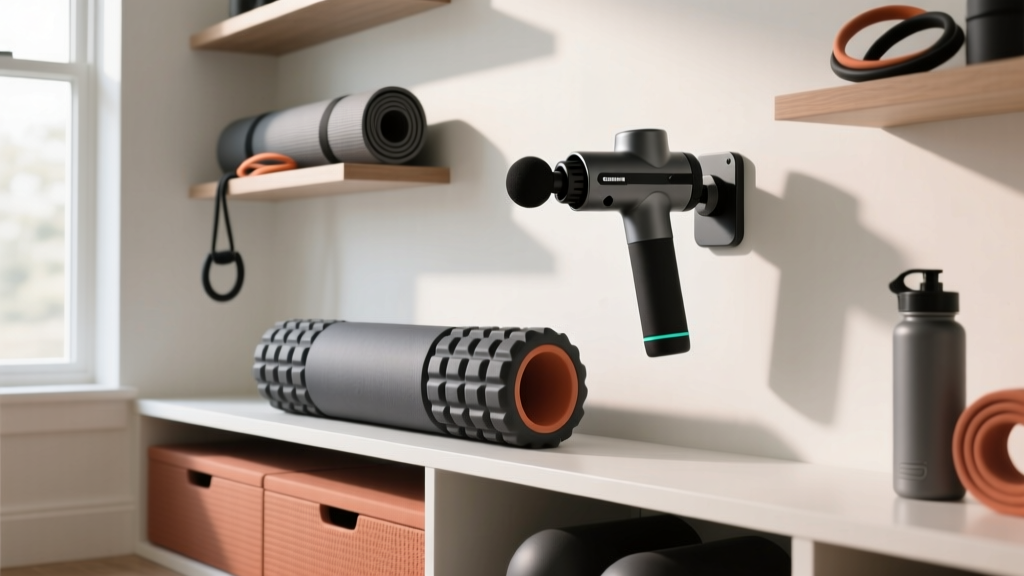
Foam Roller Density Guide & Flyby Massage Gun Space-Saving Setup
Optimize your home recovery zone. Explore our foam roller density and size guide, plus spatial layouts for pairing rollers with a Flyby massage gun.

Designing the Micro-Recovery Zone
As urban living spaces shrink and home gym footprints become increasingly constrained in 2026, the art of spatial optimization has become just as critical as the recovery modalities themselves. Building an effective myofascial release station does not require a dedicated 10x10 room; it requires a strategic understanding of equipment dimensions, material densities, and vertical storage mechanics. This guide bridges the gap between clinical recovery science and interior layout design, providing a definitive foam roller types density and size guide while demonstrating how to seamlessly integrate a compact percussive device like the flyby massage gun into a high-density living environment.
When curating a recovery corner, the primary objective is to maximize the therapeutic surface area while minimizing the spatial footprint. Misjudging the density or dimensions of your foam rollers can lead to material degradation in tight storage spaces, while poorly planned percussive therapy layouts result in cluttered, unusable zones. By treating your recovery tools as modular architectural elements, you can create a highly efficient, professional-grade myofascial release hub in as little as 4 square feet.
The Foam Roller Matrix: Density, Size, and Spatial Footprint
Selecting the right foam roller is traditionally viewed through the lens of tissue tolerance and pain thresholds. However, from a space optimization perspective, the dimensions and core materials dictate how the tool behaves in storage. A standard 36-inch roller, while excellent for longitudinal spinal alignment, is a spatial liability in a micro-apartment, often ending up shoved under a bed where it collects dust and warps. Below is a comprehensive breakdown of how size and density intersect with spatial design.
| Roller Type & Dimensions | Density & Material | Spatial Footprint & Storage | Best Use Case | Avg. Cost (2026) |
|---|---|---|---|---|
| Standard 36" x 6" | Low (EVA Foam, ~30 kg/m³) | High. Requires 38" horizontal clearance. Prone to warping if stored vertically. | Full back extension, Pilates. | $25 - $35 |
| Mid-Size 13" x 5.5" (e.g., TriggerPoint GRID) | Medium (EPP/EVA Blend, ~40 kg/m³) | Low. Fits vertically in standard 15" closet gaps or deep drawers. | IT band, quads, lats, travel. | $35 - $45 |
| Travel 4" x 3" | High (Solid TPU/EPP, ~60 kg/m³) | Minimal. Fits in gym bag side pockets or wall-mounted pegboards. | Targeted trigger point, calves. | $15 - $25 |
| Aggressive 13" (e.g., RumbleRoller) | Extra Firm (High-Density EPP, ~50 kg/m³) | Low. Heavy but structurally indestructible; can bear weight in storage. | Deep tissue, thick muscle bellies. | $65 - $75 |
Material Science: EPP vs. EVA in High-Humidity Apartments
When storing recovery equipment in tight, poorly ventilated spaces—such as a bathroom-adjacent closet or an under-bed bin in a humid climate—the material composition of your roller dictates its lifespan. Ethylene-vinyl acetate (EVA) foam, commonly used in low-density, soft rollers, is highly susceptible to compression set and moisture absorption. If an EVA roller is stored horizontally with heavy gym plates or winter blankets stacked on top, it will permanently flatten within 4 to 6 months.
Conversely, Expanded Polypropylene (EPP) is a closed-cell foam that resists moisture and boasts a high compression recovery rate. For space-constrained environments where vertical stacking is unavoidable, an EPP-core roller is mandatory. According to research published in the Journal of Sports Science & Medicine, maintaining the structural integrity of myofascial tools is vital for consistent pressure application; a warped roller fails to provide the necessary mechanical load to stimulate the Golgi tendon organs effectively.
Integrating the Flyby Massage Gun into Compact Layouts
Percussive therapy and foam rolling are highly synergistic. While rollers provide broad, sweeping myofascial release, percussive devices target deep, localized motor points. The challenge in small spaces is storing the device, its attachments, and charging cables without creating visual clutter. This is where the flyby massage gun excels as a spatial asset.
Space-Saving Profile: Flyby F1 ProUnlike bulkier, top-heavy percussive models that require dedicated shelving, the flyby massage gun features a compact, T-shaped ergonomic chassis weighing approximately 1.5 lbs. Its included hard-shell carrying case measures roughly 8 x 6 x 3 inches. This specific footprint allows the entire kit (gun, 4 attachments, USB-C cable) to slide perfectly into the top drawer of a standard 3-tier metal utility cart or mount flush against a slatwall panel using heavy-duty velcro strips.
To optimize the spatial workflow, pair a 13-inch EPP foam roller with the flyby massage gun in a 'Roll-and-Percuss' sequence. Use the roller for 60 seconds of broad tissue flushing on the quadriceps, then immediately deploy the flyby massage gun with the bullet attachment for 30 seconds of targeted 15mm-amplitude strikes on the rectus femoris trigger points. Keeping both tools within arm's reach in a unified vertical storage column eliminates the friction of transitioning between modalities.
The 4x4 Foot Recovery Blueprint: Step-by-Step Workflow
Designing a functional recovery zone in a micro-apartment requires leveraging verticality and mobile storage. The following blueprint utilizes a standard 3-tier rolling utility cart (dimensions: 13.75 x 17.75 x 30.5 inches) to create a fully mobile, high-density recovery station.
- Top Tier (The Percussive & Precision Zone): Store the flyby massage gun, its charging dock, a lacrosse ball, and a cork massage ball. This tier remains at waist height, allowing for easy access to fine-tuned tools immediately after a workout.
- Middle Tier (The Myofascial Core): Place your 13-inch EPP foam roller horizontally. Because the cart is 17.75 inches wide, a 13-inch roller fits perfectly with 2 inches of clearance on either side, preventing it from rolling off during transit. Include a collapsible massage stick for seated calf work.
- Bottom Tier (The Foundation): Store a 4mm high-density yoga mat (rolled tightly) and a set of resistance bands. The mat provides the necessary floor buffer for your rolling sessions, protecting both your hardwood floors and the roller's exterior texture from abrasive dust.
'The integration of localized percussive therapy with broad myofascial rolling yields superior acute improvements in range of motion compared to either modality alone, provided the transition between tools is seamless and immediate.' — Insights adapted from the National Academy of Sports Medicine (NASM) Corrective Exercise protocols.
Storage Failures: Warping, Degradation, and Edge Cases
Even the most meticulously planned recovery layouts can fail if environmental edge cases are ignored. When optimizing for space, recovery enthusiasts frequently make critical errors that degrade their expensive equipment. Avoid the following spatial and storage failures:
- The Under-Bed Compression Trap: Storing soft EVA foam rollers under a bed frame where they are subjected to the weight of seasonal storage bins. The continuous static load causes the cellular structure of the foam to collapse, resulting in a flat spot that creates painful friction burns during use.
- UV Degradation on Balconies: In small apartments, overflow storage often ends up on balconies or near large, un-tinted windows. Prolonged UV exposure breaks down the polymers in both EPP foam rollers and the ABS plastic shells of budget percussive devices, leading to chalky, brittle surfaces that crack under body weight.
- Battery Atrophy in Deep Drawers: Tossing a percussive device into the back of a deep drawer without a dedicated charging routine. Lithium-ion batteries in compact massage guns will degrade permanently if left at 0% charge in a dark drawer for more than 3 months. Always store the flyby massage gun at a 50% charge if it will not be used for extended periods, and utilize a magnetic USB-C charging cable on the side of your metal utility cart for passive top-ups.
- Vertical Tension Warping: Hanging foam rollers by a single paracord loop on a wall hook. Over 12 to 18 months, gravity will pull the foam downward, stretching the core and creating an uneven, oval-shaped roller that wobbles during spinal extensions.
Expert References and Further Reading
For further exploration into the physiological benefits of myofascial release and massage therapy, consult the following authoritative resources:
- Foam Rolling as a Recovery Tool After Exercise: Effects and Mechanisms - National Center for Biotechnology Information (NCBI).
- Massage Therapy: Relieving Stress, Pain and Tension - Mayo Clinic.
By treating your recovery equipment not just as clinical tools, but as modular components of your living space, you ensure consistent adherence to your mobility routines. The combination of a space-efficient 13-inch EPP roller and a highly storable flyby massage gun provides a complete, professional-grade tissue therapy suite that respects the boundaries of modern, compact living.
More gear to consider
All reviews
Rally Massage Gun vs Compression Boots: 2026 Recovery System Guide

Theragun vs Hyperice 2026: Market Data & Hyperice Massage Gun How to Turn On

Normatec vs Hyperice Boots: Can You Use a Massage Gun on Your Feet?

Theragun vs Hyperice vs Profit Elite Massage Gun: 2026 Space Guide

Normatec 3 vs Hidow Massage Gun: 2026 Recovery Comparison
