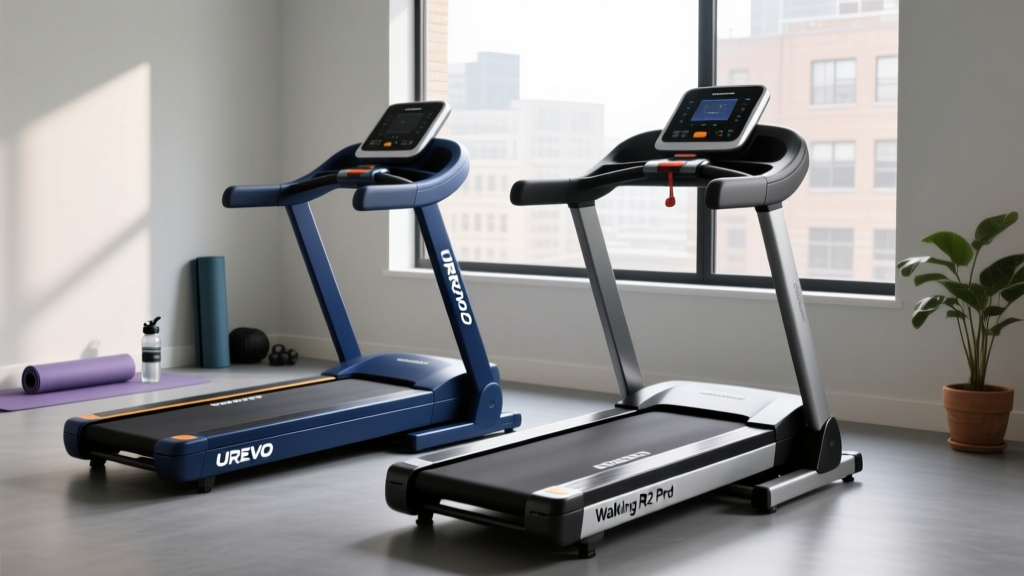
Walking Pad Comparison & Treadmill Financing No Credit Check
Compare the UREVO Strol 2E and WalkingPad R2 Pro in our head-to-head review, plus a guide to treadmill financing no credit check options.

The 2026 Walking Pad Head-to-Head: UREVO Strol 2E vs. WalkingPad R2 Pro
The shift to permanent hybrid work models has cemented the walking pad as an essential piece of home office equipment. According to the CDC physical activity guidelines, adults need at least 150 minutes of moderate-intensity activity weekly, a metric easily achieved by integrating low-impact stepping into your workday. However, choosing the right machine requires navigating a minefield of inflated motor specs and fragile folding hinges.
In this head-to-head comparison, we are putting the UREVO Strol 2E and the WalkingPad R2 Pro to the test. Both dominate the under-desk and compact treadmill market, but they cater to vastly different biomechanical needs and spatial constraints. Furthermore, with premium models now pushing the $600 mark, we will break down exactly how to secure treadmill financing no credit check options without falling prey to predatory lease-to-own traps.
Specification Showdown: The Data Matrix
Before diving into real-world failure modes and performance, let us look at the raw engineering specifications. Note that 'Peak HP' is a marketing metric; continuous duty (CHP) is what actually matters for motor longevity.
| Feature | UREVO Strol 2E | WalkingPad R2 Pro |
|---|---|---|
| Motor (Peak / Estimated CHP) | 2.5 HP / ~1.2 CHP | 2.0 HP / ~0.9 CHP |
| Max Weight Capacity | 300 lbs | 240 lbs |
| Belt Dimensions (L x W) | 43.3' x 16.5' | 47.2' x 17.3' |
| Top Speed | 7.6 MPH | 7.5 MPH |
| Deck Thickness | 5-layer non-slip | 4-layer EVA foam |
| Retail Price (MSRP) | $499 | $599 |
Deep Dive: UREVO Strol 2E (The Heavy-Duty Commuter)
The UREVO Strol 2E is engineered for users who prioritize stability and weight capacity over ultra-compact storage. Its 16.5-inch belt width is the critical differentiator here. Biomechanically, a belt narrower than 16 inches forces taller users (over 5'10') to artificially narrow their natural gait, leading to hip flexor strain over multi-hour sessions.
Pros and Cons
- Pro: 300 lb weight limit provides a much sturdier frame with less lateral wobble during 4+ MPH power walks.
- Pro: Includes a detachable handrail that locks securely into the base, transitioning it from an under-desk pad to a standard walking treadmill.
- Con: The console display is rudimentary and lacks Bluetooth connectivity for third-party fitness apps.
- Con: Known failure mode: Belt drift. After approximately 300 to 400 miles, the belt tends to drift left. You will need to use the included Allen wrench to adjust the rear roller tension bolts (usually a quarter-turn clockwise on the left side).
Deep Dive: WalkingPad R2 Pro (The Compact Folder)
WalkingPad pioneered the 180-degree folding hinge, and the R2 Pro perfects it. If you live in a micro-apartment or need to slide the treadmill under a low-clearance sofa (it folds down to just 10 inches thick), this is the undisputed champion. The 17.3-inch belt width offers excellent lateral forgiveness.
Pros and Cons
- Pro: The 180-degree folding mechanism is seamless, utilizing a hydraulic-assisted hinge that prevents finger-pinching.
- Pro: Features an intelligent auto-speed adjustment mode via a front-mounted IR sensor that speeds up or slows down based on your foot position.
- Con: The 240 lb weight limit is strict. Users near this threshold will notice the motor bogging down and the deck flexing, which accelerates belt wear.
- Con: Known failure mode: Hinge squeak. The central folding joint requires 100% silicone lubricant every 6 months; otherwise, it develops a rhythmic clicking noise that ruins the quiet under-desk experience.
Expert Insight: Never use WD-40 or petroleum-based lubricants on the folding hinge or the walking belt. Petroleum degrades the PVC and EVA foam layers, causing irreversible delamination. Always use a dedicated treadmill silicone spray.
Securing Treadmill Financing No Credit Check: What You Need to Know
Dropping $500 to $600 upfront on a walking pad is not feasible for everyone. When consumers search for treadmill financing no credit check, they are usually looking for ways to bypass the hard credit inquiries associated with traditional retail store cards (like those issued by Synchrony or Wells Fargo). However, the alternative financing landscape in 2026 requires extreme vigilance.
Here is a breakdown of the three primary 'no hard pull' financing routes available for cardio equipment:
1. Buy Now, Pay Later (BNPL) - Soft Pull
Services like Affirm, Klarna, and Afterpay dominate the checkout pages of major fitness retailers. These platforms perform a soft credit check, which does not impact your credit score. They typically split your purchase into four bi-weekly payments (0% APR) or offer 6-to-12-month terms with APRs ranging from 10% to 30%.
The Catch: While they do not do a hard pull, they still evaluate your credit profile. If your score is below 580 or you have recent missed payments, you will be denied or only approved for a smaller loan amount.
2. Lease-to-Own (LTO) - True No Credit Check
Companies like Acima and Progressive Leasing offer true 'no credit check' approvals, relying instead on your employment history and bank account routing data. You take the treadmill home immediately and make weekly or monthly lease payments.
⚠️ Consumer Warning: The 90-Day TrapAccording to reports analyzed by the Consumer Financial Protection Bureau (CFPB), alternative financing can obscure true costs. In a lease-to-own contract, if you do not pay off the treadmill within the promotional '90-day same as cash' window, the effective APR can skyrocket to over 100%. A $500 UREVO Strol could end up costing you $1,100 over a 12-month lease. Always read the FTC guidelines on rent-to-own agreements before signing.
3. Retailer-Specific Progressive Payment Plans
Some direct-to-consumer fitness brands have started offering in-house 'layaway' or progressive payment plans. You pay a 20% deposit, the brand holds the inventory or ships upon final payment, and no credit check is run because the company retains the collateral until the balance is zero. This is the safest no-credit-check method, though it delays your ability to start walking immediately.
Verdict: Which Walking Pad Wins Your Home Office?
The choice between the UREVO Strol 2E and the WalkingPad R2 Pro comes down to your physical profile and spatial reality.
- Choose the UREVO Strol 2E if: You weigh over 220 lbs, are taller than 5'10', or plan to use the treadmill for brisk 4+ MPH walks while on Zoom calls. The wider belt and beefier motor justify the slightly larger footprint.
- Choose the WalkingPad R2 Pro if: Space is your primary constraint. If you need to fold the unit in half and slide it into a closet or under a bed every evening, the R2 Pro's hydraulic hinge and lighter chassis make it the superior daily driver.
Frequently Asked Questions
Can I use a walking pad on carpet?
Yes, but thick pile carpet traps heat and restricts airflow to the motor compartment, leading to thermal shutdowns. If your home office is carpeted, purchase a high-density PVC equipment mat (at least 3/16-inch thick) to distribute the weight and allow the motor fan to breathe.
Do no-credit-check financing options report to credit bureaus?
Most lease-to-own and BNPL providers do not report on-time payments to the major credit bureaus (Equifax, Experian, TransUnion). However, if you default on the lease and the account is sent to collections, that negative mark will absolutely appear on your credit report and damage your score.
How often should I lubricate the walking belt?
For daily users (2+ hours a day), apply 100% silicone treadmill lubricant under the belt every 90 days. For casual users, every 6 months is sufficient. Friction is the number one killer of walking pad control boards, as a dry belt forces the motor to draw excess amperage, eventually frying the lower PCB.
More gear to consider
All reviews
Top Walking Pads 2026 & Fix: Treadmill Belt Keeps Moving to the Right
Curved vs Motorized Treadmills for a Treadmill and Abs Workout

Rowing Machine Guide & Technique vs ProForm SpaceSaver Treadmill

NordicTrack Treadmill C2400 Review: Small Space Folding Maintenance

Best Incline Motor NordicTrack Treadmill: 1750 vs 2450 (2026)
