Under Desk Treadmill Review: Office & VR Treadmill Quest 3
Read our under desk treadmill review for office layouts. Discover space-saving tips and how to adapt a walking pad as a VR treadmill Quest 3 setup.

The Hybrid Room: Merging the Ergonomic Office with Immersive VR
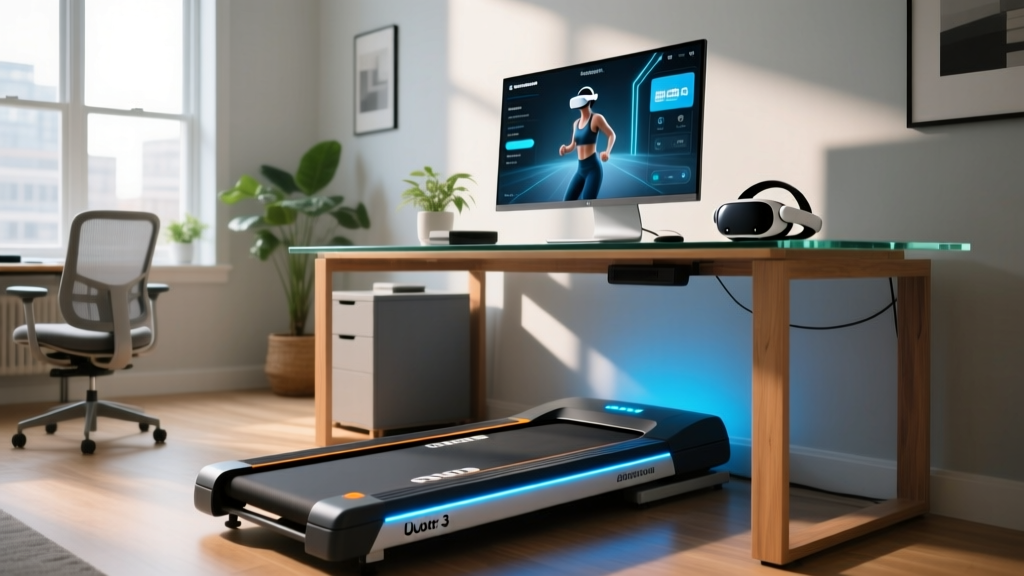
As remote work and immersive gaming continue to dominate our home environments in 2026, the average home office has evolved into a multi-purpose hybrid zone. For space-constrained users, fitting a dedicated cardio machine, a sit-stand desk, and a room-scale virtual reality play area into a standard 10x10 foot bedroom is a geometric nightmare. This spatial challenge has given rise to a unique dual-purpose trend: utilizing a compact under desk treadmill for office use during the day, and repurposing it as a budget-friendly, space-optimized vr treadmill quest 3 solution at night.
True omnidirectional treadmills (ODTs) like the KAT VR C1 cost upwards of $6,500 and demand a permanent 4x4 foot footprint. For the vast majority of hybrid workers and gamers, a high-quality walking pad offers a pragmatic alternative. In this comprehensive under desk treadmill review, we analyze the top space-saving models of 2026, evaluate their ergonomic footprints, and provide a concrete layout framework for safely integrating them into your Meta Quest 3 Guardian boundary.
The Spatial Geometry of the Hybrid Layout
Space optimization is not just about the footprint of the machine; it is about the negative space required for safe operation. According to ergonomic guidelines from the Mayo Clinic, treadmill desks require specific clearance to prevent tripping hazards and maintain proper posture. When you add a VR headset to the equation, the spatial requirements multiply.
- Desk Clearance: Your sit-stand desk must have a minimum depth of 24 inches and a width of 48 inches to accommodate a monitor, keyboard tray, and the treadmill's console.
- Vertical Clearance: The Meta Quest 3 requires a minimum ceiling height of 7 feet. When a user is on a treadmill deck (which adds 2 to 5 inches of elevation), a standard 8-foot ceiling leaves roughly 35 inches of overhead clearance for arm extensions during games like Beat Saber.
- The Egress Zone: You must maintain a 30-inch clearance behind the treadmill for a standard office chair, and a 24-inch lateral clearance on the dominant side to allow for safe, blind dismounts while wearing a headset.
Under Desk Treadmill Review: Top 2026 Models for Tight Footprints
Not all walking pads are created equal. When evaluating an under desk treadmill for office use review, we prioritize belt width, motor torque (crucial for handling the lateral shifts of VR gaming), and folded storage dimensions.
1. WalkingPad R2 (The Space-Saving Champion)
The WalkingPad R2 remains a benchmark for micro-apartments. Its 180-degree fold reduces its footprint to just 20.9 x 15.4 inches, allowing it to slide under a bed or stand vertically in a closet. Price: ~$499. Belt Size: 47.2 x 17.3 inches. VR Verdict: The 17.3-inch width is too narrow for lateral VR dodging. It is strictly for forward-marching locomotion games.
2. UREVO Strol 2E (The Budget Commuter)
Featuring a built-in handlebar and a slightly more aggressive 2.5 HP peak motor, the Strol 2E handles the sudden weight shifts of office work and gaming. Price: ~$299. Belt Size: 16.5 inches wide. VR Verdict: Avoid for VR. The narrow belt and lack of side rails make blind dismounts in a headset highly dangerous.
3. Horizon Fitness TD1000 (The Hybrid Heavyweight)
Horizon's TD1000 bridges the gap between a commercial office treadmill and a home walking pad. It features a 20-inch wide belt and heavy-duty side rails. Price: ~$699. Belt Size: 20 x 55 inches. VR Verdict: Excellent. The 20-inch width provides just enough margin for minor lateral strafe movements in VR, and the physical handrails offer a crucial tactile anchor when your vision is obscured by the Quest 3.
Repurposing the Walking Pad: The Budget VR Treadmill Quest 3 Hack
Designating a permanent 8x8 foot zone for VR room-scale tracking is a luxury most home offices cannot afford. By centering your under desk treadmill within your existing office layout, you can create a '1D Treadmill Zone' that maximizes immersion without sacrificing floor space.
To execute this layout, follow these spatial mapping steps:
- Anchor the Desk: Push your desk against the wall. Ensure your monitors are on articulated arms so they can be folded flat against the wall when transitioning to VR mode.
- Map the Guardian Boundary: According to Meta's official Guardian setup guidelines, your boundary should be at least 6.5 x 6.5 feet for room-scale. Map a tight 'Stationary Mode' boundary that perfectly outlines the physical dimensions of your treadmill belt, plus a 6-inch buffer zone on the side rails.
- Tactile Floor Markers: Place high-density EVA foam anti-fatigue mats on the floor immediately adjacent to the treadmill. This provides a distinct textural change underfoot, alerting your brain that you have stepped off the moving belt before you trip.
Footprint & Clearance Matrix
| Model | Belt Width | Active Footprint (L x W) | VR Lateral Viability | Best Use Case |
|---|---|---|---|---|
| WalkingPad R2 | 17.3' | 56.3' x 20.9' | Poor (Forward Only) | Tight bedrooms, strict office walking |
| UREVO Strol 2E | 16.5' | 53.1' x 20.1' | Dangerous | Budget under-desk office use only |
| Horizon TD1000 | 20.0' | 63.0' x 28.0' | Moderate (1D Locomotion) | Hybrid Office / VR Forward Gaming |
| KAT VR C1 (Ref) | N/A (Omni) | 48.0' x 48.0' (Fixed) | Excellent (360 Degrees) | Dedicated VR arcades, large basements |
Edge Cases and Failure Modes in VR Layouts
When merging office ergonomics with immersive technology, several non-obvious failure modes emerge. Addressing these during the layout phase is critical for long-term safety and equipment longevity.
Warning: The Center of Gravity Shift
The Meta Quest 3 weighs approximately 515 grams. If you use a third-party battery strap (adding ~200g to the rear), your center of gravity shifts backward. On a moving treadmill belt, this rearward pull increases the likelihood of drifting off the back of the deck. Always calibrate your treadmill's auto-pause safety tether to your chest, rather than relying on the magnetic key clipped to your waistband, which can detach during vigorous arm swings.
Cable Management for PCVR Users
While the Quest 3 is primarily a standalone wireless device, many users connect it to a PC via a Link Cable for high-fidelity titles like Half-Life: Alyx. A trailing cable on a treadmill is a catastrophic tripping hazard. Layout Solution: Install a ceiling-mounted retractable cable reel (like the VR Cover ceiling pulley system) directly above the center of the treadmill. This keeps the cable suspended above head-height and manages the slack dynamically as you walk, preventing the cord from tangling in the treadmill's front motor housing.
Final Verdict on Space Optimization
Optimizing a home office for both productivity and immersive cardio requires ruthless spatial discipline. If your primary goal is office ergonomics with occasional, forward-facing VR gaming, the Horizon Fitness TD1000 offers the safest belt width and the most robust motor for the price. However, if your floor plan is strictly limited to under-bed storage, the WalkingPad R2 remains the undisputed king of the foldaway footprint—just remember to keep your VR gaming strictly to thumbstick-assisted forward marching. By respecting the geometric boundaries of your room and the physiological limits of your vestibular system, you can successfully merge the modern office and the metaverse into a single, highly optimized 100-square-foot zone.
More gear to consider
All reviews
Asuna Treadmill Noise Troubleshooting & Cardio Machine Comparison

Rowing Guide: Fix Mistakes vs 30 Minute HIIT Treadmill Workout

What Is the 12 3 30 Treadmill Challenge? Compact Gear Budget Guide
T Series 8.5 S Treadmill Review: 2026 Budget & Small Space Value

Can You Put a Treadmill on Carpet? 2026 Noise Comparison