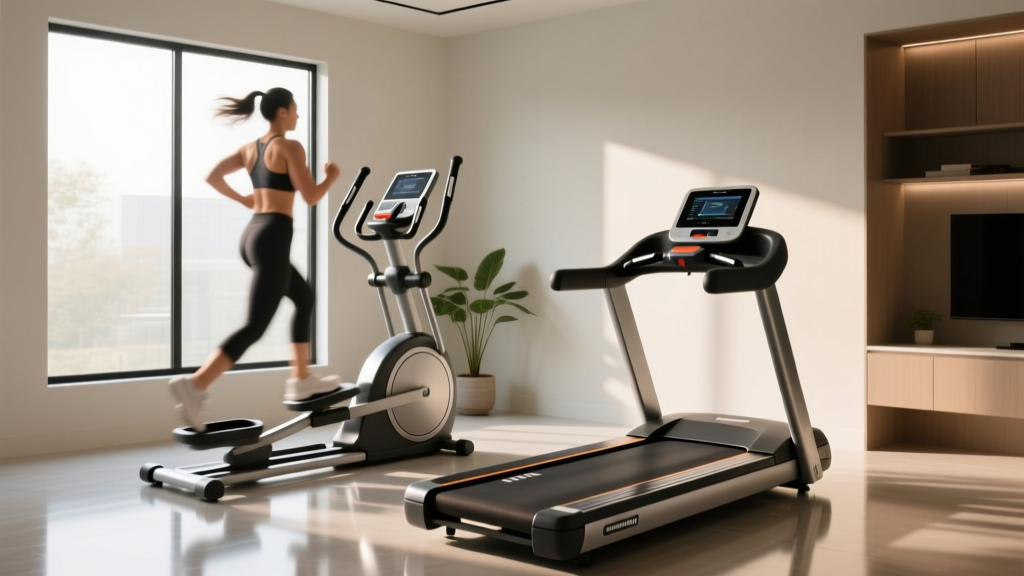
What Is the 12 3 30 Treadmill Challenge? Compact Gear Budget Guide
Discover what the 12 3 30 treadmill challenge is and explore a 2026 budget breakdown of the best compact, portable treadmills that support a 12% incline.

The intersection of viral fitness trends and small-space living has created a unique dilemma for home gym enthusiasts. You want to participate in the internet's most popular incline walking routine, but you only have room for a foldable machine or an under-desk walking pad. As of 2026, the market is flooded with ultra-compact cardio equipment, but not all of it is engineered to handle the mechanical stress of steep inclines. This guide breaks down the exact requirements of the trend, evaluates the budget-friendly compact gear that can actually handle it, and provides a value analysis to ensure you do not waste money on equipment that will fail mid-stride.
The Viral Phenomenon: What Is the 12 3 30 Treadmill Challenge?
If you have spent any time on fitness forums or social media, you have likely encountered the trend. But what is the 12 3 30 treadmill challenge exactly? Popularized by influencer Lauren Giraldo, the protocol is deceptively simple but physiologically demanding:
The 12-3-30 Protocol: Set your treadmill to a 12% incline, a speed of 3 mph (or 4.8 km/h), and walk for 30 minutes. No running, no holding onto the handrails.
The Biomechanics and Metabolic Cost
Walking on a flat surface at 3 mph operates at roughly 3.5 METs (Metabolic Equivalents). However, introducing a 12% grade drastically alters the biomechanical load. According to data aligned with the Centers for Disease Control and Prevention (CDC) guidelines on vigorous aerobic activity, a 12% incline pushes the metabolic demand to approximately 8.0 to 9.0 METs. This shifts the primary muscular engagement from the quadriceps to the posterior chain—specifically the gluteus maximus, hamstrings, and gastrocnemius (calves).
Furthermore, the American Heart Association recommends 75 minutes of vigorous aerobic activity per week. A 30-minute session of 12-3-30 easily qualifies as vigorous, making it a highly time-efficient cardiovascular tool. However, executing this safely and effectively requires equipment built to sustain high-torque angles.
The Compact Equipment Dilemma: Why Most Walking Pads Fail
When outfitting a small apartment or home office, consumers naturally gravitate toward compact portable cardio equipment options, specifically low-profile walking pads. In 2026, you can find walking pads priced between $150 and $250. However, attempting the 12-3-30 challenge on these budget-friendly, flat-deck machines is a recipe for mechanical failure and physical injury.
⚠️ The Motor Drag & Thermal Overload WarningMost ultra-compact walking pads feature 1.5 to 2.0 HP (Horsepower) motors. When a 150 lb user walks at a 12% incline, gravity exerts massive downward drag on the belt. This forces a low-HP motor to draw up to 40% more amperage to maintain 3 mph. Within 10 to 15 minutes, the motor's thermal overload switch will trip, shutting the machine down abruptly. Furthermore, walking pads lack the heavy-duty steel cross-bracing required to support a deck tilted at 12 degrees; the plastic or light-aluminum hinges will warp or snap under repetitive angled torque.
Additionally, true 12-3-30 execution requires you not to hold the handrails to maintain proper posture and caloric burn. Most compact walking pads lack handrails entirely, making a 12% incline incredibly dangerous due to the high risk of slipping off the back of the shortened deck.
2026 Budget Breakdown: Compact Treadmills That Pass the Test
To successfully complete the challenge in a small space, you need a folding compact treadmill rather than an under-desk walking pad. You need a machine with a motorized incline that reaches at least 12%, a continuous duty motor of 2.5 CHP or higher, and a deck length of at least 50 inches. Here is a value analysis of the top three compact, foldable treadmills that meet these criteria in 2026.
| Model | Max Incline | Motor (CHP) | Deck Length | 2026 Price | Folded Footprint |
|---|---|---|---|---|---|
| Sunny Health & Fitness SF-T7863 | 12% | 2.5 HP | 51 inches | $449 | 28" x 26" x 60" |
| Echelon Stride | 12% (Auto) | 1.75 HP* | 55 inches | $599 | 10" x 31" x 63" (Flat fold) |
| Horizon Fitness T202 | 12% | 2.75 CHP | 55 inches | $799 | 34" x 30" x 65" |
*Note: While the Echelon Stride lists a 1.75 HP motor, it is specifically geared with a high-torque incline mechanism designed to handle the 12% grade without thermal tripping, unlike standard walking pad motors of the same size.
Deep Dive: Value vs. Space Trade-offs
- The Budget Pick (Sunny SF-T7863): At $449, this is the most affordable way to achieve a true 12% incline. However, the 51-inch deck is relatively short. If you are taller than 5'8", your stride may feel constrained at 3 mph, and you will need to pay close attention to your footing to avoid stepping off the rear roller.
- The Space-Saver (Echelon Stride): Priced at $599, the Stride's standout feature is its auto-incline and its unique flat-folding design. It can slide under a bed or stand flat against a wall, taking up only 10 inches of depth. It is the ultimate compromise between the 12-3-30 requirement and severe space limitations.
- The Performance Pick (Horizon T202): At $799, the T202 is the heaviest and takes up the most folded space, but the 2.75 CHP motor and 3-zone cushioning make it the most joint-friendly option for daily 12-3-30 routines.
Value Analysis: The "Cost Per Incline" Metric
To truly understand the value of compact cardio equipment, we must look beyond the sticker price and analyze the Cost Per Incline Percentage (CPIP). This original metric divides the total cost of the machine by its maximum incline capability, revealing how much you are paying for the mechanical hardware required to simulate hills.
- Standard Walking Pad (e.g., $200 / 5% max incline): CPIP = $40.00 per percentage point. You are paying a premium for portability, but the machine is useless for the 12-3-30 challenge.
- Sunny SF-T7863 ($449 / 12% max incline): CPIP = $37.41 per percentage point. Excellent raw value for the incline hardware.
- Horizon T202 ($799 / 12% max incline): CPIP = $66.58 per percentage point. You are paying a higher CPIP, but that premium buys a commercial-grade motor and advanced deck shock absorption, which drastically extends the machine's lifespan under high-torque conditions.
Practical Decision Framework for Small Spaces
If you are committed to the 12-3-30 challenge but are restricted by square footage, follow this step-by-step decision framework before purchasing:
Step 1: Measure Your Vertical Clearance
At a 12% incline, the front of a treadmill deck raises by approximately 8 to 10 inches. If your ceiling is a standard 8 feet (96 inches), a user who is 6 feet tall will have less than 2 feet of head clearance at the front of the machine. Ensure your ceiling height accommodates the elevated deck plus your height.
Step 2: Check the Power Circuit
Running a 2.5+ CHP motor at a 12% incline draws significant continuous wattage. Do not plug your compact incline treadmill into a power strip shared with space heaters, air conditioners, or microwaves. It requires a dedicated 15-amp or 20-amp wall outlet to prevent tripping your home's breakers mid-workout.
Step 3: Prioritize Deck Tension Adjustability
Incline walking stretches the treadmill belt tighter than flat walking. Over 6 to 12 months, the belt will naturally loosen. Ensure the compact model you choose has easily accessible rear-roller tension bolts. Models that enclose the rear roller in hard plastic shrouds make routine maintenance incredibly frustrating.
Frequently Asked Questions
Can I do the 12-3-30 challenge on a manual (non-motorized) curved treadmill?
Yes, but the mechanics are entirely different. Curved treadmills do not have a fixed "12% incline" setting; the resistance is generated by your own stride and foot placement on the curve. To match the metabolic output of a 12% motorized incline at 3 mph, you would need to push the curved belt at a specific, sustained wattage, which is difficult to measure without a built-in power meter.
Is holding the handrails during the 12-3-30 challenge really that bad?
Holding the handrails while leaning back at a 12% incline reduces your caloric expenditure by up to 30% and completely alters your spinal alignment. It shifts the load away from your glutes and places unnatural shear force on your lower back. If you feel you must hold on to maintain 3 mph, the speed is too high for your current fitness level; drop the speed to 2.5 mph and keep your arms pumping naturally.
How often should I lubricate the belt if I do this challenge daily?
The friction and heat generated by a 12% incline degrade silicone belt lubricant much faster than flat walking. If you perform the 12-3-30 challenge 4 to 5 times a week, you should inspect and re-lubricate your treadmill deck every 45 to 60 days, rather than the standard 90-day interval recommended for general use.
More gear to consider
All reviews
Treadmill Smells Like Burning Rubber? Best Folding Picks Reviewed

How to Lubricate a NordicTrack Treadmill: Hands-On Guide
Winfita Treadmill Reviews: 2026 Noise Level Head-to-Head Test

Skill Mill Treadmill vs. Compact Portable Cardio: 2026 Picks
Precor 932i Treadmill Belt Maintenance: Cost & Value Analysis