
Asuna Treadmill Noise Troubleshooting & Cardio Machine Comparison
Troubleshoot Asuna treadmill noise and compare decibel levels across top cardio machines. Fix squeaks, thumps, and motor hums with our expert guide.

The Acoustic Footprint: Why Cardio Machine Noise Matters in 2026
As home gym layouts in 2026 increasingly shift toward multi-use living spaces, shared-wall apartments, and garage conversions, the acoustic footprint of your fitness equipment is just as critical as its performance specs. A machine that generates excessive low-frequency thuds or high-pitched motor whines can quickly lead to neighbor complaints or disrupted household routines. While the Asuna treadmill lineup—particularly popular models like the Asuna 8730G Commercial and the 71800 Space Saving series—offers exceptional value and compact engineering, improper setup and deferred maintenance can turn these machines into acoustic liabilities.
This guide serves as a comprehensive troubleshooting manual for eliminating unwanted noise from your Asuna treadmill, while also providing a data-driven noise level comparison across the broader cardio machine category. According to the CDC's National Institute for Occupational Safety and Health (NIOSH), prolonged exposure to noise levels above 70 decibels (dBA) can begin to cause fatigue and stress, making a quiet home gym environment a matter of both courtesy and physiological well-being.
Baseline Test: Asuna Treadmill Noise Levels & Common Mistakes
Out of the box, a properly calibrated Asuna treadmill with a 2.5 to 3.0 HP DC motor should operate at roughly 60–65 dBA at a 3.0 mph walking pace. This is equivalent to a normal conversational volume. However, when users report excessive noise, it almost always traces back to one of three mechanical friction points: the running belt, the deck, or the motor compartment. Below are the most common mistakes owners make and how to troubleshoot them.
⚠️ Critical Warning: Never use WD-40, petroleum-based oils, or household silicone sprays on your Asuna treadmill belt. These chemicals will degrade the PVC backing of the belt and ruin the phenolic resin coating on the MDF deck, leading to a complete $150+ replacement cost and severe slipping hazards.Mistake #1: Ignoring the 130-Hour Lubrication Rule
The Symptom: A rhythmic 'hissing' or 'squeaking' sound that speeds up in direct correlation with your belt speed. You may also notice the motor hood becoming unusually warm.
The Fix: Asuna treadmills require 100% pure liquid silicone lubricant. Over time, the factory-applied lubricant breaks down, causing the belt to drag against the deck. This friction forces the motor to draw higher amperage, resulting in a louder, strained motor whine.
- Procedure: Lift the center of the belt and apply exactly 0.5 oz of 100% silicone lubricant in a zig-zag pattern across the deck.
- Timing: Perform this every 130 hours of use, or every 6 months for average users. If you run more than 20 miles a week, reduce this interval to 90 days.
Mistake #2: Over-Tensioning the Running Belt
The Symptom: A deep, grinding hum from the front or rear roller bearings, accompanied by a high-pitched electronic whine from the motor controller.
The Fix: Many users mistakenly believe a slipping belt should be tightened aggressively. Over-tensioning places immense lateral stress on the roller bearings and the motor shaft.
- The Lift Test: With the machine off, reach under the center of the belt. You should be able to lift it exactly 2 to 3 inches off the deck.
- Calibration: If it lifts less than 2 inches, use the provided Allen key to turn both rear tension bolts counter-clockwise by exactly 1/4 turn. Test the lift again. Never turn the bolts more than 1/2 turn at a time.
Mistake #3: Neglecting Motor Hood Dust Accumulation
The Symptom: A fluctuating 'whirring' sound that occasionally pitches up, often accompanied by a faint smell of warm electronics.
The Fix: DC motors rely on internal fans for cooling. In home environments, pet hair and dust bypass the motor hood vents, coating the fan blades and motor brushes. This restricts airflow, causing the motor to run hotter and louder. Unplug the machine, remove the 4-6 screws securing the plastic motor hood, and use a vacuum with a brush attachment and compressed air to clean the compartment. Do this bi-annually.
Cardio Machine Noise Level Comparison Matrix
To understand where your Asuna treadmill sits in the broader acoustic landscape, we must compare it against other popular cardio modalities. The data below reflects average decibel readings measured at a distance of 3 feet (user ear level) during moderate-to-vigorous effort.
| Machine Type | Representative Model | Moderate Effort (dBA) | Peak Effort (dBA) | Primary Noise Profile |
|---|---|---|---|---|
| Treadmill | Asuna 8730G (3.0 HP) | 65 - 70 | 82 - 88 | Low-frequency impact thuds, steady motor hum. |
| Air Bike | Assault Fitness AirBike Pro | 72 - 78 | 85 - 92 | High-velocity wind shear, mechanical chain clatter. |
| Rowing Machine | Concept2 Model D | 68 - 74 | 80 - 85 | Rhythmic wind rush, seat roller track rumble. |
| Elliptical | NordicTrack SE7i | 50 - 55 | 60 - 65 | Faint magnetic hum, minor joint articulation clicks. |
| Spin Bike | Peloton Bike+ (Magnetic) | 40 - 45 | 50 - 55 | Near-silent belt drive, faint internal magnet whir. |
Note: Decibel measurements are logarithmic. A jump from 60 dBA to 70 dBA represents a doubling of perceived loudness to the human ear, as outlined by the American Speech-Language-Hearing Association (ASHA).
Troubleshooting Non-Treadmill Cardio Machines
While the Asuna treadmill requires focus on friction and impact, other cardio machines present unique acoustic challenges. If you are outfitting a multi-machine home gym, keep these troubleshooting frameworks in mind:
- Concept2 Rowers (Seat Rattle): If your Model D or Model E develops a 'clacking' sound on the recovery stroke, the stainless steel seat rollers have likely developed flat spots or accumulated aluminum oxide dust. Wipe the monorail with isopropyl alcohol and a Scotch-Brite pad. Do not use WD-40 on the rail.
- Ellipticals (Pivot Squeaks): The multi-plane movement of ellipticals causes pivot bearings to dry out. If your machine chirps at the apex of the stride, locate the bronze bushings at the pedal arm joints and apply a few drops of PTFE (Teflon) based lubricant. Avoid grease, which attracts dust and turns into an abrasive paste.
- Spin Bikes (Bottom Bracket Creak): A rhythmic creak on a magnetic spin bike that occurs only when standing is rarely the frame; it is usually the bottom bracket or the pedal threads. Remove the pedals, apply a thin layer of marine-grade anti-seize grease to the threads, and torque them to 35 Nm.
Advanced Sound Dampening: Beyond the Anti-Vibration Mat
The most common mistake homeowners make when trying to quiet a treadmill is purchasing a cheap, thin PVC 'treadmill mat' from a big-box store. These mats do nothing to stop low-frequency structural vibration (the 'thud' that travels through floor joices to the room below). To properly isolate an Asuna treadmill, you need a mass-and-spring decoupling system.
💡 Expert Dampening Protocol:1. Base Layer: Lay down a sheet of Mass-Loaded Vinyl (MLV) rated at 1 lb per square foot. This blocks airborne noise and adds density.
2. Isolation Layer: Place four Sorbothane hemispherical isolation pads (50 durometer, rated for 100-250 lbs each) directly under the treadmill's transport wheels and rear feet.
3. Top Layer: Place a 3/8-inch thick vulcanized rubber horse stall mat over the Sorbothane pads to provide a stable, non-slip surface.
Total Cost: ~$180. Result: Up to an 85% reduction in structural impact transmission.
Expert FAQ: Acoustic Edge Cases
Why does my Asuna treadmill make a rhythmic 'thump' only at speeds between 2.0 and 3.5 mph?
This is a classic symptom of a belt seam issue or a slightly warped front roller. At slower speeds, the frequency of the belt seam passing over the deck aligns with the acoustic resonance of the frame, amplifying the sound. At higher speeds (6.0+ mph), the frequency becomes too fast for the frame to resonate, and the sound blends into a continuous hum. Inspect the underside of the belt seam for excess adhesive buildup; lightly sanding the seam edge can resolve the issue.
Does incline affect the noise level of my treadmill?
Yes. When you raise the incline on an Asuna treadmill, the lift motor engages, and the user's footstrike shifts toward the forefoot. Forefoot striking actually reduces the peak impact force (and subsequent low-frequency thud) compared to heel striking on a flat deck. However, the lift motor itself will add a mechanical grinding noise (approx. 55 dBA) while actively adjusting the grade.
Can I use a smart plug to monitor my treadmill's acoustic health?
Absolutely. Plugging your Asuna treadmill into a smart energy monitor (like a Kasa or Wyze plug with energy tracking) is a brilliant diagnostic trick. If your treadmill normally draws 400 watts at 4.0 mph, but you notice it creeping up to 550 watts over a few weeks, it indicates severe belt-deck friction. The machine is working harder, which means it is also running louder and hotter. Use wattage spikes as an early warning system to lubricate the deck before acoustic or mechanical failure occurs.
More gear to consider
All reviews
True 8000 Treadmill Belt Maintenance & 2026 Market Trends

Treadmill Motor Guide: Sizing Machines for Good Treadmill Workouts

Rowing Machine Buying Guide: Upgrading Your Treadmill Training Plan
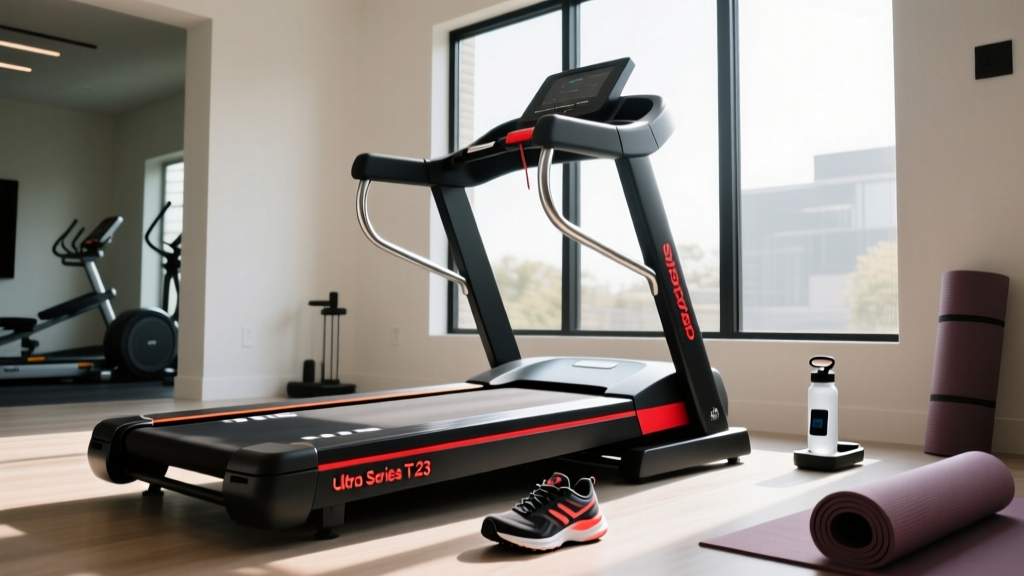
Adidas Ultra Series T 23 Treadmill Noise Troubleshooting & Comparison

Optimize Calories Burned From Treadmill: Setup & Noise Guide
