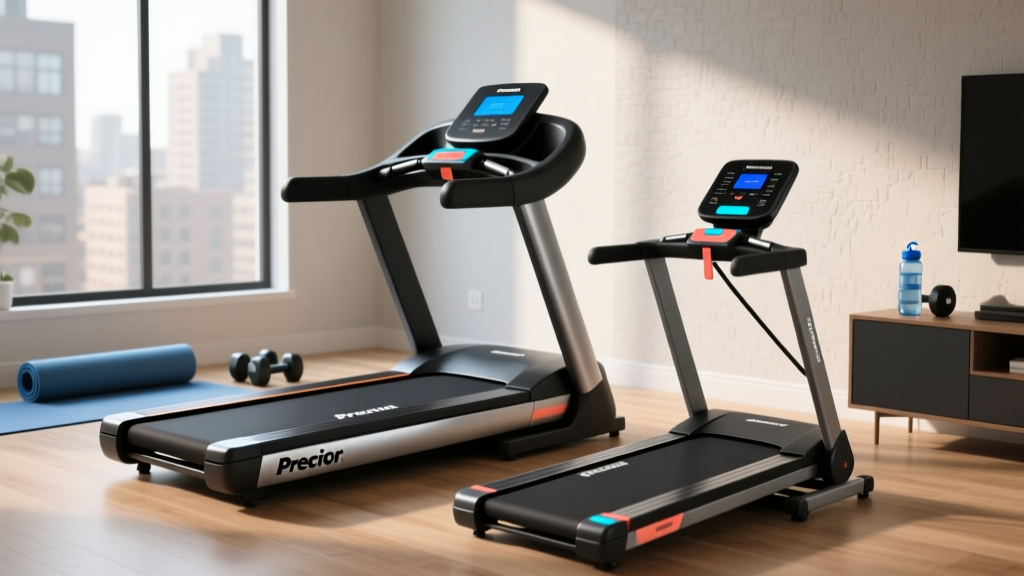
Under Desk Treadmill for Office Use Review: Space Layouts & How to Turn On Nordic Track Treadmills
Discover the best under desk treadmills for office use in 2026. We review space layouts, dimensions, and setup simplicity compared to full-size consoles.

The Modern Home Office: Reclaiming Square Footage
As the hybrid work model solidifies in 2026, the dedicated home office has evolved from a temporary corner desk into a permanent, highly optimized workspace. For professionals spending eight or more hours a day seated, integrating cardiovascular movement is no longer a luxury—it is a physiological necessity. According to Mayo Clinic's guide on office ergonomics, alternating between sitting and active standing significantly reduces musculoskeletal strain and cognitive fatigue.
However, fitting a cardio machine into a standard 10x12 foot home office requires rigorous spatial planning. Full-size treadmills demand a minimum footprint of 30 inches by 70 inches, plus an additional 36 inches of rear clearance for safety. This is where the under desk treadmill excels. By eliminating the upright console and heavy handrails, walking pads slip seamlessly beneath height-adjustable standing desks, transforming dead space into an active wellness zone without compromising your room's layout or aesthetic.
2026 Under Desk Treadmill Reviews for Office Use
Not all walking pads are created equal. When designing an office layout, the belt width, motor placement, and folding mechanism dictate how well the machine integrates into your daily workflow. Here is our expert review of the top models for space-constrained offices.
1. WalkingPad R2: The Space-Saving Benchmark
Price: $599 | Footprint: 57" L x 27" W (Unfolded) | Weight Capacity: 240 lbs
The WalkingPad R2 remains the gold standard for tight office layouts. Its patented 180-degree fold allows it to shrink down to a mere 10-inch height, sliding easily under a standard sofa or leaning vertically against a wall in a 2-inch gap. The 27-inch belt width is sufficient for walking at speeds up to 3.7 mph, though it requires users to maintain a centered stride. The brushless 1.25 HP motor operates at under 45 decibels, ensuring your Zoom calls remain uninterrupted.
2. UREVO Strol 2E: The Budget-Friendly Dual-Mode
Price: $349 | Footprint: 54" L x 20" W | Weight Capacity: 265 lbs
For those who want the option to jog during off-hours, the UREVO Strol 2E features a foldable, telescoping handrail. When the handrail is lowered, the machine acts as an under-desk treadmill with a 2.5 mph speed cap. When raised, it unlocks speeds up to 7.6 mph. At just 20 inches wide, it fits perfectly beneath narrower 48-inch executive desks, leaving ample room on either side for office chair clearance and filing cabinets.
3. LifeSpan TR1200-DT3: The Heavy-Duty Office Workhorse
Price: $999 | Footprint: 63" L x 28" W | Weight Capacity: 350 lbs
If your office layout can accommodate a slightly longer machine, the LifeSpan TR1200-DT3 offers commercial-grade durability. Designed specifically for the rigors of an 8-hour workday, it features a 20-inch by 50-inch running surface and a heavy-duty 2.5 HP continuous-duty motor. Unlike cheaper walking pads that overheat after 2 hours of continuous use, the LifeSpan is engineered for prolonged, low-speed walking, making it ideal for high-volume users.
Spatial Geometry: Designing Your Active Workspace Layout
Integrating a treadmill beneath a desk is an exercise in applied geometry. You must account for the desk's depth, the treadmill's length, and the ergonomic distance between your eyes and your monitor. The CDC's physical activity guidelines for adults recommend accumulating at least 150 minutes of moderate-intensity activity weekly, which translates to roughly 30 minutes of treadmill walking per workday.
Layout Pro-Tip: To maintain proper ergonomic alignment, your monitor should be exactly one arm's length away (approx. 24-30 inches). If your treadmill's motor housing sits at the front of the machine, it may push you too far back from your desk. Always measure the distance from the front edge of the treadmill belt to the edge of your desk before purchasing.| Desk Type | Standard Depth | Ideal Treadmill Length | Required Chair Clearance (Rear) |
|---|---|---|---|
| Compact Writing Desk | 24 inches | Under 50 inches (e.g., UREVO) | 36 inches minimum |
| Standard Executive Desk | 30 inches | 50 - 58 inches | 40 inches minimum |
| L-Shaped Corner Setup | 36+ inches | Up to 63 inches (e.g., LifeSpan) | 48 inches minimum |
Frictionless Startups: Under Desk vs. Full-Size Consoles
When transitioning from a traditional home gym setup to an integrated office layout, users immediately notice the difference in startup friction. Full-size treadmills are designed for dedicated workout sessions, which means their user interfaces are inherently complex. If you have ever found yourself searching how to turn on nordic track treadmill models—only to realize you need to locate the magnetic safety key, bypass an iFit subscription login screen, connect to Wi-Fi, and wait through a 15-second belt calibration sequence—you understand the friction involved.
In a busy office environment, this level of complexity is a workflow killer. You do not want to boot up an operating system just to walk while answering emails.
Under desk treadmills solve this through radical simplicity. Models like the WalkingPad and UREVO utilize automatic foot-sensor technology. The moment you step onto the belt, the machine wakes from sleep mode and begins moving at your pre-set walking pace. There are no safety keys to misplace, no subscription paywalls blocking your hardware, and no boot-up screens. You simply step on, grab your standing desk keyboard tray, and begin your workday. When you step off, the machine safely decelerates and powers down. This zero-friction UX is exactly what makes walking pads viable for professional environments.
Real-World Failure Modes & Edge Cases in Office Layouts
While space optimization looks great on paper, real-world office environments introduce physical edge cases that can ruin your active desk setup. As an equipment reviewer, I have documented the following common failure modes when integrating treadmills into home offices:
- Chair Caster Interference: Standard office chair wheels (casters) will easily roll off a low-profile treadmill edge, causing a tripping hazard or damaging the treadmill's side rails. Solution: Install a dedicated, low-pile office mat beneath the treadmill, or use a rolling chair specifically designed with soft, rubberized inline-skate wheels that grip the belt edge safely.
- Static Shock on Office Carpets: The friction of a walking belt, combined with synthetic office carpeting, generates significant static electricity. Users often experience sharp shocks when touching their metal desk frames or laptops. Solution: Ensure your treadmill is plugged directly into a grounded, 3-prong wall outlet (never a cheap power strip), and consider placing an anti-static mat under the machine if your office is carpeted.
- Thermal Throttling in Enclosed Spaces: Many users push their under desk treadmills flush against a wall or enclose them within a custom desk cabinetry. Walking pad motors rely on passive airflow for cooling. Blocking the rear motor housing will cause the machine to overheat and shut down within 45 minutes. Solution: Always leave a minimum of 18 inches of negative space behind the treadmill's motor housing for thermal exhaust.
- The 3-Degree Incline Limitation: To maintain a slim profile, 95% of under desk treadmills feature a fixed 3-degree to 5-degree front incline to accommodate the motor. While this mimics outdoor wind resistance, it forces a slight posterior pelvic tilt when standing. Solution: Wear supportive, low-drop running shoes (like the Hoka Bondi or Brooks Ghost) rather than walking barefoot or in socks to absorb the repetitive micro-impacts on your lumbar spine.
Expert Verdict: Final Layout Recommendations
Optimizing your home office for cardiovascular health requires balancing spatial constraints with equipment durability. If your layout is severely restricted and you prioritize seamless storage, the WalkingPad R2 offers the best folding geometry on the market. For heavy, all-day users with deeper L-shaped desks, the LifeSpan TR1200-DT3 provides the belt length and thermal management necessary for 8-hour shifts.
Ultimately, the best cardio machine is the one that removes barriers to your daily movement. By ditching the bulky consoles and complex startup routines of traditional gym equipment, an under desk treadmill transforms your office from a sedentary trap into a dynamic, space-optimized engine for both productivity and long-term health.
More gear to consider
All reviews
Zen Active Treadmill: 2026 Beginner Feature Comparison Guide
WalkingPad P1 Folding Treadmill: 2026 Budget Analysis

Rowing Buying Guide & Technique vs. a HIIT Cardio Treadmill for Beginners

Training for 5k on Treadmill: Motor Size Mistakes & Fixes
Walking Pad vs Treadmill: Using a Treadmill Distance Calculator