Under Desk Treadmill Review: Office Space & c mill treadmill
Discover the best under desk treadmills for office space optimization. We review top 2026 models and compare ergonomics to clinical c mill treadmill tech.

The Spatial Reality: Why Most Office Treadmill Setups Fail
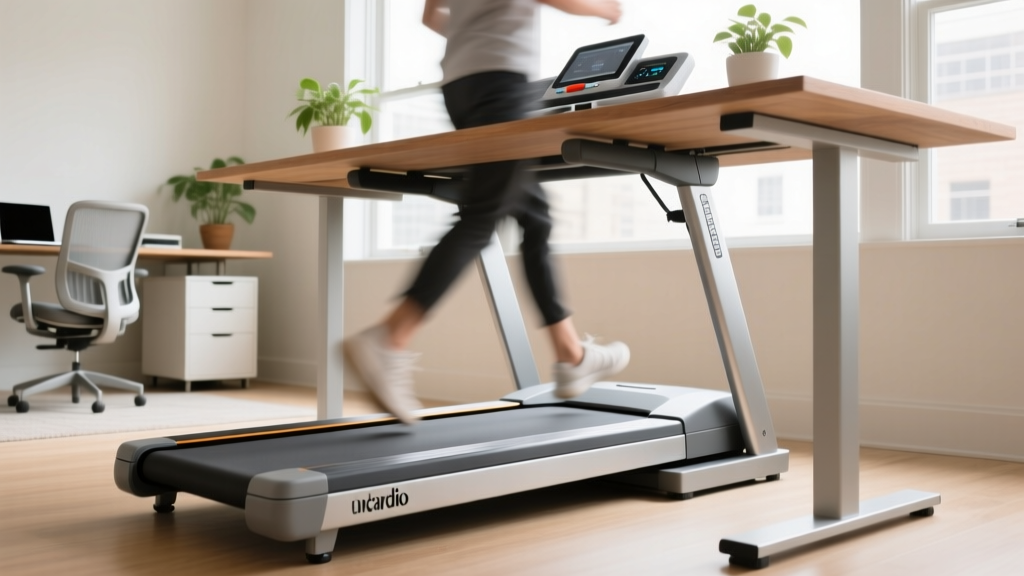
Transitioning to an active workspace in 2026 requires more than simply sliding a walking pad beneath your existing desk. The most common failure mode in home and corporate office layouts is ignoring the Z-axis (vertical clearance) and harmonic resonance. Standard office desks sit at 29 inches high. An under-desk treadmill deck adds 4.5 to 5.5 inches of elevation, pushing your required working height to at least 34.5 inches. If your adjustable standing desk maxes out at 33 inches, or if it features a lower stability crossbar at 30 inches, the treadmill will physically collide with the desk frame.
Furthermore, spatial optimization dictates that you must account for the 'swing radius' of your office chair. When the treadmill is not in use, pushing a standard 28-inch wide treadmill belt under a desk often blocks the chair's casters, forcing users to leave the machine protruding 15 inches into the room's primary walkway. According to OSHA Ergonomic Guidelines, improper monitor elevation caused by failing to adjust desk height for treadmill use leads to severe cervical flexion, negating the cardiovascular benefits of the active workstation.
⚠️ Z-Axis Clearance Warning: Before purchasing any under-desk treadmill, measure the distance from the floor to the lowest horizontal crossbar of your standing desk. You need a minimum of 6 inches of vertical clearance to accommodate the treadmill deck and your shoe height without scuffing the desk frame.Ergonomic Baselines: Consumer Belts vs. c mill treadmill Tech
When evaluating advanced gait mechanics and spatial awareness, biomechanics professionals often look to a clinical c mill treadmill for definitive data. Manufactured by Motek Medical, the c mill treadmill is a $150,000 instrumented spatial treadmill that utilizes embedded force plates and virtual reality environments to adapt to a user's stride in real-time. While an office worker is not conducting VR gait rehabilitation, the core principle of spatial feedback is highly relevant to office layouts.
The Gait Analysis Gap
Unlike a c mill treadmill that provides a 60-inch by 24-inch walking surface with real-time spatial corrections, consumer under-desk treadmills force a 'blind' walking pattern. Because the desk base is directly in your peripheral vision, users subconsciously shorten their natural stride length from 28 inches to roughly 18 inches to avoid kicking the desk crossbar. A National Institutes of Health (NIH) study on treadmill desks notes that this shortened, shuffling gait at speeds between 1.0 and 2.0 mph reduces caloric expenditure by 14% compared to natural overground walking. To combat this in a space-optimized layout, you must position the treadmill at least 20 inches away from the desk's front edge, utilizing a monitor arm to bring the screen to you rather than walking directly beneath the desk's center of gravity.
2026 Under Desk Treadmill Review: Space-Optimized Models
To optimize your office footprint, we evaluated the top under-desk treadmills based on spatial efficiency, motor duty cycles, and acoustic output. Continuous duty horsepower (CHP) is critical here; a motor that overheats in an enclosed desk space will trigger a thermal shutoff at the 45-minute mark.
| Model | Footprint (L x W) | Motor (CHP) | Max Speed | Price (2026) |
|---|---|---|---|---|
| LifeSpan TR1200-DT5 | 52" x 28" | 1/2 HP Continuous | 4.0 mph | $1,299 |
| WalkingPad X21 | 54" x 25" (Folds to 13") | 1.0 HP Continuous | 3.7 mph | $599 |
| UREVO Strol 2E | 48" x 26" | 0.75 HP Continuous | 3.0 mph | $299 |
LifeSpan TR1200-DT5: The Dedicated Zone Anchor
Weighing in at 115 lbs, the LifeSpan TR1200-DT5 is not designed to be moved daily. It is the optimal choice for a dedicated, permanent office layout where the treadmill remains under a heavy-duty standing desk like the Uplift V2. The 1/2 HP continuous motor runs exceptionally cool, preventing the thermal shutoffs common in enclosed desk spaces. Its 4-ply belt significantly dampens harmonic resonance, meaning your monitors won't shake when you walk at 2.5 mph. However, its 28-inch width requires a desk frame with at least 30 inches of clearance between the legs.
WalkingPad X21 (2026 Edition): The Multi-Use Room Savior
If your office doubles as a guest bedroom or living space, the WalkingPad X21 is the ultimate space-optimization tool. Its 180-degree fold hinge reduces the 54-inch footprint down to a 13-inch profile that slides under a sofa or into a closet. The 1.0 HP continuous motor is surprisingly robust for its size, though the narrower 17-inch walking belt requires strict spatial discipline. Users must maintain a tight, centered gait; drifting laterally by just 4 inches will cause your foot to catch the side rails.
UREVO Strol 2E: The Budget Spatial Compromise
At $299, the UREVO Strol 2E offers a dual-mode foldable handle, allowing it to function as a standalone walking station or an under-desk unit. The failure mode here is acoustic: the smaller 0.75 HP motor operates at roughly 65 decibels at 2.0 mph, which will interfere with un-muted conference calls. It is best suited for layouts where the desk is positioned in a secondary room or a large, open-plan corporate space where ambient noise masks the belt friction.
Blueprint: Designing the Perfect Treadmill Desk Layout
To achieve a seamless integration of cardio equipment into your office architecture, follow this spatial mapping protocol:
- Map the Power Brick: Under-desk treadmills draw 800W to 1200W under load. Their external power transformers generate significant heat. Never push the treadmill flush against a wall or desk base where the transformer is trapped. Allocate a 6-inch thermal exhaust zone on the right side of the desk layout.
- Install Cross-Supports: At 35 inches high, standard dual-motor standing desks experience a 15% increase in lateral wobble. When combined with the rhythmic footfalls of a 180 lb user walking at 2.0 mph, this creates harmonic resonance. Install aftermarket diagonal cross-supports on the rear desk legs to stabilize the monitor plane.
- Implement Cable Management Arms: Walking generates lateral hip sway, which translates to upper body movement. Hardwired keyboards and mice will pull taut and drag across the desk. Use a 24-inch articulated monitor arm and a wireless peripheral setup to accommodate your natural spatial drift.
- Use an Anti-Fatigue Transition Mat: Place a beveled, 1-inch thick anti-fatigue mat directly behind the treadmill. Stepping off a 5-inch treadmill deck onto a hard floor creates a jarring spatial drop that strains the Achilles tendon over a 4-hour workday.
Expert Verdict
Optimizing an office for an under-desk treadmill is an exercise in three-dimensional geometry and biomechanical compromise. While you won't get the real-time spatial force-plate feedback of a clinical c mill treadmill, selecting a machine with a high continuous duty motor and pairing it with a desk that clears 35 inches in height will transform your workspace. For permanent, heavy-use layouts, the LifeSpan TR1200-DT5 remains the gold standard for stability and thermal management. For dynamic, multi-purpose rooms, the WalkingPad X21 offers unmatched spatial flexibility without sacrificing essential walking metrics.
More gear to consider
All reviews
WalkingPad R1 Treadmill Motor Size & Horsepower Guide

CST 505 Treadmill vs Bikes: 2026 Budget Value Analysis

Beyond Barry's Treadmills: 2026 Stationary Bike Market Trends

Fitness Reality Treadmill Trends: Compact Portable Cardio for 2026

Wahoo KICKR Treadmill Review: Small Space Fit & Maintenance Care
