Treadmill Without Arms vs Stationary Bikes: Budget Breakdown
Compare the true costs of a treadmill without arms against upright, recumbent, and spin bikes. Discover which cardio machine offers the best value.

The 2026 Home Cardio Dilemma: Walking Pads vs. Pedaling
As home gym real estate becomes more precious and equipment prices fluctuate in 2026, fitness buyers are facing a unique crossroads. On one side of the aisle is the massively popular treadmill without arms—a category dominated by under-desk walking pads and flatbed manual runners. On the other side sits the traditional stationary bike market, fractured into upright, recumbent, and spin bike categories.
If you are allocating a strict budget between $400 and $2,500 for your next cardiovascular investment, how do you measure true value? It is no longer just about the sticker price. True value encompasses upfront cost, long-term maintenance, spatial footprint, and biomechanical ROI. Below, we break down the exact financial and functional realities of these machines to help you decide where your money is best spent.
Quick Cost Snapshot (2026 Averages)
- Treadmill Without Arms (Walking Pad): $299 - $699
- Upright Stationary Bike: $450 - $850
- Recumbent Stationary Bike: $900 - $1,600
- Spin / Indoor Cycle: $800 - $2,500+
Deconstructing the 'Treadmill Without Arms' Market
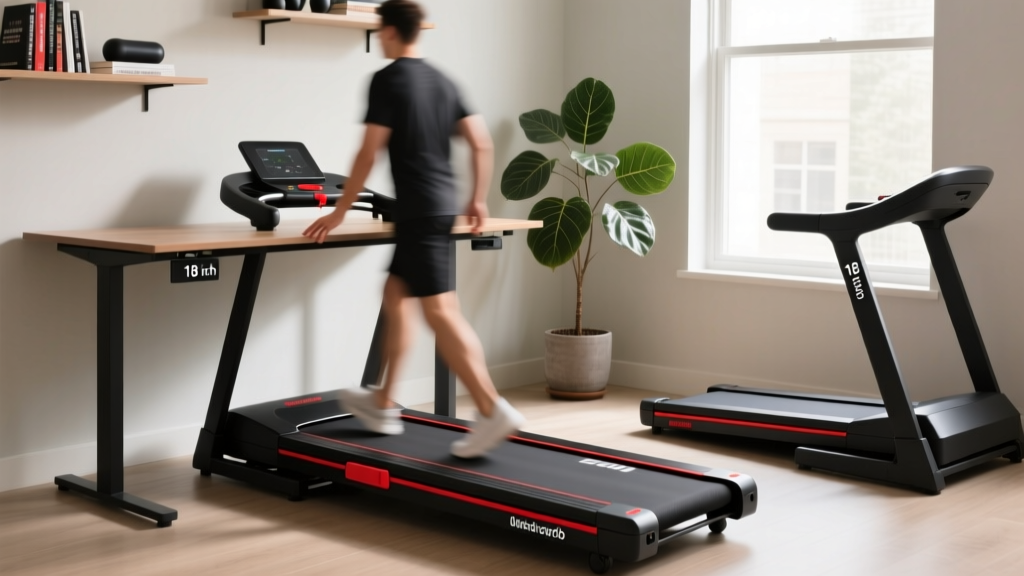
When consumers search for a treadmill without arms, they are generally looking for equipment that eliminates the bulky front console and side handrails to save space. This primarily funnels into two sub-categories:
1. Motorized Walking Pads (Under-Desk Treadmills)
Models like the KingSmith WalkingPad X21 ($599) and the UREVO Strol 2E ($399) have dominated this space. These machines feature a 2.0 to 2.5 HP motor, top speeds of 4.0 to 7.6 mph, and fold in half for under-bed storage.
- The Value Proposition: Unbeatable spatial efficiency. You can slide it under a standing desk and accumulate 10,000 steps while working.
- The Limitation: Without arms or handrails, high-intensity interval training (HIIT) and sprinting are inherently dangerous. These are strictly for Low-Intensity Steady State (LISS) cardio.
2. Flatbed Manual Treadmills
Curved manual treadmills usually have arms, but flatbed manual sliders (like the Sunny Health & Fitness SF-T723016 at $350) rely entirely on user friction. They are notoriously difficult to use for extended periods and often result in a poor biomechanical stride, making them a low-value investment for serious fitness enthusiasts.
The Stationary Bike Spectrum: Upright, Recumbent, and Spin
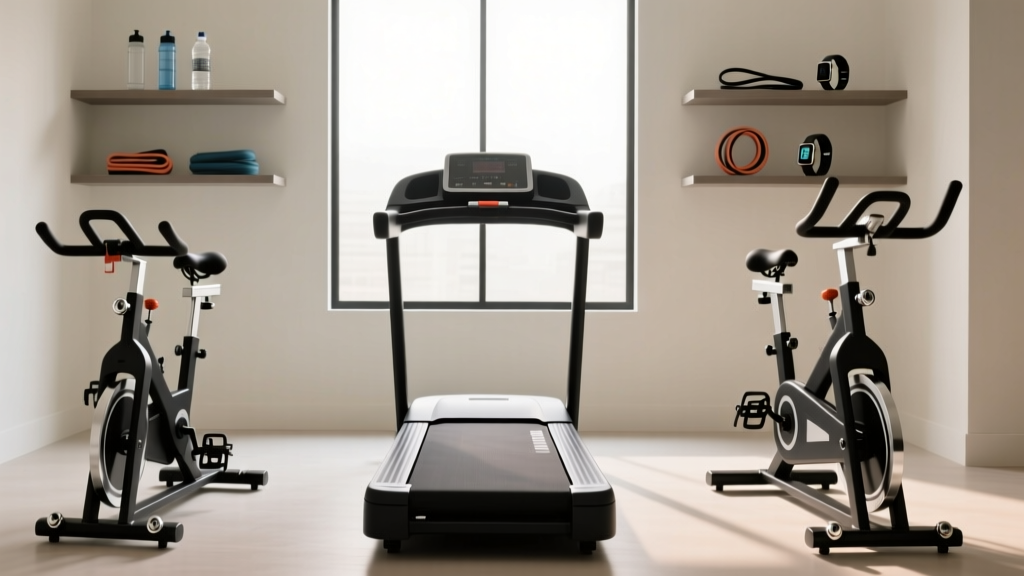
Stationary bikes offer a vastly different physiological stimulus and financial commitment. Let us break down the three primary stationary bike types: upright, recumbent, and spin.
Upright Bikes: The Budget-Friendly Standard
Upright bikes mimic the geometry of a traditional outdoor bicycle but with a wider, more comfortable seat and a stationary base. The Schwinn 130 Upright ($599) remains a benchmark in 2026, offering 22 levels of magnetic resistance and a 10-pound flywheel.
'Upright bikes engage the core and upper body slightly more than recumbent models, while maintaining a relatively small footprint of about 4 square feet.' - FitGearPulse Biomechanics Lab
Recumbent Bikes: Paying for Ergonomics
Recumbent bikes feature a step-through design with a bucket seat and backrest, placing the pedals in front of the body. This design drastically reduces lumbar strain. Premium models like the Nautilus R618 ($1,299) or Sole R92 ($1,499) include 25-pound flywheels and advanced heart-rate telemetry.
- Best For: Seniors, individuals recovering from lower-back injuries, and those requiring extended, comfortable reading-while-cardio sessions.
- Space Cost: High. Recumbents require a footprint of roughly 65 x 28 inches (12.6 sq ft).
Spin Bikes (Indoor Cycles): The High-Intensity Investment
Spin bikes are built for performance, featuring heavy flywheels (30-45 lbs), aggressive riding geometries, and infinite micro-adjustments. In 2026, magnetic resistance has entirely replaced friction pads in the mid-to-high tier. The Echelon EX3 ($899) offers entry-level smart connectivity, while the Peloton Bike+ ($2,495) commands a premium for its integrated auto-follow resistance and screen.
2026 Value Matrix: Cost Per Use & Space ROI
To truly understand the budget breakdown, we must analyze the 'Cost Per Square Foot' and the estimated 5-year maintenance costs. The table below illustrates the hidden financial realities of these machines.
| Machine Type | Avg. Upfront Cost | Footprint (Sq Ft) | 5-Yr Maintenance | Subscription Need? |
|---|---|---|---|---|
| Treadmill Without Arms (Pad) | $450 | 3.5 | $60 (Silicone lube) | No |
| Upright Bike | $600 | 4.5 | $20 (Belt tension) | Optional |
| Recumbent Bike | $1,300 | 12.6 | $50 (Grease/Track) | No |
| Spin Bike (Smart) | $1,500 | 5.0 | $120 (Sweat guards) | Yes ($39-$44/mo) |
Hidden Costs: Electricity, Subscriptions, and Sweat Corrosion
When budgeting for cardio equipment, the initial purchase price is only the beginning. Here are the non-obvious financial drains you must account for in 2026:
- The Subscription Trap: A $2,500 smart spin bike often requires a $44/month app subscription to unlock auto-resistance and live classes. Over five years, that adds $2,640 to your total cost of ownership. Conversely, a treadmill without arms relies on your own legs and a free podcast, keeping long-term costs near zero.
- Sweat Corrosion: Spin bikes and upright bikes place the rider directly over the bottom bracket and flywheel. In 2026, sweat intrusion remains the number one cause of motherboard failure in smart bikes. Budget $80 for a high-quality silicone sweat cover, or risk a $400 out-of-warranty repair.
- Electricity Draw: Motorized walking pads draw between 300W and 600W under load. If you walk for two hours a day, you will notice a slight bump in your utility bill. Manual spin bikes and magnetic upright bikes draw virtually zero wattage (aside from the console screen, which uses less than a standard LED lightbulb).
Biomechanics and Longevity ROI
Financial value is meaningless if the machine causes injury, leading to physical therapy bills. According to the American Heart Association, adults need at least 150 minutes of moderate-intensity aerobic activity per week. Consistency is the ultimate metric of ROI.
However, joint health dictates consistency. The Cleveland Clinic notes that while walking is a fantastic weight-bearing exercise for bone density, it introduces repetitive impact forces to the knees and hips. Cycling, by contrast, is a closed-chain, non-weight-bearing exercise that significantly reduces joint shear forces.
The Joint-Health Decision Framework
Choose the Treadmill Without Arms if: You need weight-bearing exercise to maintain bone mineral density, you work from home and want to combat sedentary desk time, and you have healthy knees and hips.
Choose a Recumbent or Upright Bike if: You are managing osteoarthritis, recovering from a lower-body injury, or are significantly overweight and need to offload spinal compression while still achieving the WHO Physical Activity Guidelines for cardiovascular health.
Final Verdict: Where Should Your Budget Go?
The 'best' value depends entirely on your lifestyle architecture and physical baseline.
Winner for Spatial & Financial Efficiency: Treadmill Without Arms
If your budget is under $600 and your apartment lacks a dedicated 'gym room,' a high-quality walking pad is the undisputed champion. It requires no subscription, stores under a sofa, and seamlessly integrates into a work-from-home lifestyle, guaranteeing a high 'Cost Per Use' ROI simply because it is always accessible.
Winner for Intensity & Athletic ROI: The Spin Bike
If your goal is high-calorie burn, VO2 max improvement, and anaerobic threshold training, walking pads will not suffice. A mid-tier magnetic spin bike (like the $1,200 NordicTrack S15i or similar 2026 equivalents) offers the highest ceiling for athletic performance. Just be sure to factor in the monthly app subscription and rigorous post-ride cleaning to protect your investment.
Winner for Longevity & Comfort: The Recumbent Bike
For buyers prioritizing joint preservation and long-duration comfort, the recumbent bike justifies its $1,300+ price tag. It is the ultimate 'buy it for life' cardio machine for aging populations or those with chronic lumbar issues, offering a safe, ergonomic path to daily cardiovascular health without the impact of a treadmill belt.
More gear to consider
All reviews
Oingo Boingo Running on a Treadmill: Walking Pad Setup Guide
Sole F63 Treadmill Disassembly: Motor Size & HP Guide

ProForm ZT6 Treadmill: 2026 Compact Cardio Value Breakdown
Rowing Machine Technique: Avoid the Shrimp on Treadmill Government Study Trap
Is the ProForm Treadmill 600 Quiet? 2026 Cardio Noise Comparison