Treadmill vs Rower: Curved Manual vs Motorized Treadmill Showdown
We break down the treadmill vs rower debate by comparing curved manual and motorized treadmills against the Concept2 rower for your 2026 home gym.

The 2026 Garage Gym Dilemma
When fitness enthusiasts search for the ultimate cardio machine, the treadmill vs rower debate always surfaces. However, treating all treadmills as a single category is a critical mistake. In 2026, the real comparison lies in how a curved manual treadmill stacks up against a traditional motorized treadmill, and whether either can truly dethrone the full-body metabolic demand of a rowing ergometer.
The Core Debate: Redefining the Treadmill vs Rower Argument
For decades, the rowing machine has held the crown for simultaneous upper- and lower-body conditioning. But the advent of non-motorized, curved-slat treadmills has disrupted the traditional cardio hierarchy. Unlike motorized treadmills that pull your feet backward via a mechanized belt, curved manual treadmills require you to generate 100% of the belt's momentum. This fundamental biomechanical shift bridges the gap between running and rowing, forcing heavy posterior-chain engagement that motorized models simply cannot replicate.
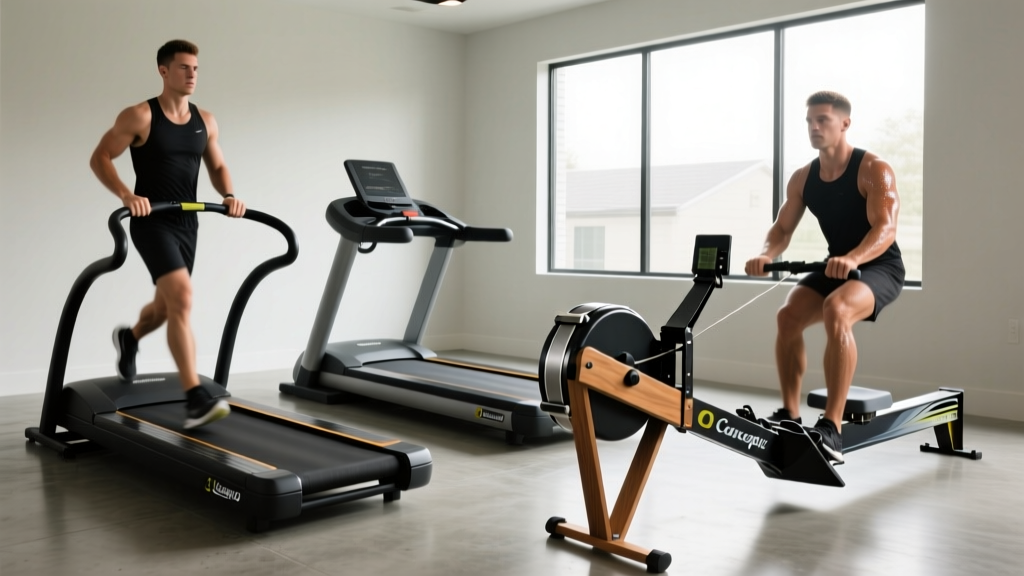
To understand which machine deserves your floor space and budget, we must dissect the biomechanics, metabolic output, and long-term failure modes of the three dominant rigs: the Assault AirRunner (Curved), the NordicTrack Commercial 2450 (Motorized), and the Concept2 RowErg (Rower).
Biomechanics and Muscle Activation
The Posterior Chain Advantage
According to biomechanics research published in the National Institutes of Health (NIH), running on a curved, non-motorized treadmill significantly increases the activation of the hamstrings and glutes compared to a motorized treadmill. Because the runner must actively 'pull' the belt backward with every foot strike, the ground reaction forces mimic the drive phase of a rowing stroke.
- Motorized Treadmills: The motor does the work of belt retraction. The user primarily engages the quadriceps and hip flexors to keep up with the set pace, leading to a quad-dominant stride.
- Curved Manual Treadmills: Forces the user into a mid-foot strike, engaging the calves, hamstrings, and glutes. It closely mirrors the lower-body power output required on a rower.
- Rowing Machines: As noted by Concept2's official training data, rowing engages 86% of the body's musculature, adding the lats, rhomboids, and biceps into the concentric phase—something no treadmill can achieve.
Head-to-Head Comparison Matrix
Below is a direct specification and performance matrix comparing the top-tier models in each category as of 2026.
| Feature | Assault AirRunner (Curved) | NordicTrack 2450 (Motorized) | Concept2 RowErg (Rower) |
|---|---|---|---|
| Current Pricing | $5,499 | $2,799 | $1,250 |
| Footprint (L x W) | 69" x 33" | 79" x 35" | 95" x 24" |
| Power Requirement | None (100% Manual) | 120V Dedicated Outlet | None (PM5 uses D-cell batteries) |
| Primary Muscle Focus | Glutes, Hamstrings, Calves | Quads, Hip Flexors, Calves | Full Body (86% Muscle Mass) |
| Max User Weight | 350 lbs | 300 lbs | 500 lbs |
| Impact / Joint Stress | Low (Slat belt absorbs shock) | Medium (Deck cushioning) | Zero (Seated, non-weight-bearing) |
Caloric Expenditure and Metabolic Demand
If your primary goal is calorie incineration, the treadmill vs rower argument shifts heavily based on the *type* of treadmill you choose. Studies indicate that running on a curved manual treadmill burns up to 30% more calories than running at the exact same speed on a motorized treadmill. The self-propelled nature eliminates the 'coasting' phase of a stride, demanding constant ATP production.
Metabolic Reality Check: A 180-lb athlete sprinting on an AirRunner will easily eclipse 1,000 calories per hour, rivaling the peak wattage output of a 500-meter rowing sprint. However, for sustained, steady-state Zone 2 cardio (45-60 minutes), the rower allows for a higher total work output with significantly less central nervous system (CNS) fatigue and zero joint impact.
Edge Cases and Real-World Failure Modes
Home gym equipment is an investment, and understanding how these machines break down is crucial for long-term ownership. Here are the specific failure modes our testing team has documented:
Curved Manual Treadmills (e.g., Assault AirRunner)
- The Slat Belt Snap: If a user over 250 lbs frequently performs heavy sled-push simulations or sprints with an aggressive heel-strike, the rubber slats can tear away from the internal guide rails. Replacement slat belts cost upwards of $400 and require significant labor to install.
- Bearing Degradation: The curved track relies on dozens of sealed ball bearings. In humid garage environments, these can seize or grind after 3-4 years, requiring a $150 bearing kit and a full teardown.
Motorized Treadmills (e.g., NordicTrack 2450)
- Incline Motor Burnout: Users who leave the treadmill at a 15% grade for extended '12-3-30' style workouts often overheat the incline actuator motor. This is a $200 part that fails far more frequently than the main drive motor.
- Screen & Software Bricking: Modern motorized treadmills are essentially giant tablets. Wi-Fi module failures and forced firmware updates can render a $2,800 machine completely unusable until patched.
Rowing Machines (e.g., Concept2 RowErg)
- Elastomer Shock Cord Stretch: The internal bungee cord that retracts the chain loses elasticity after 3-5 years of heavy use. Fortunately, it is a $15 part and takes 10 minutes to replace.
- Chain Stretch and Rust: Failure to oil the nickel-plated steel chain every 50 hours of use leads to micro-rust and chain elongation, eventually causing it to skip teeth on the main sprocket.
Space, Noise, and Maintenance Realities
When outfitting a home gym, the physical footprint and acoustic profile are often the deciding factors.
- Acoustic Output: The Concept2 RowErg generates roughly 70-75 decibels of wind noise at high damper settings, which can disrupt household members. The Assault AirRunner is remarkably quiet (around 60 dB), producing only the dull thud of footfalls. Motorized treadmills are the loudest, combining a 75 dB motor whine with heavy impact noise that travels through floor joists.
- Storage: The RowErg separates into two pieces and stands vertically, taking up just 25" x 34" of floor space. The AirRunner can be tipped onto its front stabilizer and rolled into a corner. Motorized treadmills are notoriously difficult to move; even when 'folded', the 2450 requires a massive 40" x 35" footprint and a 70-inch vertical clearance.
- Maintenance: The rower wins hands down. Wipe down the rail and oil the chain monthly. Motorized treadmills require belt alignment, silicone lubrication, and motor hood vacuuming. Curved treadmills require periodic bearing checks and slat tension adjustments.
The Final Verdict: Which Rig Belongs in Your Garage?
The treadmill vs rower showdown ultimately comes down to your specific physiological goals and spatial constraints.
Choose the Curved Manual Treadmill if: You are a field athlete, CrossFit competitor, or sprinter who needs to train the posterior chain and mimic over-ground running mechanics without the joint pounding of asphalt. It is the ultimate high-intensity interval training (HIIT) tool, provided you have the $5,500 budget.
Choose the Motorized Treadmill if: Your primary focus is marathon training, paced endurance work, or walking pad-style recovery. If you need the machine to dictate your pace and offer automated incline/decline variations, a motorized deck remains irreplaceable.
Choose the Rower if: You want the highest return on investment ($1,250), require a zero-impact modality that spares your knees and lower back, and demand full-body muscular endurance. For 80% of home gym owners, the Concept2 RowErg remains the undisputed king of efficient, low-maintenance cardiovascular conditioning in 2026.
Frequently Asked Questions
Can a curved treadmill replace a rower for CrossFit workouts?
Yes, for metabolic conditioning (metcons). Many CrossFit affiliates now substitute 1000m rowing intervals with 800m curved treadmill runs or 3-minute max-calorie AirRunner sprints, as the posterior chain demand and heart-rate spikes are nearly identical.
Are motorized treadmills bad for your knees compared to rowers?
While modern motorized treadmills feature advanced deck cushioning, running is inherently a high-impact, plyometric activity. The rower is entirely non-weight-bearing, making it the superior choice for individuals with patellar tendinopathy, meniscus tears, or severe osteoarthritis.
More gear to consider
All reviews
Sole vs Horizon Treadmill: Elliptical vs Treadmill Space Layouts
Fitbit Treadmill Sync: 2026 Head-to-Head Machine Comparison
Elliptical vs Treadmill: Using a Treadmill Military Discount
Elliptical vs Treadmill: Weslo Cadence G 5.9 Treadmill Reviewed

Perfect Your Walking Pace on Treadmill: Setup & Feature Guide