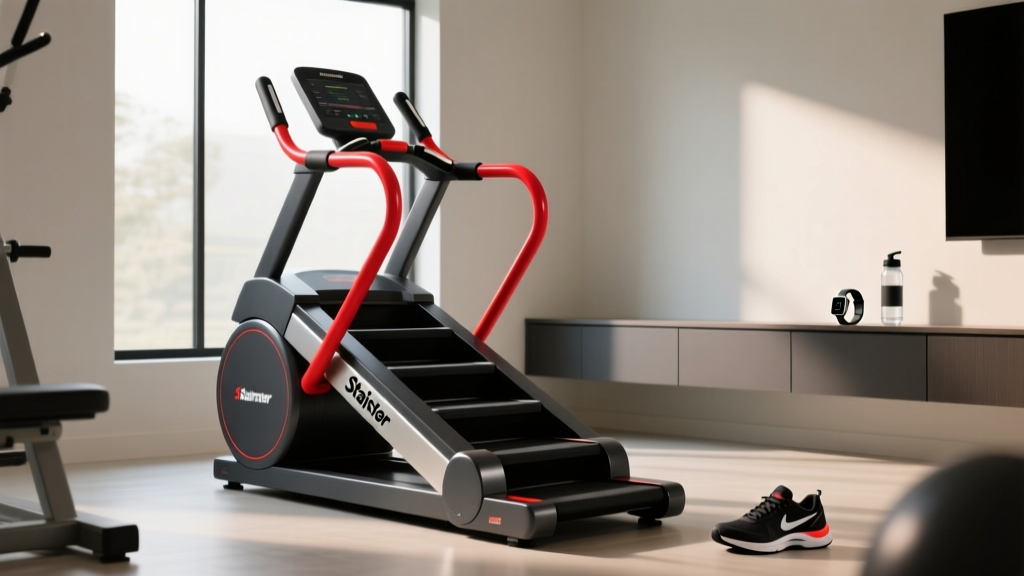
Is a StairMaster Better Than a Treadmill? Buying Mistakes
Discover if a StairMaster is better than a treadmill. Learn common feature comparison mistakes and troubleshoot your cardio machine buying guide.

When outfitting a home gym or upgrading a commercial fitness floor, the debate over whether to invest in a stair climber or a treadmill is a frequent bottleneck. Many buyers ask, is stairmaster better than treadmill equipment for their specific goals? The answer is rarely a simple yes or no; it depends entirely on biomechanics, spatial constraints, and drive-system engineering. Unfortunately, most treadmill buying guides and feature comparisons gloss over the critical mechanical differences, leading to expensive post-purchase regret.
Quick Diagnostic: Treadmills excel at versatile, multi-planar movement, sprint intervals, and eccentric loading. StairMasters provide unmatched concentric lower-body resistance, high caloric expenditure per minute, and low-impact cardiovascular conditioning. Choosing the wrong one usually stems from flawed feature comparisons.The Biomechanical Reality Check: Why Buyers Choose Wrong
Before diving into spec sheets, you must troubleshoot your physiological needs. According to the American Heart Association, adults need at least 150 minutes of moderate-intensity or 75 minutes of vigorous aerobic activity per week. Both machines fulfill this requirement, but they load the musculoskeletal system entirely differently.
Running on a treadmill involves high eccentric loading—the braking forces your muscles absorb when your foot strikes the deck. This builds bone density but increases joint stress. Conversely, a StairMaster relies almost entirely on concentric muscle contractions (the upward phase of a step). This spares the knees from impact shock but places massive metabolic demand on the quadriceps and glutes. Buyers who ignore this distinction often end up with a machine that aggravates their specific physical limitations.
4 Feature Comparison Mistakes in Your Buying Guide
When comparing a high-end treadmill like the Sole F80 or NordicTrack Commercial 2450 against a StairMaster FreeClimber or Gauntlet, consumers frequently make the following feature comparison errors.
Mistake 1: Equating Incline Percentage with Step Resistance
A common error is assuming a treadmill's 15% incline setting mimics a stair climber. It does not. On a treadmill, even at a 15% grade, you are still relying on the motorized belt to pull your foot backward, assisting in the hip-extension phase. On a StairMaster, you must manually lift your entire body weight against gravity for every single step. Comparing a treadmill's incline motor torque to a stair climber's step rate (SPM) is a false equivalence. If your goal is pure glute isolation and vertical power, no treadmill incline can replicate the mechanical disadvantage of a StairMaster step.
Mistake 2: Ignoring Ceiling Clearance and Footprint Math
Home gym builders routinely measure the floor footprint but forget the Z-axis (vertical clearance). This is a catastrophic mistake with stair climbers.
- StairMaster Clearance: The first step on a FreeClimber is roughly 8 to 10 inches off the ground. You must add your height, plus 12 inches of headroom for arm movement. A 6'0" user requires a minimum ceiling height of 8'8".
- Treadmill Clearance: A standard treadmill deck is 6 to 8 inches high. However, if you use a treadmill with a 15% to 20% incline (like the Bowflex Treadmill 22), the front of the deck raises an additional 9 to 11 inches. You still need an 8'0" to 8'6" ceiling for inclined running.
Troubleshooting Tip: If your basement ceiling is 8'0" or lower, a StairMaster is functionally unusable for anyone over 5'8". Opt for a low-profile treadmill or an elliptical.
Mistake 3: Misunderstanding Drive Systems (CHP vs. Alternator)
Buyers often look for 'horsepower' on both machines. Treadmills use Continuous Duty Horsepower (CHP) motors. For running, you need a minimum of 3.0 CHP (like the Sole F80's 3.5 CHP motor, priced around $1,099) to prevent the belt from stuttering under heavy footfalls. StairMasters, however, do not use standard drive motors to move the steps; they use alternators or hydraulic systems. An alternator generates electrical resistance as you step, powering the console and scaling the difficulty based on your cadence. Comparing a 3.0 CHP treadmill motor to a stair climber's alternator output is a fundamental misunderstanding of cardio machine engineering.
Mistake 4: Overlooking Handrail Dependency Metrics
Feature guides rarely mention the 'handrail trap.' The Mayo Clinic emphasizes proper posture for optimal aerobic benefit. On a StairMaster, leaning heavily on the handrails reduces caloric expenditure by up to 20% and shifts dangerous shear forces to the lumbar spine. Treadmills encourage a more natural, upright arm swing. If you have poor core stability or lower back issues, a StairMaster might exacerbate your pain if you rely on the rails, making a treadmill the safer biomechanical choice.
Troubleshooting Post-Purchase Regret
What if you have already made the wrong purchase? Before selling your machine at a loss, try these troubleshooting protocols to salvage your cardio routine.
Scenario A: You bought a treadmill, but your knees and shins ache.Fix: Stop running on a flat deck. Increase the incline to 2% to 3% to simulate outdoor wind resistance and reduce the eccentric braking forces on your patellar tendon. Alternatively, switch to the '12-3-30' method (12% incline, 3 mph, for 30 minutes) to shift the load from your joints to your posterior chain. Scenario B: You bought a StairMaster, but you are too fatigued to hit your AHA time goals.
Fix: The metabolic demand of concentric stepping is immense. Use interval troubleshooting: Alternate 2 minutes of stepping at 60 SPM (steps per minute) with 2 minutes of active recovery on a stationary bike or walking on a flat treadmill. Do not grip the handrails; instead, use a 'ghost grip' (hovering your hands just above the rails) to force core engagement without unloading your legs.
Head-to-Head Feature Matrix: Premium Models
To ground this troubleshooting guide in real-world purchasing, here is a direct feature comparison between two category leaders in the current market.
| Feature | Sole F80 Treadmill | StairMaster FreeClimber |
|---|---|---|
| Price Range | $999 - $1,099 | $3,499 - $3,899 |
| Drive System | 3.5 CHP DC Motor | Commercial Alternator |
| Impact Profile | Moderate (Cushion Flex Deck) | Very Low (Concentric only) |
| Min. Ceiling Req. | 7'6" (Flat) / 8'6" (Incline) | 8'8" (Standard User) |
| Primary Muscle Load | Calves, Hamstrings, Core | Quadriceps, Glutes |
Final Verdict and Expert Alignment
So, is a StairMaster better than a treadmill? If your primary objective is maximum caloric burn per minute, targeted glute hypertrophy, and joint preservation, the StairMaster wins. However, if you require sprint interval training, marathon pacing, and a lower entry price point, the treadmill is the undisputed champion.
For comprehensive guidelines on balancing these modalities to protect joint health while maintaining cardiovascular baseline, refer to the Centers for Disease Control and Prevention (CDC) physical activity frameworks. Ultimately, avoiding the feature comparison mistakes outlined above—specifically regarding ceiling clearance, drive mechanics, and eccentric loading—will ensure your capital is invested in the machine that actually serves your biomechanical reality.
More gear to consider
All reviews
Peloton Treadmill Motor Size Guide: HP & CHP Explained

Space-Saving Cardio: Livestrong LS10.0T Treadmill Small Space Review

Air Bike vs Assault Bike & NordicTrack Elite 1000 Treadmill Trends
Flylinktech Treadmill Review: 2026 Walking Pad Comparison

ProForm 505 Treadmill Setup vs Walking Pads: 2026 Review
