Beyond T101 Treadmill Reviews: Ultimate Belt Lubrication Guide
Most T101 treadmill reviews ignore long-term care. Learn exact belt lubrication steps, tension checks, and motor protection tips to extend your machine's life.

Why Most T101 Treadmill Reviews Miss the Mark on Longevity
When consumers research the Horizon Fitness T101, they are immediately drawn to its impressive entry-level specifications: a 2.25 CHP motor, Bluetooth audio connectivity, and a 50-inch running surface. However, if you read between the lines of standard t101 treadmill reviews, you will notice a glaring omission: long-term maintenance. Reviewers frequently test the machine for a few weeks and publish their findings, but they rarely address what happens in year two when friction begins to silently degrade the drive system.
As of 2026, the cost of replacing a treadmill motor control board (MCB) for entry-level models has climbed to between $140 and $180, while a replacement walking belt and deck combo can exceed $200 with labor. The single most effective way to protect your investment is through rigorous, scientifically sound belt lubrication and tension management. This guide bypasses the superficial unboxing experience and dives deep into the exact mechanical care required to keep your T101 running flawlessly for a decade.
The Physics of Treadmill Friction and Motor Strain
To understand why lubrication is non-negotiable, you must understand the anatomy of the treadmill deck. The Horizon T101 utilizes a phenolic-coated MDF (medium-density fiberboard) deck. The walking belt glides directly over this surface. Every footstrike drives the belt into the deck, creating kinetic friction.
When the belt is properly lubricated, a micro-layer of silicone separates the rubber backing from the phenolic resin, allowing the belt to hydroplane over the deck. When the lubricant dries out, rubber drags against wood resin. This friction forces the 2.25 CHP motor to work exponentially harder to maintain the belt's speed under a user's weight.
The Amp Draw Reality Check
A healthy, well-lubricated treadmill motor operating at 3.0 MPH with a 175-pound user should draw between 2.5 and 4.0 amps. When lubrication fails and friction spikes, that amp draw can easily surge to 7.0 to 10.0 amps. According to repair data compiled by the Treadmill Doctor, sustained amp draw above 6 amps is the primary culprit behind blown MOSFETs on motor control boards and tripped thermal breakers.
The 100% Silicone Mandate: What to Use and What to Avoid
The most catastrophic mistake a treadmill owner can make is reaching for a household lubricant. The chemical composition of the walking belt's underside requires a very specific type of fluid.
- USE: 100% pure liquid silicone or silicone gel designed specifically for fitness equipment. Liquid silicone is generally preferred for the T101 as it wicks easily across the 18-inch width of the deck.
- NEVER USE: WD-40, 3-in-One oil, Vaseline, or any petroleum-based distillate. Petroleum products will immediately break down the rubber compounds in the walking belt, causing it to stretch, warp, and ultimately snap.
- AVOID: Aerosol sprays containing propellants. The chemical propellants used in aerosol cans can degrade the belt adhesive and leave a sticky residue that attracts dust and debris.
Premium 100% silicone treadmill lubricants typically cost between $10 and $15 for a bottle that will last several years. This is a fractional premium to pay for motor preservation.
Step-by-Step T101 Belt Lubrication Protocol
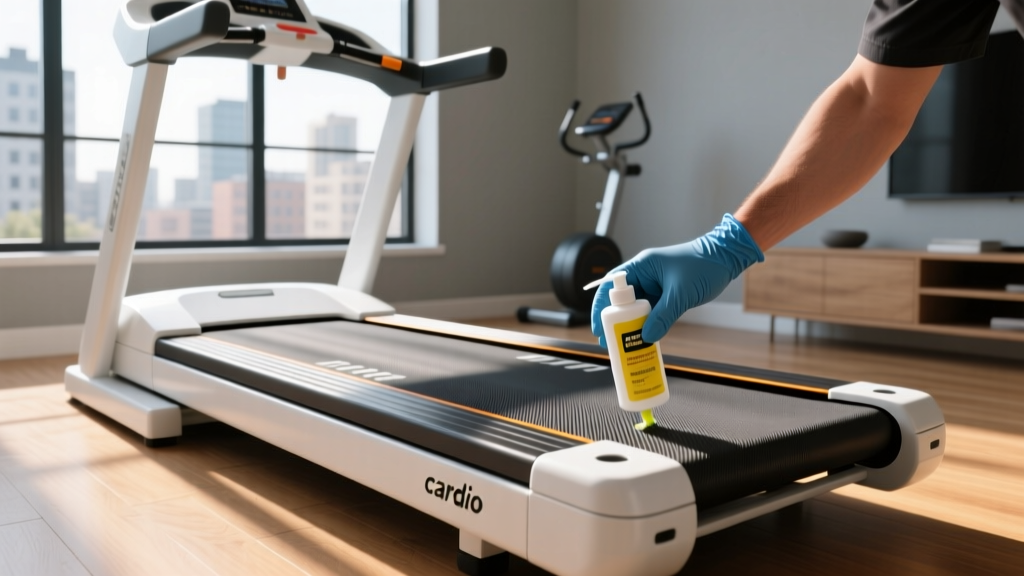
Do not simply squirt oil onto the belt and hope it spreads. Proper application requires a methodical approach to ensure even coverage across the entire 18' x 50' surface area.
- Power Down and Secure: Turn off the treadmill and remove the safety key. Unplug the machine from the wall outlet to eliminate any risk of accidental startup or electrical shock.
- Clean the Deck Edges: Use a microfiber cloth slightly dampened with water to wipe away dust, pet hair, and debris from the edges of the belt where it meets the side rails. Debris pushed under the belt will act like sandpaper on the phenolic deck.
- Lift the Belt: Reach under the center of the walking belt and gently lift it away from the deck. You should be able to lift it about 2 to 3 inches without straining the tension.
- Apply the Silicone: Insert the nozzle of your 100% silicone applicator under the belt. Squeeze exactly 0.5 ounces (about half a standard squeeze bottle line) in a zig-zag pattern across the width of the deck, focusing on the center where footstrikes are most concentrated.
- Repeat on the Opposite Side: Walk to the other side of the treadmill, lift the belt, and apply another 0.5 ounces. The total application should not exceed 1 ounce per session.
- Distribute the Lubricant: Plug the treadmill back in. Stand on the side rails, start the machine at a slow walking pace (2.0 to 3.0 MPH), and carefully walk on the belt for 3 to 5 minutes. Your foot pressure will force the silicone to spread evenly from the center to the edges.
Expert Insight: If you notice silicone squeezing out from the edges of the belt onto the side rails during the distribution walk, you have over-applied. Wipe the rails immediately with a dry cloth, as excess silicone on the rails creates a severe slip hazard for mounting and dismounting.
Verifying Belt Tension and Alignment
Lubrication reduces friction, but improper tension will destroy the motor roller and rear roller bearings. The T101's rear roller is adjusted via two tensioning bolts located at the very back of the machine, requiring a 6mm Allen wrench.
The Lift Test
With the machine off, lift the walking belt at the exact center point between the front and rear rollers. The belt should lift 2 to 3 inches off the deck. If it lifts higher than 3 inches, it is too loose and will slip under heavy footstrikes. If it lifts less than 2 inches, it is over-tensioned, which will cause premature bearing failure and excessive amp draw.
The Quarter-Turn Rule
If adjustment is necessary, use the quarter-turn rule. Turn both the left and right tensioning bolts exactly one-quarter turn clockwise. Test the lift again. Never adjust one side more than the other, as this will immediately throw the belt out of alignment, causing it to track off the deck and shred against the plastic side caps.
Diagnostic Matrix: Usage vs. Lubrication Frequency
Manufacturer manuals often provide vague advice like 'lubricate every 3 months.' However, maintenance schedules must be dictated by actual usage volume and environmental factors. The following matrix provides a precise, data-driven maintenance schedule for the Horizon T101.
| Weekly Usage Profile | Estimated Hours/Week | Lubrication Interval | Tension Check Interval |
|---|---|---|---|
| Light (Walking only, < 150 lbs user) | Under 3 hours | Every 6 months | Annually |
| Moderate (Jogging, 150-200 lbs user) | 3 to 5 hours | Every 3 months | Every 6 months |
| Heavy (Running, > 200 lbs user) | 5 to 10 hours | Every 6 weeks | Every 3 months |
| Extreme (Multiple users, HIIT sprints) | 10+ hours | Monthly | Monthly |
Note: Environmental factors matter. If your treadmill is located in a garage, basement, or arid climate where ambient humidity drops below 30%, the silicone will evaporate and degrade up to 30% faster. Adjust your intervals accordingly.
Real-World Failure Modes: The Cost of Neglect
Understanding what happens when maintenance is ignored provides the necessary motivation to stick to the schedule. Based on service data tracked by industry experts and publications like Consumer Reports, here are the three most common catastrophic failures associated with dry treadmill belts:
1. Deck Delamination and Grooving
When rubber drags against phenolic resin without a silicone barrier, the friction generates immense heat. Over time, this heat melts the resin coating, causing the belt to literally sand grooves into the MDF wood core. Once the wood is exposed, the deck is ruined. A replacement deck for a T101 costs roughly $90, but installing it requires removing the motor hood, loosening the rollers, and slipping the belt off—a labor-intensive process.
2. Motor Controller (MCB) Blowout
The MCB is the brain that regulates power to the drive motor. When friction spikes the amp draw, the MCB's capacitors and MOSFETs overheat. When a MOSFET fails, it typically fails 'shorted,' meaning the treadmill will immediately surge to maximum speed the second it is turned on, or it will trip the household circuit breaker instantly. Replacing an MCB requires sourcing the exact part number from Horizon Fitness support and carefully managing static electricity during installation.
3. Drive Belt Stretch and Slippage
While the walking belt is what you lubricate, the motor drive belt (the ribbed belt connecting the motor pulley to the front roller) also suffers from a dry deck. Because the motor is working twice as hard to pull a dry walking belt, the torque placed on the small motor drive belt causes it to stretch and slip, resulting in a jarring, stuttering sensation while running.
Final Thoughts on Equipment Longevity
The Horizon T101 remains one of the most capable budget-friendly treadmills on the market, provided it is treated as a mechanical machine rather than a plug-and-play appliance. By implementing a strict 100% silicone lubrication protocol, monitoring your amp draw, and respecting the quarter-turn tensioning rule, you can easily push the lifespan of your treadmill well past the standard 5-year industry average. Stop relying solely on initial unboxing reviews, and take control of your equipment's mechanical destiny.
More gear to consider
All reviews
NordicTrack T5 Zi Treadmill: Motor HP & Troubleshooting Guide

Beyond the Basic Treadmill Definition: Curved vs Motorized Guide

Pesticide Treadmill Definition: Fixing Toxic Belt Care
Treadmill Belt Care & Ladder Treadmill Machine Space Layouts

Curved vs Motorized Treadmill: Beyond Treadmill Pronunciation