SB Fitness Curved Treadmill vs Folding Models (2026)
We analyze the 2026 small-space cardio market, comparing the SB Fitness curved treadmill footprint against top folding treadmills for compact apartments.

The 2026 Small-Space Cardio Dilemma: Curved Performance vs. Compact Footprints
As urbanization accelerates and apartment square footage shrinks, the home fitness industry has pivoted hard toward spatial efficiency. In 2026, the market for compact cardio equipment is dominated by two competing philosophies: the biomechanical superiority of manual curved decks and the sheer convenience of hydraulic folding frames. For serious runners living in micro-apartments, this creates a distinct purchasing paradox.
This trend report and market analysis dissects the spatial realities of the SB Fitness curved treadmill against the leading folding treadmills for small spaces. While curved treadmills offer unparalleled calorie burn and joint-friendly mechanics, their rigid chassis designs pose significant challenges for compact floor plans. Below, we break down exact measurements, engineering limitations, and the best folding alternatives for space-starved home gyms.
The Engineering Reality: Why the SB Fitness Curved Treadmill Doesn't Fold
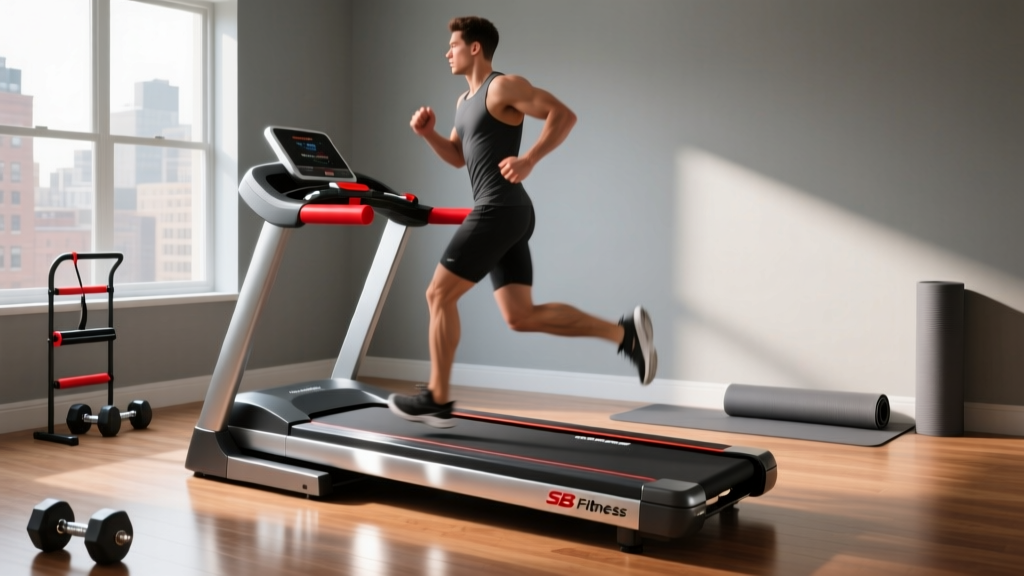
To understand the spatial footprint of the SB Fitness curved treadmill, you must first understand its structural engineering. Unlike motorized flat treadmills that utilize a simple hinge-and-lock mechanism at the base of the upright mast, curved treadmills rely on a continuous, arched steel subframe to support the vulcanized rubber slat belt.
Structural Warning: Introducing a folding hinge into the curved chassis of a manual treadmill compromises the lateral stability required to handle 300+ lbs of dynamic, off-center impact. Consequently, true folding curved treadmills do not exist in the 2026 commercial or prosumer market. The SB Fitness curved treadmill remains a fixed-footprint machine.The average SB Fitness curved model measures approximately 70 inches long by 33 inches wide, occupying roughly 16.1 square feet of permanent floor space. Furthermore, the curved deck inherently lifts the running surface by 4 to 5 inches at the apex, which alters ceiling clearance requirements—a critical factor for small basement or attic gyms.
Spatial Footprint Analysis: SB Fitness vs. 2026 Folding Leaders
How does the permanent footprint of a high-end curved manual treadmill compare to the latest folding motorized models? The table below maps the exact spatial economics of the top compact cardio machines available this year.
| Model | Type | Unfolded Footprint | Folded Footprint | 2026 Price |
|---|---|---|---|---|
| SB Fitness Curved (Pro Series) | Manual Curved | 70" x 33" (16.1 sq ft) | N/A (Fixed Frame) | $2,199 |
| Horizon Fitness T101 | Motorized Folding | 70" x 28" (13.6 sq ft) | 46" x 28" (8.9 sq ft) | $599 |
| NordicTrack EXP 7i | Motorized Folding | 70.5" x 29.5" (14.4 sq ft) | 42" x 29.5" (8.6 sq ft) | $699 |
| WalkingPad X21 | Ultra-Compact Folding | 63" x 20" (8.7 sq ft) | 38" x 20" x 5" (Stored flat) | $499 |
Top Folding Treadmills for Small Spaces: 2026 Market Review
If the permanent 16.1 square-foot footprint of the SB Fitness curved treadmill is incompatible with your living space, the 2026 folding treadmill market offers highly engineered alternatives. Here is our review of the top space-saving models, focusing on hinge durability, motor thermals, and stored dimensions.
1. Horizon Fitness T101: The Best Overall Spatial Compromise
The Horizon T101 remains a benchmark for small-space motorized treadmills. Its 2.5 HP continuous duty motor is sufficient for users up to 300 lbs, and its featherlight folding mechanism allows a single user to lock the deck vertically in under three seconds. Failure Mode Edge Case: In high-humidity environments, the T101's deck board can warp if stored vertically against an exterior wall for prolonged periods. We recommend storing it at least 4 inches away from drywall to allow airflow beneath the folded deck.
2. NordicTrack EXP 7i: The Interactive Space-Saver
For users who refuse to sacrifice digital integration for spatial efficiency, the EXP 7i offers a 10-inch pivoting screen and iFIT compatibility. When folded, the mast lays flush, reducing the machine's depth to just 42 inches. Expert Insight: The EXP 7i utilizes a hydraulic drop-fold system. While excellent for deployment, the hydraulic cylinder is known to lose pressure after 3-4 years of heavy daily use, requiring a $120-$150 replacement part. Factor this into your long-term cost of ownership.
3. WalkingPad X21: The Ultra-Compact Disruptor
When floor space is measured in inches rather than feet, the WalkingPad X21 is unmatched. Its 180-degree true-flat fold allows it to slide under a standard sofa (requiring only 5.5 inches of vertical clearance). Performance Caveat: With a 2.0 HP motor and a max speed of 7.5 MPH, this is strictly a walking and light-jogging machine. It cannot replicate the 15+ MPH sprint capabilities or the 30% higher caloric expenditure of a curved manual treadmill.
Biomechanics vs. Square Footage: Is the Spatial Sacrifice Worth It?
Why do athletes continue to buy fixed-frame curved treadmills like the SB Fitness model despite the spatial penalties? The answer lies in biomechanics. According to a comprehensive study published in the National Center for Biotechnology Information (NCBI), running on a curved treadmill significantly alters stride mechanics, increasing energy expenditure by up to 30% compared to standard motorized treadmills at the same perceived exertion level.
"The curved design forces the runner to strike the ground with the midfoot or forefoot, reducing the heavy heel-strike impact forces associated with traditional flat decks and motorized belt pulling."
Furthermore, the American Council on Exercise (ACE) consistently highlights manual treadmills as superior tools for high-intensity interval training (HIIT), as the user controls the belt speed instantaneously without waiting for a motor to spool up or spin down.
The Ceiling Height Trap
When planning space for a curved treadmill, do not just measure the floor. The SB Fitness curved deck adds roughly 4.5 inches to your standing elevation. If your apartment ceiling is 84 inches (7 feet), a 68-inch tall runner will have only 11.5 inches of head clearance at the apex of the curve—leaving zero room for vertical bounce during a sprint. Always add the deck lift to your height when calculating ceiling clearance.
The 2026 Compact Cardio Decision Framework
To finalize your purchasing decision, apply this practical framework based on your specific spatial and performance constraints:
- Choose the SB Fitness Curved Treadmill if: You have a dedicated, non-shared room with at least 16.5 square feet of permanent floor space, ceilings higher than 8 feet, and your primary goal is elite athletic conditioning, HIIT, and joint-friendly biomechanics.
- Choose the Horizon T101 if: You need a traditional motorized running experience (up to 10 MPH) but must reclaim 7 square feet of floor space post-workout. Ideal for shared living rooms and multi-purpose guest rooms.
- Choose the WalkingPad X21 if: You live in a studio apartment or dorm, your workouts consist primarily of walking or light jogging while working at a standing desk, and you need the machine to disappear completely under furniture.
Final Market Verdict
The 2026 cardio market forces consumers to choose between spatial dominance and biomechanical superiority. The SB Fitness curved treadmill remains an elite, uncompromising piece of athletic equipment, but its rigid engineering ensures it will never be a viable option for true small-space living. Conversely, modern folding treadmills have vastly improved their hinge durability and motor thermals, offering 90% of the cardiovascular benefits in a fraction of the stored footprint. Measure your space, respect the ceiling clearance, and align your purchase with your actual square footage, not just your fitness aspirations.
More gear to consider
All reviews
HealthRider SoftStrider Treadmill vs Modern Stair Climbers: 2026 Guide

Rowing Machine Setup: Avoid Aligning Treadmill Belt Hassles

Small Space Folding Treadmills Built for Treadmill Speed Workouts

Spin, Upright, Recumbent Care & NordicTrack Treadmill Manual Guide
Arm Treadmill vs Stationary Bike Types: 2026 Trends