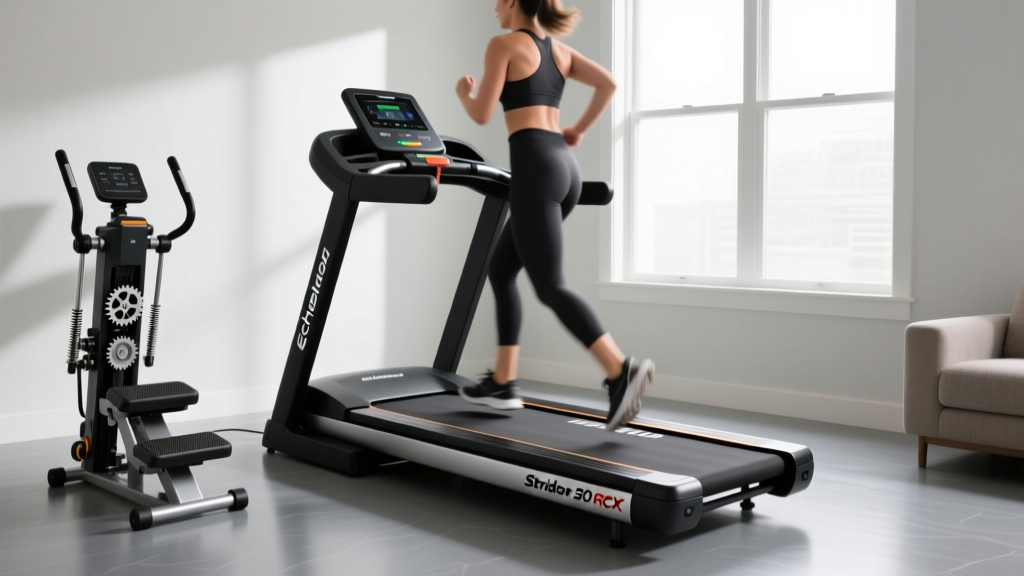
Home Stair Climber Fixes & Echelon Stride 50 RCX Treadmill Guide
Fix home stair climber mechanical issues and form mistakes. Compare vertical steppers to the Echelon Stride 50 RCX treadmill in our expert guide.

The Biomechanical Trap: Form Mistakes on Vertical Steppers
Bringing a stair climber machine into your home gym is one of the most effective ways to build lower-body power and elevate your VO2 max. However, the vertical stepping motion is highly unforgiving of poor biomechanics. Unlike flat-ground walking, a stair climber forces your glutes, quadriceps, and calves to lift your entire body weight against gravity with every repetition. When users fail to respect this mechanical demand, they not only sabotage their fitness results but also invite chronic joint pain.
"Leaning heavily on the handrails of a stair climber alters your center of gravity, effectively reducing your caloric expenditure by up to 30% while simultaneously placing dangerous shear forces on your lumbar spine." — American Council on Exercise (ACE)
The "Handrail Hang" and Shallow Stepping
The most pervasive mistake on home stair climbers is the "handrail hang." Users drape their upper body weight over the console rails, turning a rigorous vertical climb into a low-intensity shuffle. To correct this, maintain a "hover grip"—rest your fingertips lightly on the rails purely for balance, not support. Your torso should remain upright, with a slight 5-degree forward hinge originating from the ankles, not the waist.
Furthermore, many users take shallow, rapid steps. Biomechanical analyses from ExRx.net indicate that full-depth stepping (driving the pedal down until your knee reaches near-full extension) is required to properly activate the gluteus maximus. Aim for a cadence of 60 to 80 steps per minute with full range of motion, rather than 120 shallow, fluttering steps.
Equipment Selection: Stair Climber vs. Echelon Stride 50 RCX Treadmill
When outfitting a home gym, space constraints and joint impact are primary concerns. Many buyers cross-shop heavy vertical steppers with ultra-compact auto-folding treadmills. For instance, the Echelon Stride 50 RCX treadmill is a highly popular choice for low-profile, steady-state walking in small apartments or home offices.
However, transitioning from the Echelon Stride 50 RCX treadmill to a dedicated stair climber requires a complete recalibration of your expectations. Here is a decision framework to help you avoid the mistake of buying the wrong machine for your physiological goals:
| Feature / Goal | Home Stair Climber (e.g., Sunny Health SF-S9002) | Compact Auto-Folder (e.g., Echelon Stride 50 RCX treadmill) |
|---|---|---|
| Primary Muscle Target | Glutes, Hamstrings, Calves (High Load) | Quads, Hip Flexors (Low Load / Endurance) |
| Joint Impact | Zero-impact, but high compressive force on patellofemoral joint | Low-impact, natural gait cycle |
| Footprint & Storage | Small base (approx. 25" x 30"), but tall vertical clearance required | Folds flat for under-bed storage; low vertical profile |
| Best Use Case | Hypertrophy, VO2 Max intervals, climbing prep | NEAT (Non-Exercise Activity Thermogenesis), walking pad desk use |
If your goal is to maximize caloric burn in under 20 minutes and build lower-body strength, the stair climber is superior. If you need a machine that disappears under your bed and allows you to walk while working at a standing desk, the Echelon Stride 50 RCX treadmill is the undisputed winner. The mistake lies in expecting a compact walking pad to deliver the muscular overload of a vertical stepper, or expecting a heavy stepper to fold away into a closet.
Mechanical Troubleshooting Matrix: Fixing Home Steppers
Home stair climbers rely on a combination of hydraulic cylinders, eddy-current magnetic resistance, and optical sensors. When these machines break down, it is rarely a catastrophic motor failure; it is usually a minor calibration or maintenance issue. Cardiologists at the Cleveland Clinic often recommend stair climbing for cardiovascular health, but only if the machine operates smoothly without jerky resistance that could cause a knee tweak.
Use this diagnostic matrix to troubleshoot the most common mechanical failures on home stair climbers:
| Symptom | Probable Cause | Exact Fix & Tool Required |
|---|---|---|
| Console displays "E1" or "E2" Error | Optical speed sensor is misaligned with the flywheel slotted disc, or data cable is loose. | Remove lower shroud. Align the U-shaped optical sensor so the disc passes perfectly through the center without rubbing. Clean sensor eye with 90% isopropyl alcohol. (Requires: Phillips #2 screwdriver, Q-tips). |
| Pedal arm squeaks at "Top Dead Center" | Friction in the upper pivot bushing or lack of lubrication on the main crank bearing. | Apply a dry PTFE (Teflon) spray lubricant directly into the pivot bushing seam. Wipe away excess. (Requires: PTFE Dry Lube, shop rag). |
| Resistance surges or feels "jerky" | The servo motor cable that moves the magnetic bracket is sticking, or the potentiometer is dirty. | Locate the tension cable connecting the servo motor to the magnet assembly. Apply a single drop of synthetic grease to the cable guide pulley. (Requires: 3/16" Allen key, synthetic grease). |
| Pedals slowly sink to the floor when idle | Hydraulic cylinder seal failure (common on older, non-magnetic mini-steppers). | Hydraulic cylinders cannot be repaired; they must be replaced. Order OEM replacement cylinders matched to your exact model's stroke length and Newton rating. |
⚠️ CRITICAL WARNING: The WD-40 Trap
Never use standard WD-40 or petroleum-based wet lubricants on the pivot points, chains, or drive belts of your stair climber. Wet lubricants attract dust, pet hair, and microscopic debris, which rapidly turns into an abrasive grinding paste that will destroy your machine's bushings and optical sensors within weeks. Always use a dry PTFE or silicone-based lubricant designed for fitness equipment.
Preventative Maintenance: The 90-Day Protocol
To ensure your stair climber lasts through years of high-intensity interval training (HIIT), implement this strict 90-day maintenance schedule. Neglecting this protocol is the root cause of 80% of all out-of-warranty service calls.
- Static Grounding Check: Ensure the machine is plugged directly into a grounded wall outlet, never a cheap extension cord. Static buildup from synthetic workout clothes can fry the upper console memory or cause the LCD screen to flicker and reset mid-workout.
- Hardware Torque Audit: The vertical vibration of stair climbing loosens hardware faster than any other cardio machine. Every 90 days, use a torque wrench to check the M8 x 60mm carriage bolts connecting the pedal arms to the main crank. They should be tightened to exactly 25 Nm (Newton-meters).
- Belt and Chain Tension: If your model uses a chain drive, check the deflection. Press down on the middle of the chain; it should have exactly 1/4 inch to 1/2 inch of play. If it sags more than 1/2 inch, loosen the rear axle nuts and slide the axle back slightly to re-tension the chain.
Final Thoughts on Home Cardio Selection
Whether you are troubleshooting a squeaky pivot arm on your vertical stepper or trying to decide if the Echelon Stride 50 RCX treadmill better suits your compact living space, understanding the mechanical and biomechanical realities of your equipment is paramount. Stop leaning on the rails, keep your optical sensors clean, and match the machine to your specific physiological goals. Your joints, your fitness metrics, and your home gym investment will thank you.
More gear to consider
All reviews
Sole F80 Treadmill vs Walking Pads: Beginner Setup Guide

ProForm Carbon TL Treadmill: Features Comparison & Setup Guide

Interval Walking Treadmill Belt Maintenance for Small Spaces
Portable Cardio & Puppy Treadmill Training: 2026 Budget Guide

Rowing Machine Buying Guide: Technique & 1750 Treadmill Comparison
