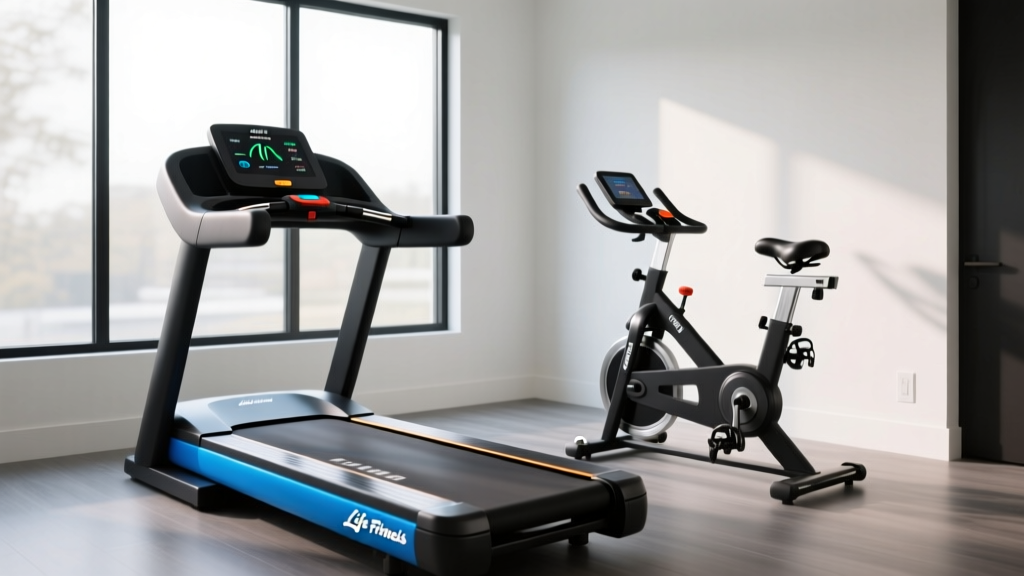
Life Fitness Treadmills vs Stationary Bikes: 2026 Market Analysis
Explore the 2026 market shift from Life Fitness treadmills to stationary bikes. We analyze upright, recumbent, and spin bike trends, specs, and pricing.

For over two decades, the luxury home gym and commercial fitness floor were defined by a single, dominant footprint: the premium treadmill. Specifically, Life Fitness treadmills like the Club Series+ and Integrity Series have long been the gold standard for cardiovascular training, commanding premium price tags and serving as the anchor of high-end fitness facilities. However, as we navigate the 2026 fitness equipment market, a distinct macroeconomic and biomechanical shift is underway. Consumers and facility managers are increasingly reallocating capital away from traditional treadmills and toward specialized stationary bikes—specifically spin, upright, and recumbent models.
This trend report and market analysis dissects the fragmentation of the cardio equipment market. By comparing the historical dominance of Life Fitness treadmills against the surging demand for modern stationary bike types, we uncover the data-driven reasons behind this pivot and provide a strategic purchasing framework for the year ahead.
The Macro Shift: Why Buyers Are Rethinking the Treadmill
To understand the rise of the stationary bike, we must first establish the baseline. A standard Life Fitness Club Series+ Treadmill requires a minimum of 22 square feet of operational clearance, weighs over 300 pounds, and carries an MSRP hovering around $7,499. While its FlexDeck shock absorption system remains industry-leading, the modern consumer is constrained by urbanization and multi-family housing layouts.
2026 Market Insight: According to facility data aggregated by the Health & Fitness Association (HFA), the average square footage dedicated to cardio equipment in new boutique and residential gyms has decreased by 14% since 2022. Facility managers are prioritizing high-density, low-impact machines to maximize ROI per square foot.Furthermore, longevity-focused training has overtaken pure caloric expenditure as the primary motivation for home cardio. The repetitive ground-reaction forces associated with treadmill running—even on premium shock-absorbing decks—are driving aging millennials and Gen X buyers toward zero-impact alternatives. This has catalyzed a massive R&D investment into three distinct stationary bike categories: spin, upright, and recumbent.
Spin Bikes (Indoor Cycles): The High-Performance Segment
The spin bike category, technically classified as indoor cycles, has evolved from friction-resistance basement bikes into highly calibrated, data-rich performance machines. In 2026, the market is defined by magnetic resistance systems, belt-driven drivetrains, and Bluetooth FTMS (Fitness Machine Service) connectivity for seamless integration with platforms like Zwift and Kinomap.
Biomechanics and Engineering
When analyzing high-end spin bikes, the critical metric is the Q-factor—the horizontal distance between the outside of the pedal attachment points. A narrower Q-factor mimics the natural biomechanics of outdoor cycling, reducing lateral knee strain.
- Life Fitness ICG IC7: Featuring a precision 155mm Q-factor and a Coach Color Power display, the IC7 remains a staple in commercial studios. Its magnetic resistance offers virtually silent operation and requires zero maintenance compared to older friction pads. Priced at approximately $2,199, it represents the premium tier of non-subscription-locked hardware.
- Keiser M3i: The undisputed king of wattage accuracy. Utilizing eddy current magnetic resistance and a rear-mounted 3-pound flywheel with a massive gear ratio, the M3i delivers +/- 1 watt accuracy across all cadences. At $2,295, it is the preferred choice for serious cyclists who require exact power-zone training.
Unlike Life Fitness treadmills, which demand dedicated electrical circuits and structural floor reinforcement in older homes, these premium spin bikes draw negligible power (or operate on AA batteries, in Keiser's case) and occupy a mere 8 square feet.
Upright Bikes: The Traditionalist's Compromise
Upright stationary bikes occupy the middle ground between the aggressive, forward-leaning geometry of a spin bike and the fully supported posture of a recumbent. They are characterized by a wider, padded saddle, a vertical seat post, and integrated console systems that prioritize guided programming over raw performance metrics.
The 2026 upright bike market is heavily focused on ergonomic frame design to mitigate the lower back fatigue historically associated with traditional upright cycling. The Life Fitness CSX Upright Cross-Trainer and the Life Fitness Club Series+ Upright Bike (MSRP $3,999) utilize a 'V-shaped' frame geometry. This design subtly alters the hip-to-pedal angle, reducing knee extension strain at the bottom of the pedal stroke by up to 12% compared to legacy straight-tube frames.
“We are seeing a distinct pivot in the luxury home market. Buyers who previously purchased Life Fitness treadmills for general health are now opting for high-end upright bikes. They want the cardiovascular benefits without the joint degradation, and they want a machine that allows them to read or work on a tablet comfortably.” — 2025 Consumer Reports Fitness Equipment Analysis (Source)
Upright bikes are currently dominating the 'active recovery' and 'steady-state zone 2' training segments. With integrated tablet holders, USB-C fast charging, and automated magnetic resistance that adjusts via Bluetooth API, the modern upright bike is essentially a mobile office that happens to burn 400 calories an hour.
Recumbent Bikes: The Longevity and Rehabilitation Standard
If spin bikes are for performance and upright bikes are for convenience, recumbent bikes are the undisputed champions of longevity, rehabilitation, and accessibility. Featuring a step-through design, a bucket seat with a mesh backrest, and pedals positioned in front of the user, recumbent bikes eliminate axial loading on the spine entirely.
The Clinical and Demographic Driver
The aging global population and the rise of post-operative orthopedic rehabilitation have made recumbent bikes a mandatory inclusion in 2026 fitness facility planning. According to annual trend reports published in ACSM's Health & Fitness Journal, functional fitness and low-impact rehabilitation protocols remain top-tier global trends, directly driving recumbent bike procurement.
The Life Fitness Integrity Series CLRB Recumbent Lifecycle (approx. $4,800) sets the commercial benchmark. Its 13-degree recline angle is specifically engineered to decompress the sciatic nerve while maintaining optimal blood flow to the lower extremities. For the home market, the Schwinn 270 Recumbent (approx. $1,199) offers a compelling value proposition, featuring dual LCD screens, 29 preset programs, and a walk-through frame design that accommodates users with severe hip or knee mobility restrictions.
2026 Market Comparison Matrix
To contextualize the market shift away from traditional treadmills, facility managers and home gym builders must evaluate the distinct operational profiles of each machine type.
| Machine Type | Avg. Footprint | Joint Impact | 2026 Price Range | Primary Demographic |
|---|---|---|---|---|
| Premium Treadmill (e.g., Life Fitness Club+) | 22 - 25 sq ft | High (Axial) | $6,500 - $9,000 | Marathoners, Sprinters |
| Spin Bike (e.g., ICG IC7, Keiser M3i) | 8 - 10 sq ft | Zero | $1,800 - $2,800 | HIIT, Cyclists, Tech-Users |
| Upright Bike (e.g., Life Fitness CSX) | 10 - 12 sq ft | Low | $2,000 - $4,500 | General Fitness, Multitaskers |
| Recumbent Bike (e.g., Integrity CLRB) | 14 - 16 sq ft | Zero (Spinal) | $2,500 - $5,500 | Rehab, Seniors, Lumbar Issues |
Strategic Purchasing Framework for 2026
Choosing between a premium treadmill and a specialized stationary bike is no longer just a matter of personal preference; it is a spatial and biomechanical calculation. Use the following framework to guide your 2026 equipment acquisition:
1. The Space-Constrained Urban Professional
Verdict: Spin Bike. If your dedicated fitness space is under 50 square feet, a Life Fitness treadmill is mathematically unviable. Invest in a Keiser M3i or Life Fitness ICG IC7. The small footprint, combined with the ability to fold away or easily roll the bike into a closet, maximizes utility without sacrificing high-intensity interval training (HIIT) capabilities.
2. The Longevity and Joint-Preservation Buyer
Verdict: Upright or Recumbent Bike. If you are over 45, recovering from a lower-body injury, or simply prioritizing joint preservation over raw athletic performance, abandon the treadmill. An upright bike like the Life Fitness Club Series+ provides excellent Zone 2 cardiovascular conditioning. If lumbar support is a priority, the recumbent Lifecycle series is the only logical choice.
3. The Commercial Facility Manager
Verdict: Diversified Fleet. The days of filling a cardio theater with 20 identical Life Fitness treadmills are over. The 2026 standard dictates a 40/40/20 split: 40% treadmills for traditional runners, 40% spin/upright bikes for low-impact and tech-integrated users, and 20% recumbent bikes to ensure ADA compliance and cater to the growing active-aging demographic.
Conclusion
While Life Fitness treadmills will forever hold a prestigious place in the hierarchy of cardiovascular equipment, the 2026 market data is unequivocal: the stationary bike—in its spin, upright, and recumbent iterations—has captured the majority of new market growth. Driven by spatial efficiency, advanced magnetic resistance engineering, and a cultural shift toward joint-preserving longevity training, stationary bikes are no longer just alternatives to the treadmill; for a growing majority of consumers, they are the superior primary investment.
More gear to consider
All reviews
Curved vs Motorized: NordicTrack Commercial 1750 Treadmill with iFIT

Vision T600 Treadmill vs Portable Cardio: 2026 Market Trends
SL Q22 Treadmill Review: Budget Under-Desk Value Analysis
Urevo Foldi 3S Treadmill vs. Quiet Cardio: 2026 Noise Comparison
Curved vs Motorized: Beginner Guide to Fitness on Treadmill Setups
