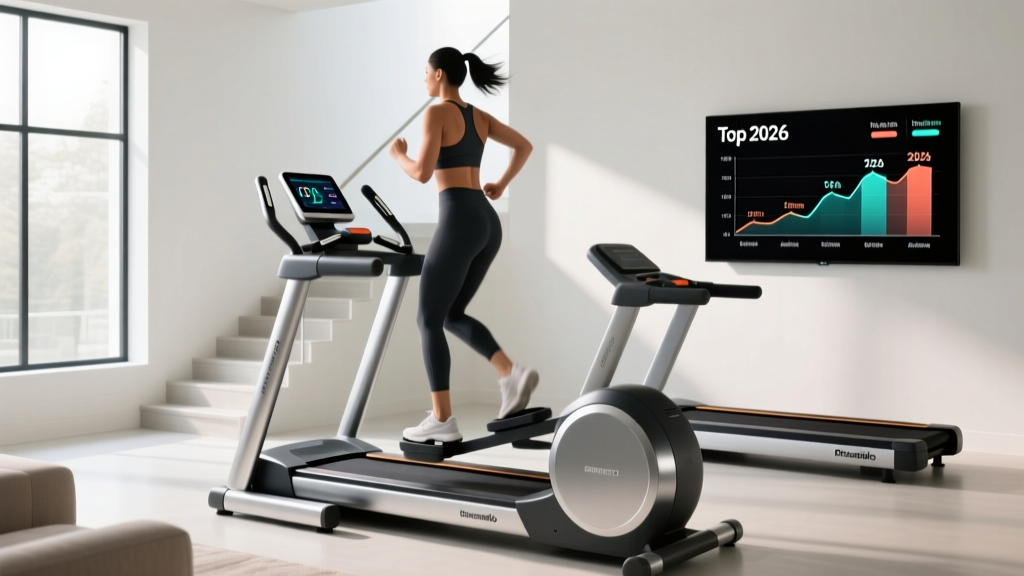
Home Stair Climber Guide: Treadmill Time Chart Comparison
Discover the best home stair climbers of 2026. We compare top models and use a treadmill time chart to prove which machine burns calories faster.

The Great Cardio Debate: Stair Climber vs. Treadmill
As we navigate the 2026 home fitness landscape, the battle for limited garage and basement space has forced consumers to choose between traditional treadmills and vertical cardio machines. While treadmills remain the default for marathon training, the stair climber has emerged as the undisputed king of high-yield, low-impact glute and cardiovascular conditioning. But how do you quantify the efficiency of a stair climber against a standard treadmill walk or run? The answer lies in a direct metabolic comparison.
In this comprehensive home stair climber guide, we will break down the biomechanics of vertical stepping, review the top three stair climbing machines for home use this year, and utilize a specialized treadmill time chart to demonstrate exactly how much time you save by stepping instead of striding.
Biomechanical Insight: The Vertical Advantage
When you walk on a flat treadmill, your body primarily engages in horizontal force production. A stair climber forces vertical force production against gravity with every single step. According to the American Council on Exercise (ACE), vertical stepping recruits the gluteus maximus, quadriceps, and hamstrings simultaneously through a deeper range of motion, resulting in a significantly higher metabolic demand per minute compared to level-ground ambulation.
The Treadmill Time Chart: Calorie Equivalency Matrix
To understand the true value of a stair climber, we must translate its output into treadmill metrics. Below is our 2026 treadmill time chart, which maps the estimated calorie burn of 30 minutes on a commercial-grade stair climber against various treadmill speeds and inclines. Data is modeled on a 155-pound (70kg) individual, referencing baseline metabolic equivalents (METs) from Harvard Health Publishing.
| Machine / Activity Setting | Duration | Est. Calorie Burn | Joint Impact Force |
|---|---|---|---|
| Stair Climber (Moderate, 60 SPM) | 30 Minutes | 310 - 340 kcal | 1.5x Bodyweight |
| Treadmill (3.5 mph, 0% Incline) | 65 Minutes | 315 kcal | 2.0x Bodyweight |
| Treadmill (3.5 mph, 10% Incline) | 40 Minutes | 325 kcal | 2.2x Bodyweight |
| Treadmill (6.0 mph Run, 0% Incline) | 30 Minutes | 340 kcal | 3.0x Bodyweight |
The Takeaway: To match a 30-minute moderate stair climbing session, you must either walk on a treadmill for over an hour, or run at a 10-minute-mile pace. Furthermore, running generates double the joint impact force compared to the smooth, controlled descent of a stair climber's pedals.
2026 Head-to-Head: Top 3 Home Stair Climbers Reviewed
Not all stair climbers are created equal. The market is split between rotating stepmills, hybrid steppers, and hydraulic mini-steppers. Here is how the top models compare for home integration this year.
1. StairMaster StepMill 3 (SM3) – The Premium Biomechanical Standard
The SM3 is the gold standard for home stepmills, bringing commercial-grade rotating stairs into a residential footprint. Unlike pedal-based steppers, the SM3 forces you to lift your foot entirely, mimicking real-world stadium stairs.
- Price: ~$2,499
- Dimensions: 46" L x 20" W x 73" H
- Step Specs: 8-inch step height, 10-inch depth
- Motor: 3.0 HP Continuous Duty
Expert Insight: The SM3 requires a minimum ceiling clearance of 8 feet 6 inches. If you are 6 feet tall, the peak of your step will put your head within 14 inches of the ceiling. Do not install this in a basement with low ductwork. Additionally, the 3.0 HP motor requires a dedicated 20-amp circuit; sharing it with a mini-fridge or space heater will trip the breaker mid-workout.
2. Bowflex Max Trainer M9 – The Space-Saving HIIT Hybrid
If a rotating stepmill is too tall or heavy, the Bowflex Max M9 offers a pedal-based hybrid design that combines the vertical stepping motion of a climber with the upper-body engagement of an elliptical.
- Price: ~$2,299
- Dimensions: 49" L x 30.5" W x 65.5" H
- Resistance: 20 levels of magnetic resistance
- Tech: JRNY adaptive coaching integration
Expert Insight: The M9 uses a magnetic flywheel rather than a motorized stair track, meaning it is whisper-quiet and can be placed in an upstairs bedroom without vibration transfer. However, the 6-inch pedal travel is shorter than a true stepmill, making it better suited for high-intensity interval training (HIIT) rather than steady-state endurance climbing.
3. Sunny Health & Fitness SF-S722013 – The Budget Mini-Stepper
For apartments or tight corners, this hydraulic mini-stepper provides a vertical burn at a fraction of the cost, though it sacrifices the continuous motion of its premium counterparts.
- Price: ~$149
- Dimensions: 17" L x 13" W x 52" H (with handlebar)
- Resistance: Hydraulic cylinders with adjustable tension knob
- Max User Weight: 220 lbs
Expert Insight: Hydraulic cylinders are highly sensitive to ambient temperature. If you keep this in an uninsulated garage during winter, the hydraulic fluid viscosity increases, resulting in a sluggish pedal return and a jerky stepping motion. It is strictly an indoor, climate-controlled machine.
Real-World Failure Modes & Maintenance Edge Cases
When deciding between a treadmill and a stair climber, long-term maintenance is a critical, often overlooked factor. Treadmills require relentless belt lubrication and tensioning. Stair climbers present a different set of mechanical edge cases.
⚠️ Common Stair Climber Failure Points
- Optical Sensor Dust (Rotating Stepmills): The SM3 relies on an optical encoder to track stair speed and ensure user safety. In dusty home gyms, particulate matter builds up on the sensor lens, causing the machine to falsely read that the stairs are moving too fast, triggering an abrupt, jarring emergency stop. Fix: Wipe the internal sensor housing with compressed air every 3 months.
- Hydraulic Seal Blowouts (Mini-Steppers): Budget steppers like the Sunny model rely on O-ring seals inside the hydraulic pistons. Exceeding the 220 lb weight limit, or stepping with a heavy, stomping cadence rather than a smooth press, will blow these seals, resulting in fluid leaks and total loss of resistance.
- Potentiometer Drift (Pedal Steppers): On magnetic pedal climbers, the tension dial uses a physical potentiometer. Over time, the carbon track wears down, causing the digital display to show Level 10 resistance while the physical magnets are stuck at Level 4.
Spatial & Electrical Framework: What Contractors Don't Tell You
Before purchasing any cardio equipment in 2026, run this spatial checklist. The Mayo Clinic emphasizes that environmental safety and proper ergonomics are just as vital as the exercise itself for preventing domestic injuries.
- The Ceiling Math: Take your height in inches, add 12 inches (for the peak of the step and head clearance), and add the machine's base step-up height (usually 10 to 14 inches). If your ceiling is 84 inches (7 feet), a 6-foot-tall user cannot safely use a rotating stepmill.
- The Footprint Trap: Treadmills require 24 inches of clearance behind the belt for safety egress. Stair climbers do not require rear clearance, but they do require 18 inches of lateral clearance for mounting and dismounting, especially for users with limited hip mobility.
- Power Draw: Motorized stepmills draw peak amperage during the initial startup torque (getting the stairs moving from a dead stop). Ensure your home gym is wired with 12-gauge wire on a 20-amp breaker to prevent voltage drops that can fry the machine's lower control board.
Final Verdict: Which Machine Belongs in Your Home Gym?
If your primary goal is marathon prep, horizontal pacing, or walking pad integration under a standing desk, the treadmill remains your only logical choice. However, if you are optimizing for time efficiency, glute hypertrophy, and joint preservation, the stair climber is the superior investment.
As our treadmill time chart proves, you would need to spend more than double the time on a flat treadmill to match the caloric and muscular output of a standard stair climbing session. For the ultimate home experience, the StairMaster SM3 offers unparalleled biomechanical realism, provided your ceiling height and electrical grid can support it. For those prioritizing quiet operation and upper-body integration, the Bowflex Max M9 remains the most versatile hybrid on the market this year.
More gear to consider
All reviews
Starting Treadmill Running vs Stair Climber: Home Guide & Mistakes

Sole F63 Treadmill Specs: Feature Comparison & Buying Mistakes
Maintaining Your Gold's Gym Treadmill 450 & Stationary Bike Types
Maximize Benefits of Treadmill for Belly Fat: Belt Care
Setup Guide: Curved vs Motorized for Brisk Walking on Treadmill
