Stair Climber Home Guide vs HIIT Training on Treadmill for Beginners
Discover why a stair climber beats HIIT training on treadmill for beginners. Our 2026 home buying guide compares top models, dimensions, and joint impact.

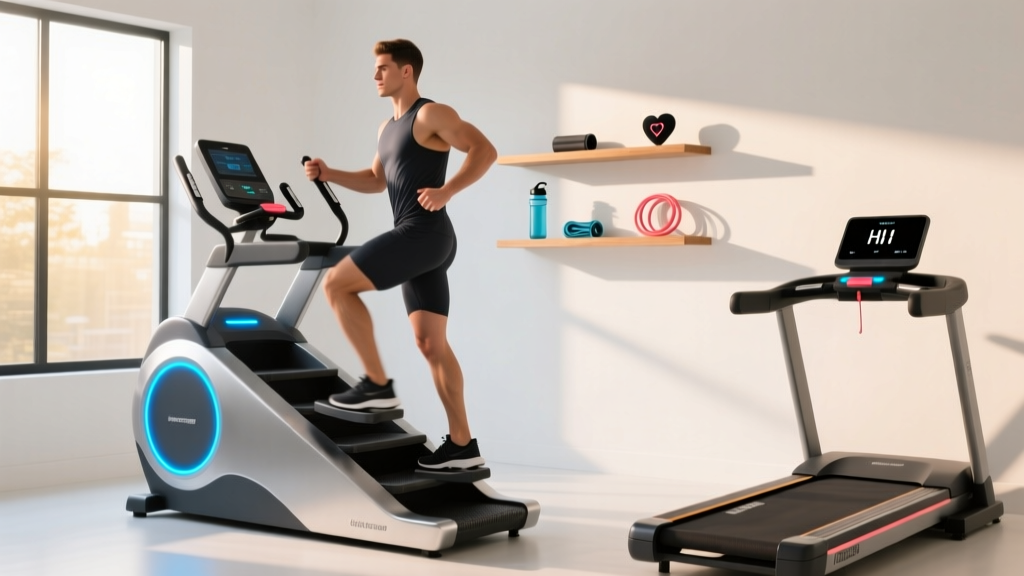
When outfitting a home gym in 2026, the debate between vertical climbers and traditional treadmills remains a primary sticking point for cardiovascular conditioning. While many mainstream fitness apps default to prescribing HIIT training on treadmill for beginners, the biomechanical reality of high-intensity sprinting in a confined home space often leads to joint fatigue, equipment wear, and spatial limitations. This in-depth buying guide explores why transitioning to a stair climber machine for home use might be the superior choice for your cardiovascular health, joint longevity, and spatial footprint.
The Home Cardio Dilemma: Stair Climbers vs. Treadmills
For beginners, the appeal of a treadmill is familiarity. However, executing true High-Intensity Interval Training (HIIT) on a motorized treadmill presents unique mechanical hurdles. When you transition from a walking pace to an all-out sprint, the treadmill belt requires time to accelerate. This "belt lag" forces users to either jump onto the moving rails—a dangerous maneuver for beginners—or endure a suboptimal 5-to-8-second acceleration phase that dilutes the anaerobic stimulus of the interval.
Conversely, stair climbers and vertical climbers offer instantaneous resistance. The moment you push harder, the machine responds, making it vastly superior for true zero-lag interval work. Furthermore, according to Cleveland Clinic's analysis on stair climbing benefits, the vertical plane of motion recruits the gluteus maximus and quadriceps with significantly higher activation rates than flat-surface running, all while reducing the eccentric impact forces that typically cause patellar tendinopathy in novice runners.
⚠️ CRITICAL SPATIAL WARNING: The Ceiling Clearance RuleBefore purchasing any stair climber, measure your ceiling height. Standard US residential ceilings are 8 feet (96 inches). If you are 6 feet tall (72 inches) and the machine's peak step height is 15 inches, your head will be at 87 inches, leaving less than a foot of clearance. This causes psychological claustrophobia and physical danger during high-cadence HIIT. Always ensure a minimum of 15 inches of clearance above your tallest user's head at the machine's maximum step elevation.
Key Metrics: Stair Climber vs. Treadmill for Beginner HIIT
To understand why fitness professionals are increasingly recommending climbers over treadmills for novice interval work, we must look at the raw biomechanical and spatial data.
| Feature | Motorized Treadmill | Home Stair Climber |
|---|---|---|
| Impact Force (per stride) | 2.5x to 3.0x Body Weight | 1.2x to 1.5x Body Weight |
| Sprint Acceleration Lag | 3 to 8 seconds | 0 seconds (Instantaneous) |
| Avg. Footprint (L x W) | 75" x 32" (16.6 sq ft) | 45" x 30" (9.3 sq ft) |
| Primary Muscle Recruitment | Calves, Hamstrings, Core | Glutes, Quads, Calves |
| Ceiling Requirement | Standard 8 ft | 8.5 ft to 10 ft |
2026 Home Stair Climber Buying Guide: Top Models Tested
The market has bifurcated into two distinct categories: rotating stairmills (which mimic actual stairs) and vertical climbers (which use alternating pedals and arm levers). Here are the top performers for home use this year.
1. Bowflex Max Trainer SE (Premium Hybrid Climber)
Price: $1,999 | Footprint: 49" L x 30.5" W x 65.5" H | Resistance: 20 levels of magnetic eddy current
The Max Trainer SE remains the gold standard for home HIIT. Unlike hydraulic steppers of the past, the SE utilizes a magnetic resistance flywheel that provides a buttery-smooth pedal stroke with zero "dead spots" at the apex. The integrated JRNY app adapts your resistance in real-time based on your heart rate variability. For beginners, the low-impact elliptical-stepper hybrid motion is exceptionally forgiving on the Achilles tendon while still delivering the VO2 max benefits of vertical climbing.
2. MaxiClimber XL-2 (Best Budget Vertical)
Price: $299 | Footprint: 36" L x 28" W x 71" H | Resistance: 12 levels magnetic
If you are strictly focused on upper-and-lower body synchronization without the $2,000 price tag, the XL-2 is the undisputed budget king. It folds down to a mere 5-inch profile, making it ideal for apartment dwellers. Expert Caveat: Because it lacks a heavy flywheel, the momentum is entirely user-generated. Beginners must focus on controlled, deliberate steps rather than bouncing, which can cause the pedals to bottom out harshly.
3. StairMaster StairMill 9 (The Commercial Gold Standard)
Price: $4,299 | Footprint: 69" L x 32" W x 84" H | Resistance: Self-generating alternator
For those with dedicated home gym spaces and 9-foot ceilings, the StairMill 9 brings the commercial gym experience home. It features actual rotating stairs, forcing the user to lift their dead body weight with every step. The self-generating alternator means it requires zero wall outlets. It is the ultimate tool for posterior chain development, but its massive footprint and strict ceiling requirements make it a non-starter for standard residential bedrooms.
Programming Your First Stair Climber HIIT Routine
According to the American Heart Association guidelines on HIIT, interval training should elevate your heart rate to 80-95% of its maximum during work periods. Here is a 15-minute beginner-friendly protocol designed specifically for the instantaneous resistance of a stair climber.
- The Warm-Up (Minutes 0-3): Maintain a steady, conversational pace (RPE 4/10). Focus on pushing through the heel of your foot to engage the glutes, rather than staying on your toes, which will prematurely fatigue the calves.
- The Interval Block (Minutes 3-12):
- Work (30 seconds): Push the cadence to a brisk climb (RPE 8/10). Do not hold onto the handrails; this reduces caloric expenditure by up to 20% and compromises lumbar posture.
- Active Recovery (60 seconds): Slow the cadence to a casual stroll (RPE 3/10). Do not stop completely, as blood pooling in the lower extremities can cause dizziness.
- Repeat this 30/60 cycle 6 times.
- The Flush (Minutes 12-15): Gradually decrease the resistance level (if applicable) and slow your pace to bring your heart rate back below 100 BPM.
"The beauty of the stair climber for novice interval work is the elimination of the braking phase. On a treadmill, your hamstrings must work eccentrically to decelerate your body weight with every footstrike. On a climber, the concentric push is the entire movement, drastically reducing delayed onset muscle soreness (DOMS) for beginners."
— Biomechanical Analysis of Vertical vs. Horizontal Locomotion
Installation & Maintenance Edge Cases
Home stair climbers require specific maintenance protocols that differ vastly from treadmills. Ignoring these will lead to catastrophic failure modes within the first year of ownership.
Sensor Dust and Optical Tracking
Unlike treadmills that use magnetic reed switches, many modern climbers use optical sensors to track step cadence. In a home environment, dust and pet dander easily accumulate in the sensor housing, leading to "phantom steps" or sudden resistance dropouts. Actionable Fix: Use a can of compressed air to blow out the pedal housing sensors every 60 days.
Hydraulic vs. Magnetic Fluid Leaks
If you purchase a budget hydraulic mini-stepper (typically under $150), be aware that the hydraulic cylinders are prone to thermal degradation. After 20+ minutes of continuous HIIT, the hydraulic fluid heats up, thins out, and can blow the cylinder O-rings, resulting in a slick, dangerous mess on your hardwood floors. For any HIIT routine exceeding 15 minutes, always opt for magnetic or eddy-current resistance systems.
Floor Reinforcement and Vibration
A 200 lb user stepping dynamically on a stair climber generates localized downward force exceeding 400 lbs per square inch. If your home gym is on a second-floor wooden joist system, place a 3/4-inch high-density EVA foam mat beneath the machine. This not only dampens the low-frequency acoustic vibration that travels to the floor below but also prevents the machine's leveling feet from punching through vinyl plank flooring.
Final Verdict: Making the Switch
While Mayo Clinic's research on interval training confirms that any modality that elevates the heart rate will yield cardiovascular adaptations, the stair climber offers a uniquely optimized package for the home environment. It eliminates the dangerous belt-lag of treadmills, slashes joint impact forces by half, and provides superior gluteal recruitment. For beginners ready to commit to home HIIT, investing in a quality magnetic stair climber is the most biomechanically sound and spatially efficient decision you can make in 2026.
More gear to consider
All reviews
Treadmill Motor Size Guide: Is the XTERRA TR300 Treadmill HP Enough?
Elliptical vs Treadmill: Can You Train for a Marathon on a Treadmill?

ProForm XP Weight Loss 620 Treadmill vs Under-Desk Office Review

Curved vs Motorized: Long Walk Movie Treadmill Screening Mistakes

Nordic Track T 6.5 S Treadmill vs Stationary Bike Types: 2026 Guide
