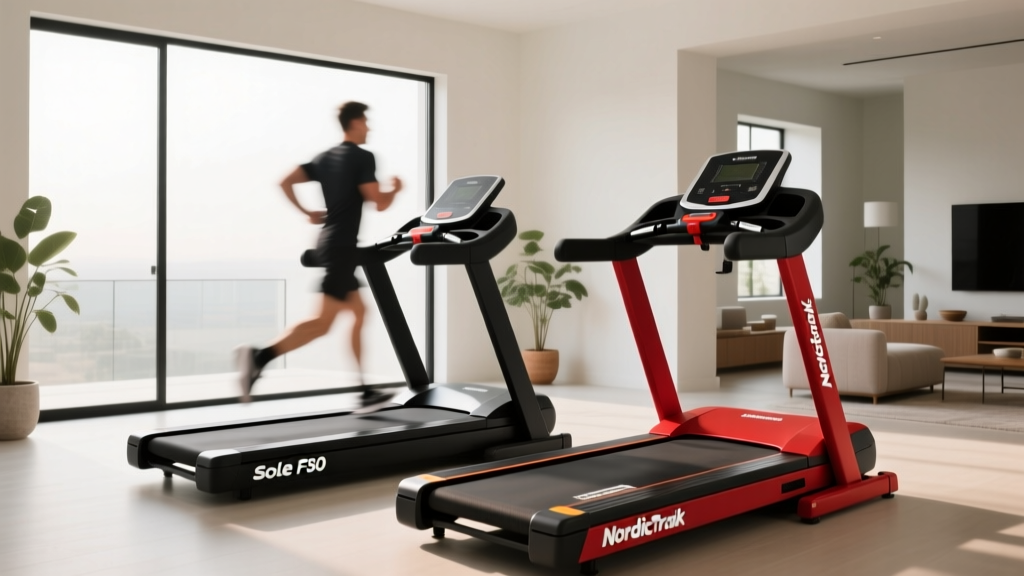
Sole F80 vs NordicTrack: Best for a Person Running on a Treadmill
Compare the Sole F80 and NordicTrack 1750 to find the best fit for a person running on a treadmill. Deep dive into motors, belts, and tech.

The Heavyweight Treadmill Showdown: Sole F80 vs. NordicTrack 1750
Choosing the right cardio equipment for your home gym requires looking past flashy marketing and diving into biomechanics, engineering, and long-term reliability. When observing a person running on a treadmill, the interaction between the runner's gait cycle and the machine's deck response dictates not only performance but also injury prevention. In 2026, the mid-to-high-end home treadmill market is dominated by two distinct philosophies: the utilitarian, durability-focused approach of the Sole F80, and the immersive, tech-heavy ecosystem of the NordicTrack Commercial 1750.
Both machines feature 3.5 Continuous Horsepower (CHP) motors and spacious 22-inch by 60-inch running belts, but their similarities largely end there. According to Consumer Reports, motor cooling efficiency and deck cushioning are the primary differentiators in treadmills priced between $1,000 and $2,000. This head-to-head comparison will dissect the exact specifications, failure modes, and real-world usability of both models to help you decide which machine truly supports your running mechanics.
Motor Dynamics and Belt Engineering
The heart of any treadmill is its motor. While both the Sole F80 and the NordicTrack 1750 boast 3.5 CHP motors, their thermal management and torque delivery differ significantly. The Sole F80 utilizes a heavy-duty flywheel and an advanced cooling fan system that keeps the motor temperature remarkably low during sustained marathon-training runs. Conversely, the NordicTrack 1750 relies on a self-cooling motor design that performs exceptionally well during interval training but can run slightly warmer during continuous 90-minute steady-state runs.
Belt Tension and Deck Friction
A common failure mode in home treadmills is belt stretching and deck friction, which forces the motor to overwork. The Sole F80 features a 2-ply phenolic-coated belt that requires zero lubrication and maintains tension far longer than standard belts. The NordicTrack uses a 1-ply commercial belt that is remarkably smooth but may require re-tensioning after 300 to 400 miles of heavy use. For a heavier person running on a treadmill (over 220 lbs), the Sole's robust belt tracking system provides a noticeable advantage in edge-case stability.
Expert Insight: Never confuse Peak Horsepower with Continuous Duty Horsepower (CHP). Peak HP only measures the motor's maximum output for a few seconds. Both Sole and NordicTrack correctly advertise 3.5 CHP, meaning they can sustain this power output indefinitely without overheating.Biomechanics: Cushioning and Joint Impact
The biomechanics of a person running on a treadmill involve repetitive ground reaction forces that can reach up to 2.5 times the runner's body weight. The American Council on Exercise (ACE) emphasizes that inadequate shock absorption leads to tibial stress and patellofemoral pain. Here is where the two machines diverge sharply in their engineering philosophy.
- Sole F80 (Cushion Flex Whisper Deck): Sole utilizes a multi-zone elastomer cushioning system. The front of the deck (strike zone) is softer to absorb impact, while the rear (push-off zone) is firmer to provide energy return. Independent testing shows this reduces joint impact by up to 40% compared to running on asphalt.
- NordicTrack 1750 (FlexSelect Cushioning): NordicTrack offers an adjustable dial that allows you to turn the cushioning on or off. When turned off, the deck mimics the rigid feel of a road surface, which is excellent for runners training for outdoor marathons who need to condition their legs to hard pavement.
If your primary goal is joint preservation and recovery, the Sole F80's engineered, non-adjustable elastomers provide a more consistently forgiving ride. If you are a competitive runner needing to simulate outdoor road conditions, the NordicTrack's adjustable deck is a superior training tool.
Specifications and Performance Matrix
Below is a detailed breakdown of the core specifications that dictate the running experience on both machines.
| Feature | Sole F80 (2026 Edition) | NordicTrack Commercial 1750 |
|---|---|---|
| Motor | 3.5 CHP | 3.5 CHP |
| Running Surface | 22' x 60' | 22' x 60' |
| Top Speed | 12 MPH | 12 MPH |
| Incline / Decline | 0% to 15% Incline | -3% Decline to 15% Incline |
| Display | 9.0' LCD (Device Casting) | 14' HD Smart Touchscreen |
| Max User Weight | 350 lbs | 300 lbs |
| Retail Price (Approx.) | $1,199.99 | $1,799.00 |
Incline, Decline, and the Eccentric Loading Advantage
One of the most significant functional advantages of the NordicTrack 1750 is its -3% decline capability. When a person running on a treadmill utilizes a decline, it forces the quadriceps and anterior tibialis muscles to perform eccentric contractions. This is vital for runners preparing for downhill segments in trail races or road marathons, as it builds the specific muscular endurance required to handle braking forces without suffering delayed onset muscle soreness (DOMS). The Sole F80 maxes out at a steep 15% incline, which is excellent for glute activation and VO2 max hill sprints, but lacks the eccentric training benefits of a decline feature.
Tech Ecosystems: iFIT vs. Sole Fitness App
The user interface is where the price gap between these two machines is most justified. The NordicTrack 1750 is built around the iFIT ecosystem. Its 14-inch HD touchscreen streams global running routes with automatic incline and decline adjustments. If you run through the Swiss Alps in an iFIT video, the machine physically tilts to match the topography in real-time. However, this requires a mandatory iFIT subscription (approximately $396 per year) and a stable Wi-Fi connection. If your home gym is in a basement with poor signal, the NordicTrack's smart features become a liability.
The Sole F80 takes a pragmatic approach. Its 9-inch LCD is basic, displaying standard metrics (pace, distance, heart rate, calories). However, it features a built-in device holder and Bluetooth connectivity that allows you to cast the Sole Fitness App or third-party apps like Zwift and Peloton Digital directly from your own tablet. You own the machine outright without being locked into a mandatory monthly software subscription, making it highly cost-effective over a 5-to-10-year lifespan.
'The best treadmill is the one that removes friction from your daily routine. If a mandatory Wi-Fi connection or subscription paywall prevents you from starting your run, the technology has failed its primary purpose.' — FitGearPulse Editorial Team
Real-World Failure Modes and Warranty Edge Cases
Based on long-term repair data and consumer feedback, the failure modes for these two machines differ based on their complexity. The NordicTrack 1750, due to its advanced electronics and moving touchscreen pivot, occasionally experiences console screen digitizer failures or incline motor calibration errors after 3 to 4 years of heavy use. The Sole F80, lacking a massive touchscreen and complex decline motors, has a significantly lower electronic failure rate. Its most common maintenance requirement is simply vacuuming dust from the motor hood every six months to prevent thermal throttling.
Warranty coverage reflects this reliability gap. Sole offers a lifetime warranty on the frame and motor, plus 3 years on parts and electronics. NordicTrack offers a lifetime frame warranty, but only 1 year on parts and labor. When factoring in the total cost of ownership, the Sole F80's superior parts warranty and lower initial price point make it a safer financial investment for budget-conscious buyers.
The Final Verdict: Which Machine Should You Buy?
The decision ultimately hinges on your training goals, budget, and technological preferences. If you are a competitive runner who values immersive coaching, requires eccentric decline training, and wants automatic topographical adjustments, the NordicTrack Commercial 1750 is unmatched in its class. The $1,799 price tag and ongoing iFIT subscription are justified by the premium, studio-like experience it delivers.
However, if you want a no-nonsense, highly durable workhorse that prioritizes joint health and long-term reliability over flashy screens, the Sole F80 is the undisputed winner. Its superior weight capacity (350 lbs), zero-maintenance belt, and lack of mandatory software subscriptions make it the most practical and cost-effective choice for the everyday person running on a treadmill in a home gym environment.
More gear to consider
All reviews
Curved Manual vs Motorized: Picking the Right ifit.com Treadmill
Air Bike vs Assault Bike: Value Beyond iFIT Treadmill Workouts
ProForm 345 Crosswalk Treadmill vs Elliptical: Value Breakdown

Folding Treadmill Longevity: Care Tips Beyond a Treadmill GIF

Hitting a 7.2 Treadmill Pace on Compact Portable Cardio Gear
