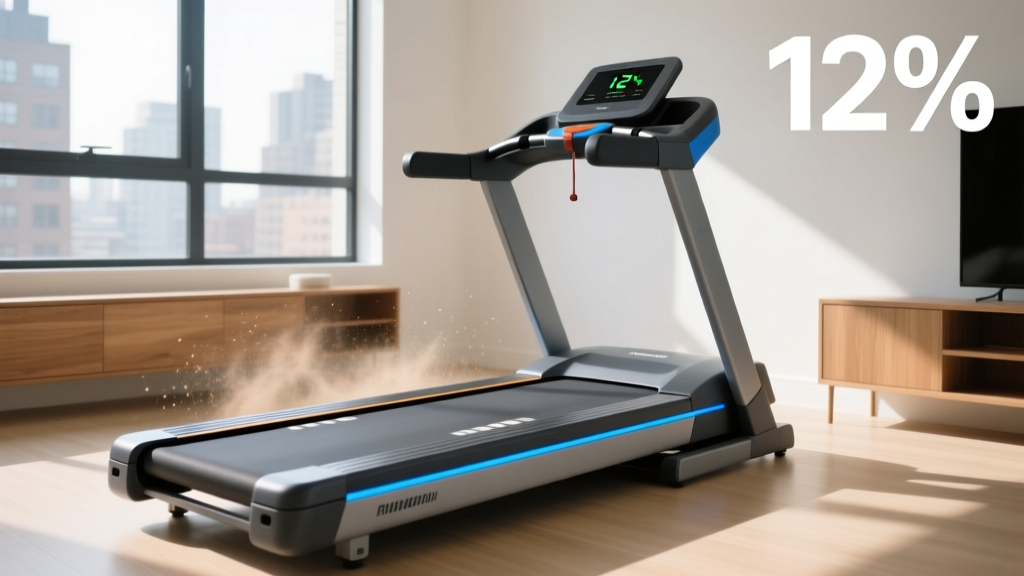
Treadmill Belt Costs: What Is 12 Incline on Treadmill in Numbers?
Analyze treadmill belt maintenance costs and lubrication budgets. Plus, learn what is 12 incline on treadmill in numbers and how it affects belt wear.

The Hidden Budget of Treadmill Ownership in 2026
When budgeting for a home cardio setup, most buyers focus entirely on the upfront retail price of the machine. However, the true cost of ownership lies in the long-term maintenance of the treadmill's most critical wear-and-tear component: the running belt and deck. As we navigate the fitness equipment market in 2026, automated friction sensors have become common in premium commercial models, but the vast majority of residential treadmills still require manual belt lubrication and tension adjustments to prevent catastrophic motor failure.
Furthermore, the explosion in popularity of high-resistance walking routines has fundamentally changed how home treadmills are utilized. This shift brings up a vital biomechanical and mechanical question that directly impacts your maintenance budget: what is 12 incline on treadmill in numbers, and how does that specific grade accelerate the degradation of your belt's silicone barrier? This comprehensive value analysis breaks down the exact costs of treadmill belt care, the physics of high-incline friction, and how to maximize your equipment's ROI.
Treadmill Maintenance Budget Matrix (2026 Estimates)
Understanding the financial stakes of neglecting your treadmill belt is the first step in building a proactive maintenance budget. A dry belt creates immense kinetic friction, which forces the drive motor to draw excessive amperage, eventually burning out the motor controller or the windings themselves.
| Maintenance Task | Estimated Cost (DIY vs. Pro) | Frequency | Value / ROI Impact |
|---|---|---|---|
| 100% Silicone Lubrication | $12 - $18 (DIY) | Every 3-6 months (or 150 miles) | Prevents $400+ motor burnout; extends belt life by 40%. |
| Belt Tension & Alignment Calibration | $0 (DIY) / $85-$120 (Pro Tech) | Annually or after relocation | Prevents edge fraying and deck gouging. |
| OEM Replacement Belt (Mid-Range) | $90 - $160 (e.g., Sole F80, Horizon 7.8) | Every 4-7 years | Restores factory performance; cheaper than buying a new unit. |
| Deck Replacement (Phenolic/Composite) | $150 - $350 + Labor | Only if severe grooving occurs | Mandatory if old deck is warped; otherwise ruins new belts instantly. |
| Drive Motor Replacement | $350 - $650+ (Commercial grade) | Rare (Usually a result of neglect) | Poor ROI; often signals the end of the machine's viable lifespan. |
The Physics of Friction: What Is 12 Incline on Treadmill in Numbers?
To understand why your lubrication budget might need to increase, we must address the mechanics of steep incline walking. When users adopt viral fitness challenges and search for what is 12 incline on treadmill in numbers, they are looking for the mathematical translation of the machine's digital display.
In engineering and physics, a '12 incline' does not mean 12 degrees. It represents a 12% grade. This means that for every 100 units of horizontal distance, the belt rises 12 units vertically. Using trigonometry (the arctangent of 0.12), a 12% grade translates to an actual physical angle of roughly 6.84 degrees. According to biomechanics data cited by the American Council on Exercise (ACE), walking at a 12% grade drastically alters your center of gravity and increases the ground reaction forces exerted on the deck.
⚠️ The 12% Grade Friction Multiplier
When you walk on a flat (0%) treadmill, your weight is distributed relatively evenly, and the belt glides over the deck with minimal downward pressure. At a 12% incline, gravity pulls you backward into the deck, increasing the normal force. This heightened downward pressure squeezes the microscopic layer of silicone lubricant out from between the belt and the phenolic deck. Consequently, users who frequently run the 12-3-30 routine (12% incline, 3 mph, 30 minutes) will degrade their belt lubrication up to 30% faster than users who only train on flat surfaces.
Lubricant Chemistry: Why the Cheapest Option is the Most Expensive
A common budget mistake is substituting specialized treadmill lubricant with household multi-purpose sprays like WD-40 or generic silicone blends. This is a catastrophic error that will void your warranty and destroy your equipment.
- Petroleum Distillates (The Enemy): Standard aerosol lubricants contain petroleum-based solvents. These chemicals react with the rubber and PVC compounds of the treadmill belt, causing it to dry rot, stretch, and eventually snap. Replacing a snapped belt and a damaged deck will cost upwards of $300.
- 100% Pure Silicone (The Standard): Treadmill manufacturers, including industry leaders like NordicTrack and Sole Fitness, mandate the use of 100% pure liquid silicone. Silicone is chemically inert, meaning it will not break down the rubber compounds, and it possesses a high thermal stability that withstands the heat generated by high-friction incline walking. A standard 4 oz bottle of 100% silicone costs between $12 and $18, making it one of the highest-ROI investments in your fitness budget.
Step-by-Step Belt Lubrication and Tension Check
To ensure your maintenance budget remains in the 'DIY' tier rather than the 'Professional Repair' tier, follow this exact procedure every 150 miles or every 6 months (whichever comes first, or every 3 months if you exclusively train at a 12% incline).
- The Lift Test (Tension Check): Turn off and unplug the machine. Reach into the center of the belt and lift it away from the deck. You should be able to lift it exactly 2 to 3 inches. If it lifts higher, the belt is too loose (causing slippage); if lower, it is too tight (straining the motor bearings).
- Loosen the Rear Rollers: Using the provided Allen wrench, turn the rear adjustment bolts counter-clockwise by exactly two full rotations on both the left and right sides to create slack.
- Apply the Silicone: Slide your hand under the belt as close to the center of the deck as possible. Squeeze the applicator bottle to draw a continuous 'S' or 'W' shape across the width of the deck, using roughly 0.5 oz of liquid silicone.
- Retighten to Factory Spec: Turn the rear bolts clockwise by the exact same two full rotations to restore the original tension.
- Distribution Run: Plug the machine in, stand on the side rails, and start the belt at 3.0 MPH. Let it run for 5 minutes. The friction will naturally heat the silicone and distribute it evenly across the entire phenolic deck surface.
When to Abandon Lubrication and Budget for a Replacement
Lubrication is a preventative measure, not a cure for terminal wear. According to equipment longevity reports tracked by Consumer Reports, even meticulously maintained belts will eventually succumb to mechanical fatigue. You must budget for a full belt and deck replacement if you observe any of the following failure modes:
1. Visible Deck Grooving
If you can remove the belt and feel physical trenches or grooves worn into the wooden or composite deck, lubrication will no longer work. The new belt will act like sandpaper against the grooved deck and be destroyed within weeks. Budget $150–$250 for a new OEM deck and belt combo.
2. Edge Fraying and Delamination
If the edges of the belt are curling, fraying, or separating from the internal woven nylon tension layer, the structural integrity is compromised. This is often caused by chronic misalignment or running at high speeds on a dry deck.
3. Chronic Motor Overheating
If your treadmill abruptly shuts down after 20 minutes of use, or if you smell a distinct 'hot rubber' or ozone odor, the friction coefficient has exceeded the motor's thermal limits. While this can sometimes be fixed with a deep clean and heavy silicone application, it often indicates that the belt's underside has glazed over and lost its porous ability to hold lubricant.
Final Value Analysis
Maintaining a treadmill is an exercise in micro-economics. Spending $15 a year on pure silicone and 10 minutes of your time yields a massive return by protecting a $600 drive motor and a $200 belt-deck assembly. Furthermore, understanding the mechanical realities of your workouts—such as the exact physics of what is 12 incline on treadmill in numbers—allows you to adapt your maintenance schedule to your training style. By treating your treadmill belt as a consumable component rather than a permanent fixture, you ensure that your cardio investment continues to deliver value for a decade or more.
More gear to consider
All reviews
Air Bike vs Assault Bike Care: Beyond the ProForm Treadmill Manual

Stair Climber Guide: Setup Without a Commercial 1750 Treadmill Manual

Is It Better to Walk Outside or on a Treadmill? Elliptical ROI

SF-T7917 Treadmill: Curved vs Motorized 2026 Buying Guide

Are Treadmill Miles Accurate? Curved vs Motorized Guide
