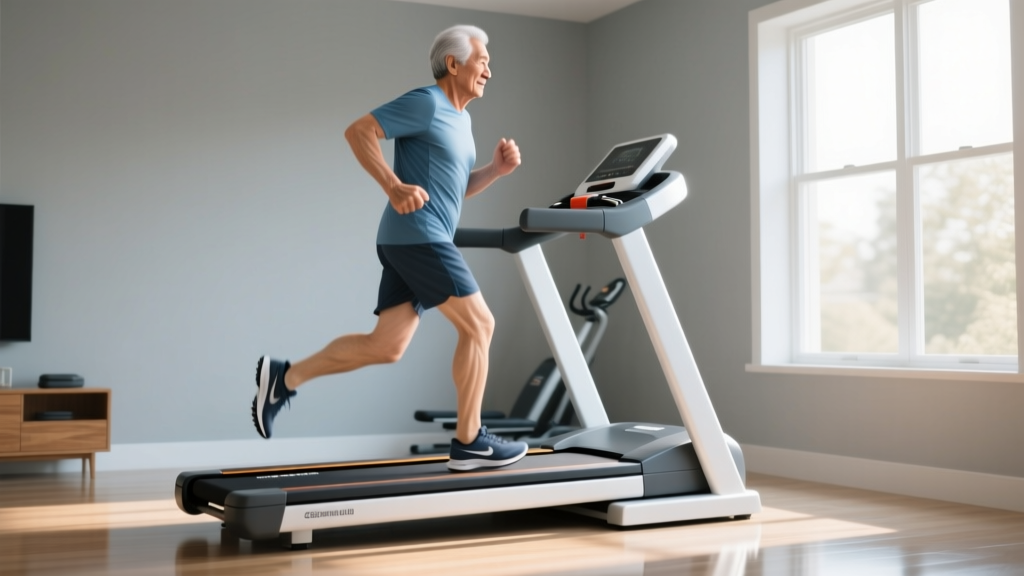
Senior Running on Treadmill: Foot Drop Issues Guide 2026
Navigate the senior running on treadmill foot drop issue with our 2026 buying guide. Compare low-profile decks, AFO compatibility, and safety features.

The Biomechanical Reality of Foot Drop on a Moving Belt
The senior running on treadmill foot drop issue is rarely just about cardiovascular endurance; it is fundamentally a biomechanical safety challenge. Foot drop, characterized by a weakness in dorsiflexion (the ability to lift the front part of the foot), severely compromises the swing phase of the human gait cycle. According to the Mayo Clinic, this condition—often stemming from peroneal nerve compression, stroke, or age-related neuropathy—causes the toes to drag or catch during forward movement.
When translated to a moving treadmill belt, a micro-second toe catch does not just result in a stumble; the continuous rearward momentum of the belt amplifies the fall velocity. Therefore, standard commercial treadmills with high step-up heights, aggressive minimum speeds, and standard belt traction are inherently dangerous for this demographic. In 2026, selecting a treadmill for a senior with foot drop requires a meticulous evaluation of deck engineering, motor torque at low speeds, and orthotic compatibility.
⚠️ CRITICAL SAFETY WARNING: Seniors with moderate to severe foot drop should never engage in unsupervised 'running' on a treadmill. The focus must be on high-velocity walking and gait retraining. Always consult a physical therapist before initiating a treadmill protocol for dorsiflexion deficits.4 Non-Negotiable Treadmill Features for Dorsiflexion Deficits
To mitigate the tripping hazard and joint strain associated with foot drop, your equipment must meet strict engineering thresholds. Do not compromise on the following four features.
1. Ultra-Low Step-Up Height (Under 5 Inches)
Standard home treadmills feature a deck height of 8 to 10 inches to accommodate large drive rollers and thick cushioning elastomers. For a senior with foot drop, lifting the affected leg over a 9-inch side rail requires excessive hip flexion and compromises balance before the workout even begins. You must seek out 'low-profile' or 'rehab-style' treadmills with a step-up height of 5 inches or less. This minimizes the vertical clearance required to mount the belt and reduces the severity of a lateral fall.
2. Micro-Increment Speed Controls & High-Torque Motors
Gait retraining requires starting at extremely slow speeds (0.5 mph to 1.0 mph). Many budget treadmill consoles only allow speed adjustments in 0.5 mph increments—a massive and dangerous jump for a compromised gait. You need a console that adjusts in 0.1 mph increments. Furthermore, the motor must be a high-torque Continuous Horsepower (CHP) system (minimum 2.5 CHP). Low-torque motors 'stutter' or hesitate at speeds below 1.5 mph, creating a jerky belt motion that will instantly throw off a senior's fragile cadence.
3. AFO-Friendly Belt Traction
Most seniors with foot drop utilize an Ankle-Foot Orthosis (AFO). Carbon-fiber or rigid plastic AFOs lack the rubber tread of a standard running shoe. If the treadmill belt is a smooth, single-ply PVC, the plastic AFO will slip upon heel-strike, leading to a backward fall. The belt must be a 2-ply polyurethane with deep diamond grooving or a high-friction matte finish to grip rigid orthotics securely.
4. Extended Ergonomic Handrails
Standard front-mounted console handles are useless for fall prevention during the swing phase. Look for treadmills with extended, multi-grip side rails that run parallel to the user's hips, allowing for a natural, upright posture while maintaining a stabilizing anchor point.
2026 Treadmill Comparison Matrix: Senior Mobility & Foot Drop
We evaluated the top low-profile and high-cushion treadmills on the 2026 market specifically through the lens of senior mobility and orthotic compatibility.
| Model (2026) | Step-Up Height | Min Speed / Increment | Deck Cushioning | AFO Belt Grip | Est. Price |
|---|---|---|---|---|---|
| Horizon Fitness T202 | 4.8 inches | 0.5 mph / 0.1 mph | Variable Zone (Soft front) | High (Diamond Texture) | $899 |
| True Fitness Z5 | 4.2 inches | 0.1 mph / 0.1 mph | HRC+ Wax-Free (Firm) | Very High (Matte Poly) | $3,499 |
| Sole F65 | 7.5 inches | 0.5 mph / 0.1 mph | Cushion Flex (Whisper Deck) | Moderate (Standard) | $1,599 |
| Life Fitness T3 (Track) | 5.5 inches | 0.5 mph / 0.1 mph | FlexDeck (Orthopedic) | High (Rexon Weave) | $4,299 |
Expert Note: While the Sole F65 offers industry-leading joint cushioning, its 7.5-inch step-up height makes it less ideal for severe foot drop compared to the ultra-low Horizon T202 or the rehab-grade True Fitness Z5.
Integrating Ankle-Foot Orthoses (AFOs) with Home Treadmills
Running or brisk walking with an AFO fundamentally alters the kinetic chain. Because the ankle is locked in a neutral or slightly plantar-flexed position by the brace, the knee and hip must absorb the impact that the ankle would normally dissipate.
'When prescribing treadmill gait training for patients utilizing carbon-fiber AFOs, we look for decks with a low durometer (softer) strike zone in the anterior third of the belt. This mimics the energy return of a healthy Achilles tendon and prevents compensatory knee hyperextension.' — Biomechanical Gait Analysis Guidelines, Shirley Ryan AbilityLab
When testing a treadmill in a showroom or during a home trial period, wear the exact AFO and shoe combination you intend to exercise in. Pay attention to the acoustic feedback: a loud 'clacking' sound indicates the belt is too hard and will transmit shock directly to the senior's tibia and femur.
Overhead Suspension and Fall Arrest Systems
The National Institute on Aging emphasizes that fall prevention is the cornerstone of senior fitness programming. For seniors with unpredictable foot drop episodes, relying solely on handrails is insufficient.
In 2026, the gold standard for home use is integrating a ceiling-mounted or freestanding overhead suspension harness (such as the Bioness or Biodex home-adaptations). While expensive (adding $1,500 to $3,000 to your setup), these systems utilize a dynamic bungee or motorized winch that supports 10% to 20% of the user's body weight. This unloads the joints, guarantees that a foot-drop toe-catch cannot result in a ground-level fall, and builds the cardiovascular confidence required to increase walking speed safely.
Step-by-Step Harness Rigging Protocol
- Measure Clearance: Ensure your ceiling height is at least 8.5 feet to accommodate the overhead gantry and the user's full height.
- Select the Harness: Use a pelvic-thigh harness, not a chest harness. Chest harnesses alter the center of gravity and can cause shoulder impingement during the arm swing phase of walking.
- Calibrate Unweighting: Start with 15% body weight support. As dorsiflexion strength improves via physical therapy, reduce support by 2% increments weekly.
The FitGearPulse Decision Framework
Before finalizing your purchase, run your chosen treadmill model through this final diagnostic checklist tailored for neurological and mobility constraints:
- The Mount Test: Can the user step onto the side rails and transition to the belt without lifting their knee above their hip crease?
- The Stutter Test: Set the treadmill to 0.5 mph and place a 10 lb dumbbell on the belt. Does the motor maintain a smooth, continuous rotation without hesitating?
- The Emergency Stop Test: Is the magnetic safety lanyard easily reachable from a seated or severely hunched position, not just from a standing posture?
- The Incline Warning: Avoid using inclines greater than 2% until cleared by a PT. Incline walking forces greater dorsiflexion demands, which will exacerbate toe-dragging in foot drop patients.
Addressing the senior running on treadmill foot drop issue requires abandoning the 'bigger motor, bigger screen' marketing narrative and focusing entirely on low-profile deck geometry, micro-speed calibration, and orthotic traction. By prioritizing these biomechanical safeguards, you transform a high-risk piece of equipment into a vital tool for longevity, cardiovascular health, and gait preservation.
More gear to consider
All reviews
ProForm 490 C Treadmill vs Under Desk Treadmills: Office Review
Stair Climber Setup: Beating Treadmill French Door Clearance Issues
Elliptical vs Treadmill: Echelon Stride 6s 10 Treadmill 2026 Data
CT800 Treadmill Review: Top Folding Pick for Small Spaces (2026)

Treadmill Motor HP Guide: Sustaining a 7.0 Treadmill Pace
