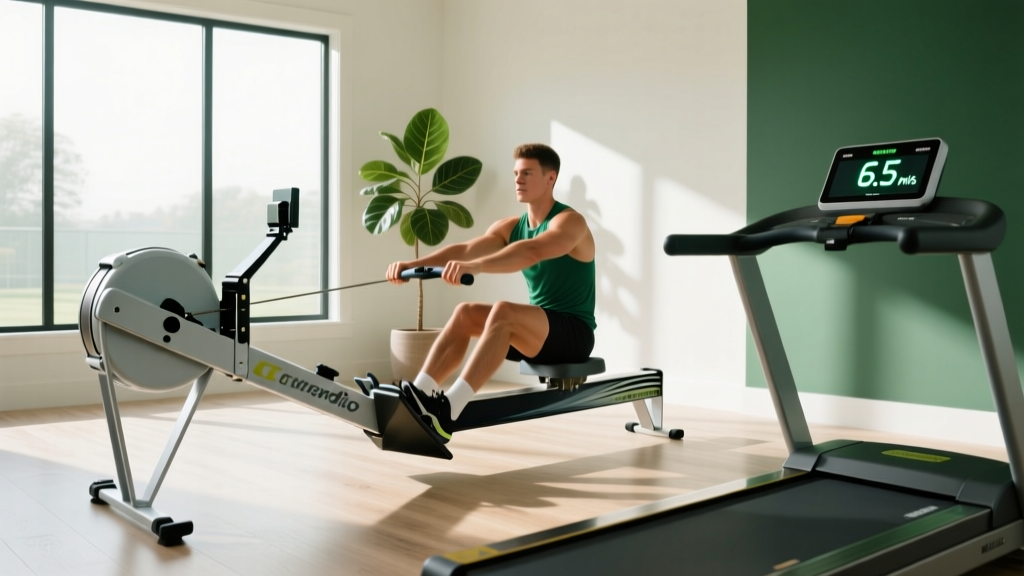
Rowing Machine Buying Guide: Beating 6.5 Speed on Treadmill
Compare top 2026 rowing machines against a 6.5 speed on treadmill. Our head-to-head buying guide covers technique, calorie burn, and joint impact.

The Cardio Conundrum: Rowing vs. The Treadmill Grind
For many home gym enthusiasts, the default cardiovascular workout is a familiar one: stepping onto the belt, punching in the dashboard, and holding a steady 6.5 speed on treadmill for 45 minutes. This pace—a brisk 9:13 minute-per-mile jog—is a staple for building aerobic base and burning calories. But as fitness technology evolves and biomechanical science advances, a pressing question emerges for buyers in 2026: Is the traditional treadmill jog still the king of home cardio, or does the rowing machine offer a superior, full-body alternative?
This comprehensive head-to-head comparison and rowing machine buying guide will break down the physiological differences, joint impacts, and equipment realities of rowing versus running. Whether you are looking to replace your treadmill or add a rower to your existing setup, understanding how these two modalities stack up is critical for making an informed investment.
Biomechanics & Caloric Output: The Head-to-Head Data
To accurately compare the two machines, we must establish equivalent effort levels. Maintaining a 6.5 speed on treadmill (mph) requires a Metabolic Equivalent of Task (MET) value of approximately 10.2. On a rowing machine, the equivalent steady-state aerobic effort is a 2:00 to 2:05 per 500-meter split pace. Here is how the two modalities compare across critical performance metrics for a 155-pound (70 kg) individual over a 30-minute session.
| Metric | Treadmill (6.5 mph Pace) | Rowing Machine (2:00/500m Split) |
|---|---|---|
| Primary Muscle Recruitment | Lower body (calves, quads, hamstrings, glutes), core stabilization | Full body (60% legs, 20% core, 20% upper body pulling muscles) |
| Estimated MET Value | ~10.2 METs | ~12.0 METs (Vigorous effort) |
| Caloric Burn (30 mins) | ~370 - 400 kcal | ~420 - 450 kcal |
| Ground Reaction Force (Impact) | High (2.5x to 3x body weight per footstrike) | Zero (Seated, non-weight-bearing glide) |
| Postural Demand | Upright, requires anti-rotational core stability | Hinged, requires active posterior chain engagement |
According to the Harvard T.H. Chan School of Public Health, vigorous rowing consistently outpaces steady-state running in caloric expenditure per minute, primarily because the rower demands concentric and eccentric muscle contractions from the lats, rhomboids, and biceps, which are entirely dormant during a treadmill jog.
2026 Rowing Machine Buying Guide: Top Models Compared
If the data convinces you to pivot from the treadmill to the rower, the next hurdle is selecting the right machine. The 2026 market is segmented by resistance type: Air, Magnetic, and Water. Here is a head-to-head look at the industry leaders.
1. Concept2 RowErg (The Gold Standard)
Price: ~$990 | Resistance: Air | Best For: Purists, CrossFitters, and data-driven athletes.
The Concept2 RowErg remains the undisputed champion of indoor rowing. Unlike treadmills where belt friction can skew calorie metrics, the Concept2's air flywheel provides infinitely variable resistance that perfectly mirrors your effort. If you pull harder, the resistance increases. Its PM5 monitor is the most accurate ergometer on the market, making it the only machine trusted for official global competitions.
2. Hydrow Gen-2 (The Immersive Experience)
Price: ~$2,495 | Resistance: Electromagnetic | Best For: Tech-forward users who miss the scenic routes of outdoor running.
Hydrow uses a patented electromagnetic drag system that simulates the feeling of water resistance. It is exceptionally quiet compared to the Concept2's air 'whoosh', making it ideal for apartment living. The 22-inch HD touchscreen offers live, on-the-water workouts, providing an engagement factor that rivals the best interactive treadmill platforms like Peloton or NordicTrack.
3. Echelon Row (The Budget Magnetic Option)
Price: ~$1,199 (with membership) | Resistance: Magnetic | Best For: Fitness beginners and space-constrained homes.
Magnetic rowers use a brake pad near the flywheel to create resistance. While they lack the dynamic, effort-based feel of air or water rowers, they offer precise, repeatable resistance levels (usually 1-32). The Echelon Row folds vertically, solving the footprint issue that plagues traditional 8-foot-long rowing rails.
Buyer's Callout: Damper Setting vs. Incline
On a treadmill, increasing the incline simulates a hill. On an air rower, the damper setting (1-10) does not dictate 'difficulty'—it dictates the feel of the boat. A setting of 10 feels like a heavy, slow rowboat (high drag factor), while a setting of 3 feels like a sleek racing shell. To mimic the aerobic steady-state of a 6.5 speed on treadmill, set your damper between 3 and 5. This is where the aerodynamic drag curve most closely matches actual water dynamics.
Technique Translation: From Treadmill Stride to Rowing Stroke
The most significant barrier to entry for treadmill converts is the learning curve. Running is a natural human locomotion pattern; rowing is a highly technical, sequenced movement. Poor technique on a rower doesn't just reduce calorie burn—it can lead to lumbar strain. According to the Concept2 Official Technique Guide, the stroke must be broken down into four distinct phases.
- The Catch: Shins are vertical, torso is hinged forward at roughly 11 o'clock, and arms are fully extended. Unlike the upright posture of a treadmill jog, your core must be braced to protect the lower back.
- The Drive: This is where the power happens. Push explosively with the legs first. Do not pull with the arms yet. The sequence is: Legs, then Core swing, then Arms. Think of it as a horizontal deadlift.
- The Finish: Legs are fully extended, torso is leaned back slightly to 1 o'clock, and the handle is pulled to the lower sternum. Shoulders are relaxed and down.
- The Recovery: The exact reverse of the drive. Arms extend first, torso hinges forward, and finally, the knees bend to slide back to the catch. The recovery should take twice as long as the drive, allowing your heart rate to micro-recover, similar to the flight phase of a running stride.
Joint Health and Longevity: The Impact Analysis
While a 6.5 mph treadmill pace is an excellent cardiovascular stimulus, the repetitive ground reaction forces take a toll over time. Every time your foot strikes the treadmill belt at this speed, your knees, hips, and lower back absorb forces equivalent to 2.5 to 3 times your body weight. Over a 5-mile run, that equates to roughly 22,000 impact cycles.
Rowing eliminates this axial loading entirely. The Mayo Clinic highlights that non-weight-bearing aerobic exercises like rowing and cycling are critical for aging populations or athletes managing patellofemoral pain syndrome, plantar fasciitis, or stress fractures. By transitioning high-volume Zone 2 cardio sessions from the treadmill to the rower, athletes can double their weekly cardiovascular volume without increasing their risk of overuse joint injuries.
The Final Verdict: Which Machine Wins Your Garage?
The head-to-head matchup ultimately comes down to your specific physiological needs and fitness goals.
- Stick with the Treadmill if: You are training for a road race, you prioritize bone-density-building weight-bearing exercises, or you prefer the mental ease of 'zoning out' without having to focus on stroke sequencing.
- Buy the Rowing Machine if: You want maximum caloric burn per minute, you suffer from joint pain exacerbated by high-impact running, or you want to build a resilient, muscular posterior chain (glutes, hamstrings, and back) that a treadmill simply cannot provide.
While setting a 6.5 speed on treadmill and pressing start is undeniably convenient, the rowing machine offers a more comprehensive, joint-friendly, and full-body stimulus. If you have the patience to master the four-part stroke sequence, the rower is arguably the most complete piece of cardiovascular equipment you can bring into your home in 2026.
More gear to consider
All reviews
NordicTrack Commercial X32i Treadmill vs Elliptical: Value Breakdown

NordicTrack Commercial 1250 Treadmill vs. Walking Pads: Common Mistakes

SendNudesX Treadmill Noise Troubleshooting: How It Compares to Top Brands

Life Fitness Treadmill Models: 2026 Head-to-Head Comparison
Echelon Stride-6 Treadmill vs High-HP Motors: Sizing Guide
