Air Bike vs Assault Bike Guide: Space & Seated Treadmill Layouts
Compare Rogue Echo and Assault Bike footprints for home gyms. Discover space optimization layouts and seated treadmill alternatives for compact areas.

The Spatial Reality of Fan Bikes: Footprint vs. Clearance
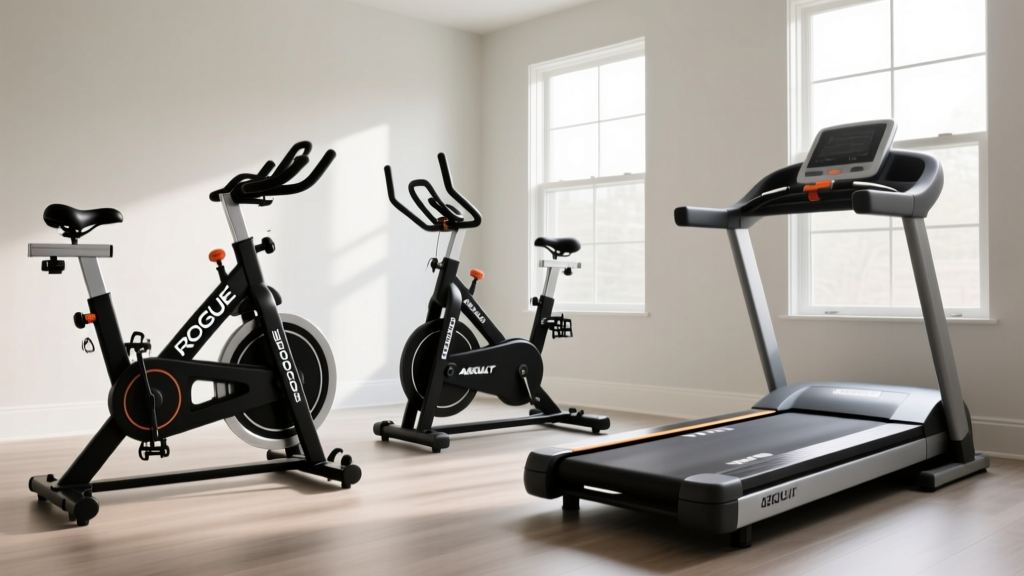
Designing a high-performance home cardio zone in 2026 requires more than just measuring floor space; it demands an understanding of volumetric clearance, thermal displacement, and acoustic buffers. When evaluating the premier air resistance machines on the market—specifically the Rogue Echo Bike and the Assault Fitness Classic—most buyers focus solely on drivetrain mechanics and console features. However, from a space optimization perspective, these upright fan bikes present unique layout challenges that dictate where they can and cannot live in your home.
Unlike traditional magnetic resistance bikes, fan bikes generate a massive vortex of displaced air. This aerodynamic reality means you cannot simply shove an air bike into a tight corner or flush against a wall. Furthermore, for homeowners dealing with severe spatial constraints, low ceilings, or dual-use office environments, pivoting to a compact seated treadmill or under-desk walking pad often becomes the most logical layout solution. This guide breaks down the exact spatial requirements of the top air bikes and explores when alternative cardio footprints make superior sense.
Dimensional Breakdown: Rogue Echo vs. Assault Classic
To properly map your gym layout, we must first look at the hard dimensional data. Both machines command a significant footprint, but their center of gravity and base width dictate different flooring and matting requirements.
| Specification | Rogue Echo Bike (Belt) | Assault Fitness Classic V4 |
|---|---|---|
| Length | 53.5 inches | 50.5 inches |
| Width (Base Stance) | 29.5 inches | 23.5 inches |
| Height (To Handlebar Peak) | 53.5 inches | 52.0 inches |
| Total Machine Weight | 125 lbs | 105 lbs |
| Minimum Recommended Clearance | 36 inches on all sides | 30 inches on all sides |
| Current Pricing (2026) | ~$995 | ~$799 |
Rogue Echo Bike: The Heavyweight Footprint
The Rogue Echo is widely considered the gold standard for durability, utilizing a belt-drive system that drastically reduces acoustic output. However, its 29.5-inch wide stance requires a broader base mat (at least 4x6 feet of 3/4-inch rubber flooring is recommended to prevent creeping during high-wattage sprints). According to Rogue Fitness specifications, the Echo's reinforced steel frame provides immense stability, but this translates to a rigid, unyielding spatial footprint that cannot be easily tucked away.
Assault Fitness Classic: The Streamlined Alternative
The Assault Classic features a slightly narrower profile (23.5 inches wide), making it marginally easier to integrate into narrow galley-style home gyms or converted hallways. Its chain/belt hybrid drive (depending on the exact 2026 V4 iteration) produces more mechanical noise than the Echo, which introduces an acoustic spatial constraint: you must account for sound transmission through shared walls if placing the bike in a multi-family dwelling or adjacent to a home office.
The Hidden Spatial Constraints: Thermal Zones and Airflow
A frequently overlooked factor in cardio layout design is the thermal and aerodynamic envelope created by the user and the machine. When an athlete performs a maximal VO2 effort on an air bike, the 25-inch front fan pushes a high-velocity wall of air backward and outward.
Layout Warning: The Wind Vortex EffectDo not place an air bike facing a bookshelf, a desk with loose papers, or lightweight decor. The fan displaces enough air to create a localized wind tunnel that will scatter documents and knock over unsecured items within a 6-foot radius. Always orient the front fan toward an open room center or an exterior wall with no obstructions.
Additionally, high-intensity interval training (HIIT) on these machines generates immense radiant body heat. As noted by Harvard Health Publishing, HIIT protocols elevate core temperature and metabolic output far beyond steady-state cardio. If your air bike is crammed into a poorly ventilated alcove, the ambient room temperature will spike rapidly, degrading performance and requiring dedicated HVAC venting or a high-velocity floor fan positioned outside the machine's immediate clearance zone.
The Compact Pivot: When a Seated Treadmill Makes More Sense
What happens when your room dimensions fail the 360-degree clearance test? What if your ceiling height is under 8 feet, or your gym doubles as your primary workspace? This is where the upright air bike loses the spatial war, and the seated treadmill emerges as the ultimate layout optimization tool.
A seated treadmill (often categorized alongside under-desk treadmills and ultra-compact walking pads like the Lifespan TR1200 or advanced 2026 WalkingPad models) fundamentally changes the geometry of your room. Instead of demanding a 5-foot vertical column of permanent space, a seated treadmill operates in the horizontal plane and can be stored vertically against a wall or slid entirely beneath a standard 30-inch desk.
Comparing Spatial Volume: Upright Bike vs. Seated Treadmill
- Upright Air Bike: Requires approximately 75 cubic feet of dedicated, unobstructed 3D space for safe operation and airflow.
- Seated Treadmill (In Use): Requires roughly 12 cubic feet of floor space, with zero vertical clearance requirements above the user's seated height.
- Seated Treadmill (Stored): Compresses to under 2 cubic feet when folded or stood on its tail, effectively disappearing into the room's architecture.
For users prioritizing low-intensity steady-state (LISS) cardio or active recovery while working, a seated treadmill provides an ergonomic, space-efficient alternative that completely eliminates the acoustic and aerodynamic penalties of a fan bike. The Mayo Clinic frequently highlights the value of consistent, moderate aerobic activity for cardiovascular health, a metric easily achieved via a seated treadmill without sacrificing your home's spatial flow.
Step-by-Step Home Gym Layout Workflow
If you are finalizing your 2026 equipment purchases, follow this structural workflow to ensure your chosen machine actually fits your lifestyle and architecture:
- Map the Swing and Reach Radius: Sit on a mock-up chair. Extend your arms and legs to their maximum anatomical limits. Add 12 inches to this perimeter. This is your hard biological clearance zone, independent of the machine's air displacement.
- Calculate the Acoustic Buffer: If choosing the chain-driven Assault Bike, add a 4-foot acoustic buffer zone between the machine and any shared drywall. If choosing the belt-driven Echo or a seated treadmill, you can reduce this buffer to 1 foot.
- Assess Flooring Transitions: Air bikes require dense rubber mats to prevent micro-movements during arm-push/pedal-pull phases. Seated treadmills require smooth, hard surfaces (wood, tile, or low-pile carpet) to allow the motorized belt to track correctly without friction burn.
- Verify the Thermal Pathway: Ensure there is a direct line of sight between your cardio zone and a window, ceiling fan, or HVAC return vent to manage the localized heat bloom.
Expert Verdict: Which Machine Wins the Space War?
The battle between the Rogue Echo and the Assault Classic is ultimately a matter of inches and acoustics. The Assault Classic wins on pure base footprint width (23.5 inches vs 29.5 inches), making it the superior choice for narrow galley layouts. The Rogue Echo, however, wins the acoustic space war; its belt-drive system allows it to be placed closer to shared living spaces without violating noise ordinances or disrupting housemates.
"True space optimization isn't just about what fits on the floor plan; it's about how the machine interacts with the room's air, sound, and thermal dynamics. An air bike commands a room, while a seated treadmill quietly integrates into it."
If your primary goal is elite, high-wattage anaerobic conditioning and you have a dedicated garage or basement with high ceilings, the spatial demands of an air bike are a worthy trade-off. But if you are designing a multi-use apartment, a low-clearance attic gym, or an integrated home office, abandoning the upright fan bike in favor of a high-quality seated treadmill is the smartest layout decision you can make in 2026. Evaluate your volume, respect the airflow, and choose the machine that serves both your physiology and your floor plan.
More gear to consider
All reviews
Elliptical vs Treadmill Budget: Why a Human Treadmill for Dogs Fails

Manual vs Motorized Treadmills: How Do You Say Treadmill in Spanish?
Stationary Bike Types vs Adaptive Treadmill: Expert Review

Elliptical vs Treadmill: 2026 Market Trends & Sole Treadmills Reviews

Top Compact Treadmills for Walking Backwards on Treadmill Incline
