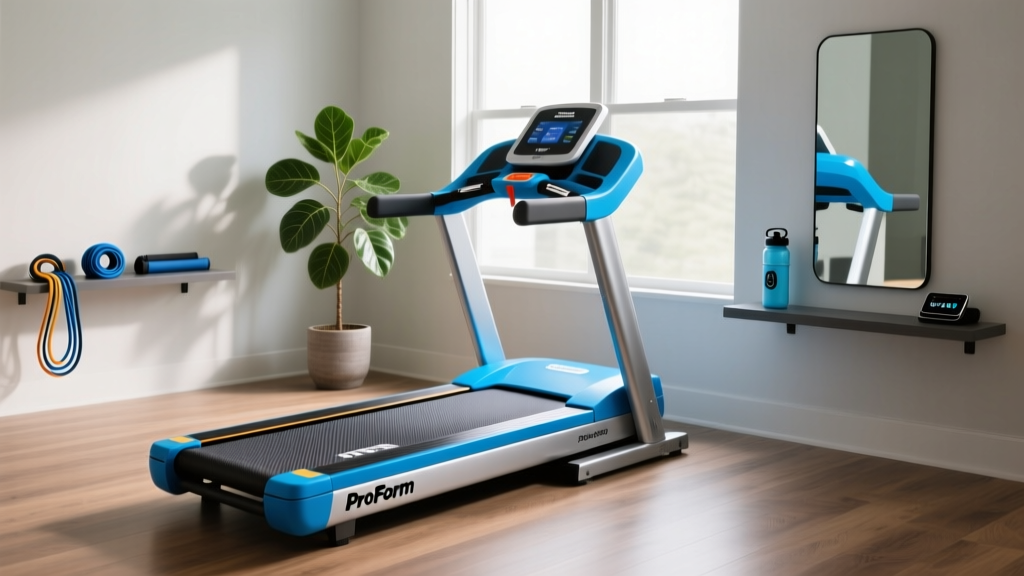
ProForm Sport 4.0 Treadmill vs Under Desk Treadmills: Office Value Analysis
Is the ProForm Sport 4.0 treadmill viable for office use? We break down the budget, ergonomics, and motor lifespan versus dedicated under-desk models.

The Home Office Cardio Dilemma: Budget Traditional vs. Dedicated Walking Pads
As remote work and hybrid office setups solidify in 2026, the demand for active workstations has skyrocketed. Non-Exercise Activity Thermogenesis (NEAT)—the energy expended for everything we do that is not sleeping, eating, or sports-like exercise—has become a primary focus for occupational health. According to Harvard Health Publishing, integrating low-intensity walking into the workday can significantly improve cardiovascular markers and cognitive focus without inducing the fatigue associated with high-intensity cardio.
This brings us to a common budget-conscious crossroads for home office workers: Can you save money by purchasing a cheap, traditional folding treadmill, like the ProForm Sport 4.0 treadmill, and using it under a standing desk? Or is a dedicated under-desk walking pad a mandatory investment? In this comprehensive budget breakdown and value analysis, we evaluate the ProForm Sport 4.0 against dedicated under-desk treadmills to determine which setup truly offers the best return on investment for office use.
Spec Sheet Showdown: ProForm Sport 4.0 vs. Premium Under-Desk Models
To understand the value proposition, we must first look at the raw hardware. The ProForm Sport 4.0 is designed as a budget-friendly, entry-level jogging treadmill. Dedicated under-desk treadmills (such as the UREVO Strol 2E or KingSmith WalkingPad R2) are engineered specifically for low-speed, continuous walking. Here is how they compare on paper:
| Feature | ProForm Sport 4.0 (Traditional) | Premium Under-Desk Treadmill (e.g., WalkingPad R2) |
|---|---|---|
| Primary Use Case | Jogging / Interval Running | Continuous Low-Speed Walking |
| Motor | 1.5 HP (Peak/Standard DC) | 1.25 HP (High-Torque, Low-RPM Tuned) |
| Belt Dimensions | 16" x 50" | 17" x 47" |
| Deck Height | ~7.5 inches | ~4.5 inches |
| Console / Poles | Fixed Angled Poles w/ Display | None (or foldable minimalist handle) |
| Average 2026 Price | $349 - $399 | $399 - $499 |
At first glance, the ProForm Sport 4.0 appears to be the budget winner, offering a larger belt and a lower upfront cost. However, the true cost of an office treadmill extends far beyond the initial retail price.
The Ergonomic Clash: Deck Height, Console Poles, and Desk Depth
The most immediate failure mode when attempting to use the ProForm Sport 4.0 as an under-desk treadmill is physical geometry. Standard standing desks range from 48 to 30 inches in depth. The ProForm Sport 4.0 features a motor hood that extends roughly 14 inches from the front of the belt, followed by angled console poles.
⚠️ Ergonomic Warning: The Desk Collision ProblemIf you attempt to slide a standard 30-inch deep standing desk over the ProForm Sport 4.0, the desk edge will collide with the console poles before the belt is fully covered. This forces the user to stand too far back, altering their center of gravity and increasing the risk of a fall. Furthermore, removing the console poles on most traditional treadmills voids the warranty and disables the safety key mechanism.
The Deck Height Penalty
Ergonomics dictate that your workspace must adapt to your body, not the other way around. The Cornell University Ergonomics Department emphasizes that maintaining a neutral 90-degree elbow angle is critical for preventing repetitive strain injuries (RSIs) during typing.
- Under-Desk Treadmill: With a 4.5-inch deck height, your overall elevation increases minimally. Most motorized standing desks can easily lower to 28 inches to accommodate this, keeping your elbows at the perfect 90-degree angle.
- ProForm Sport 4.0: With a 7.5-inch deck height, you are elevated significantly higher. To maintain a 90-degree elbow angle, your desk surface must be raised to approximately 46-48 inches. Many budget standing desks max out at 43 inches, forcing users to shrug their shoulders or bend their wrists upward, leading to cervical strain and carpal tunnel syndrome over time.
The 1.5 MPH Motor Burnout Phenomenon
Beyond physical fit, the most critical difference lies in motor engineering. Budget traditional treadmills like the ProForm Sport 4.0 utilize standard DC motors designed to cool via the friction and airflow generated at jogging speeds (4.0+ mph).
When you walk at 1.0 to 1.5 mph for three to four hours continuously while working, the motor draws high amperage to overcome static friction and your body weight. However, the belt speed is too slow to trigger adequate internal cooling fan airflow. This results in thermal throttling. The motor overheats, the Printed Circuit Board (PCB) takes heat damage, and the treadmill eventually shuts down or suffers a catastrophic controller failure.
Dedicated under-desk treadmills solve this by using specialized low-RPM, high-torque motors equipped with passive aluminum heat sinks or specialized low-speed cooling architectures designed specifically for continuous, low-velocity loads. According to OSHA Ergonomics Guidelines, minimizing physical stressors in the workplace includes ensuring equipment operates safely under expected continuous use conditions; a traditional treadmill motor overheating under a desk is a distinct safety and financial hazard.
Budget Breakdown: 3-Year Total Cost of Ownership (TCO)
Let us break down the actual financial reality of both setups over a standard 3-year lifecycle, factoring in required accessories, desk modifications, and replacement risks.
| Cost Factor | ProForm Sport 4.0 Setup | Dedicated Under-Desk Treadmill Setup |
|---|---|---|
| Base Treadmill Cost | $369 | $449 |
| Required Desk Modifications | $120 (Keyboard tray riser to offset deck height) | $0 |
| Lubrication & Maintenance | $45 (Silicone lube, frequent due to slow-speed friction) | $20 |
| Motor/PCB Replacement Risk | $150 (High risk of thermal failure by Year 2) | $0 (Covered under standard 2-yr warranty) |
| Space Storage Solution | $0 (Folds up, but heavy at 115 lbs) | $40 (Under-bed storage bag/wheels) |
| Estimated 3-Year TCO | $684 | $469 |
While the ProForm Sport 4.0 saves you roughly $80 at the point of purchase, the hidden costs of ergonomic adapters, increased maintenance, and the high probability of motor burnout make it nearly 45% more expensive over a three-year period when used strictly as an office walking pad.
Actionable Verdict: Where Should Your Office Fitness Budget Go?
The ProForm Sport 4.0 is an excellent piece of equipment for its intended purpose: short-duration jogging, walking intervals, and general fitness in a dedicated workout space. However, as an under-desk treadmill for office use, it represents a false economy.
Buy the ProForm Sport 4.0 IF:
- You have a dedicated home gym space separate from your office desk.
- Your primary goal is to break a sweat with 30-minute jogging sessions before or after work.
- You already own a premium, extra-deep standing desk (36+ inches) and are willing to modify the treadmill console.
Buy a Dedicated Under-Desk Treadmill IF:
- You intend to walk at 1.0 - 2.0 mph for 2+ hours continuously while answering emails and typing.
- You require a seamless, trip-free transition between sitting, standing, and walking without adjusting your monitor heights or keyboard trays.
- You want a motor warranty that actually covers low-speed, continuous duty use.
Do not force a square peg into a round hole. The upfront savings of the ProForm Sport 4.0 are entirely negated by ergonomic compromises and thermal motor limits. For true office integration, invest the extra $80 into a dedicated under-desk walking pad. Your posture, your productivity, and your treadmill's motherboard will thank you in the long run.
More gear to consider
All reviews
Apple Watch Indoor Run Does Not Match Treadmill? 2026 Rowing Guide

Instructions for Treadmill Stress Tests vs Upright & Recumbent Bikes

Under Desk Treadmill Review: Office Space vs Assault Runner Treadmill
Garmin Treadmill Accuracy: Belt Maintenance and Lubrication Guide

Roller Homegym Space & Budget Essentials: Smart Setup for Serious Indoor Cycling