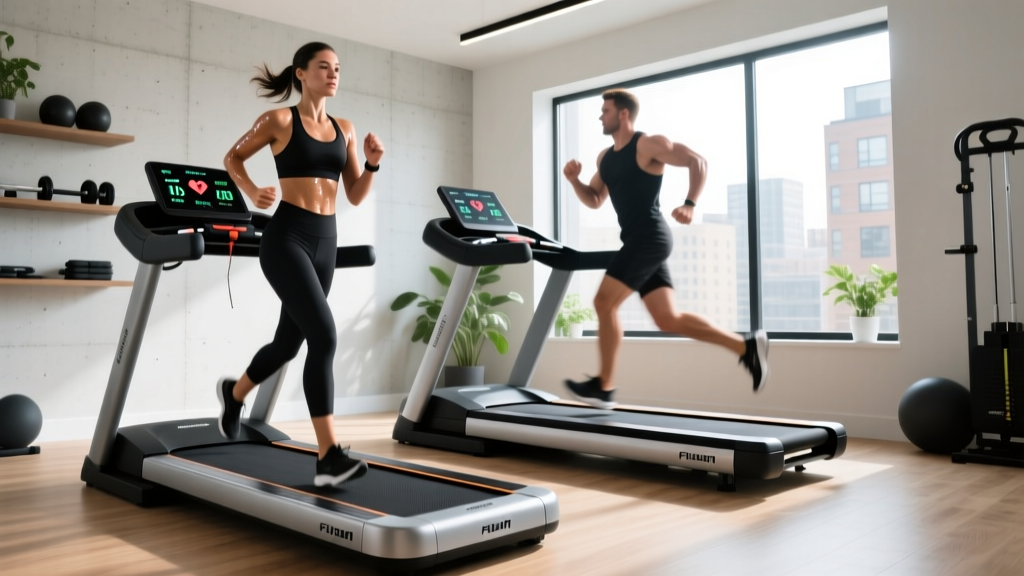
Walking Pad vs Treadmill: Best for HIIT Exercises in 2026
We compare top walking pads and standard treadmills to find the best machine for HIIT exercises in 2026. Discover motor specs, safety tips, and reviews.

The explosion of remote and hybrid work has made compact walking pads a staple in modern home offices. However, as users build their baseline cardiovascular endurance, many attempt to transition from casual stepping to high-intensity interval training. When buyers search for a HIIT exercises treadmill, they are often lured by the compact aesthetic and low price of under-desk walking pads, assuming these devices can handle sprint intervals. This is a critical misconception that can lead to equipment failure and injury.
In this 2026 in-depth buying guide, we bridge the gap between compact walking pads and traditional treadmills. We will dissect motor duty cycles, deck biomechanics, and thermal limits to help you determine whether a walking pad can survive your interval protocols, or if you need to invest in a dedicated HIIT treadmill.
⚠️ Safety Warning: Attempting sprint intervals (8+ mph) on a walking pad with a 43-inch deck and no handrails drastically increases the risk of clipping the motor housing and falling. Always match your machine's physical dimensions to your biomechanical stride length.The Motor Reality Check: Why Most Walking Pads Fail at HIIT
To understand why walking pads struggle with High-Intensity Interval Training, we must look at motor engineering. Treadmill motors are rated in two ways: Peak Horsepower (HP) and Continuous Duty Horsepower (CHP).
- Peak HP: The maximum power the motor can draw for a fraction of a second before tripping a breaker. Walking pads often advertise '2.5 HP', which is usually a Peak rating.
- Continuous Duty HP (CHP): The power the motor can sustain indefinitely under a heavy load without overheating. True HIIT treadmills start at 3.0 CHP.
According to the American Council on Exercise (ACE), effective HIIT requires pushing your heart rate to 80-95% of its maximum, which on a treadmill translates to rapid accelerations and high-speed sprints. When a 180-pound user demands a sudden burst from 3 mph to 9 mph, the amperage spike generates immense heat in the Motor Control Board (MCB). Walking pads lack the internal cooling fans and heavy-duty heat sinks found in standard treadmills. The result? Thermal throttling, belt hesitation mid-sprint, and eventual MCB burnout.
2026 Walking Pad vs. True Treadmill Comparison Matrix
Below is our benchmarked comparison of the most popular compact walkers versus entry-level and mid-tier HIIT-capable treadmills available in 2026.
| Model | Category | Motor | Max Speed | Deck Size | 2026 Price |
|---|---|---|---|---|---|
| WalkingPad R2 | Compact Walker | 2.5 HP (Peak) | 6.2 mph | 47 x 17 in | $499 |
| UREVO Strol 2E | Hybrid Walker | 2.25 HP (Peak) | 7.6 mph | 45 x 16 in | $359 |
| Horizon T101 | Standard Treadmill | 3.0 CHP | 10.0 mph | 55 x 20 in | $699 |
| Sole F80 | Heavy-Duty HIIT | 3.5 CHP | 12.0 mph | 60 x 22 in | $1,099 |
Evaluating the Contenders: In-Depth Reviews
The Compact Compromise: WalkingPad R2 & UREVO Strol 2E
Let us be unequivocally clear: Neither the WalkingPad R2 nor the UREVO Strol 2E should be used for true HIIT. The WalkingPad R2 is an engineering marvel for what it is—a foldable, under-desk stepping device. Its 15-pound flywheel and 6.2 mph top speed are perfectly calibrated for 10,000 daily steps. However, if you attempt 30-second sprint intervals, the belt will physically struggle to keep up with your footfalls, creating a dangerous 'stutter' effect.
The UREVO Strol 2E offers a slightly higher 7.6 mph ceiling and a foldable handrail, making it viable for light jogging intervals (e.g., alternating between 3.5 mph walking and 6.0 mph jogging). But for users seeking the anaerobic threshold-pushing sprints defined by the Mayo Clinic's interval training guidelines, these compact pads fall dangerously short.
The Entry-Level HIIT Solution: Horizon Fitness T101
If you are transitioning from a walking pad and need a dedicated HIIT exercises treadmill without sacrificing your entire living room, the Horizon T101 is the 2026 budget champion. Priced around $699, it features a legitimate 3.0 CHP motor. This means the motor can handle the rapid acceleration required for 400-meter sprint equivalents without triggering thermal shutoffs.
The Edge Case: The 55-inch deck is adequate for users under 5'10". If you are taller, your stride at 10 mph will naturally extend beyond 55 inches, forcing you to subconsciously shorten your gait, which can lead to shin splints and Achilles strain over a 6-week HIIT program.
The Heavy-Duty HIIT Standard: Sole F80
For serious athletes executing advanced protocols like the Norwegian 4x4 method, the Sole F80 remains the gold standard in the sub-$1,200 category. The 3.5 CHP motor is paired with a massive 60-inch by 22-inch deck. This extra real estate is non-negotiable for true sprinting. When you are running at 11 or 12 mph, your foot strike lands significantly further back on the deck than during a jog. The Sole F80 also features a 15% power incline, allowing for low-impact, high-resistance hill sprints that spare the joints while maximizing cardiovascular output.
Biomechanics & Safety: Deck Length and Sprinting
One of the most overlooked metrics in cardio equipment purchasing is the correlation between user height, sprint speed, and deck length.
'At 6 mph, the average adult stride length is roughly 40 inches. At 10 mph, that same stride dynamically extends to 54 inches or more. Attempting to sustain a 10 mph pace on a 45-inch walking pad deck forces the user to run with a chopped, unnatural gait, drastically increasing the shear force on the patellar tendon.'
Furthermore, walking pads lack the heavy-duty side rails and emergency magnetic safety clips found on standard treadmills. During a high-fatigue HIIT session, a momentary lapse in concentration or a missed step on a handle-less walking pad at 7 mph will result in a fall onto the floor or the hard plastic motor housing.
Programming Your Treadmill HIIT Exercises Safely
Once you have selected a machine with an adequate CHP rating and deck length, structuring your intervals correctly is vital for both your physiology and the machine's lifespan. Avoid jumping the belt speed instantly from 0 to 10 mph; this causes massive amp-draw spikes that degrade the motor brushes over time.
- The Ramp-Up (Warm-up): Spend 5 minutes gradually increasing speed from 2.5 mph to 5.0 mph. This lubricates the belt and prepares the MCB for higher loads.
- The Work Interval: Increase speed to your target sprint (e.g., 9.5 mph). Pro-Tip: Straddle the side rails and let the belt reach full speed before stepping back onto it. This reduces motor strain and prevents the belt from jerking under your weight.
- The Active Recovery: Drop the speed to 3.5 mph. Do not stop completely; active recovery clears blood lactate more efficiently than passive rest.
- The Cool-Down: 5 minutes of walking at 2.5 mph to bring the heart rate down and allow the treadmill motor to cool off before folding or powering down.
Final Verdict: Which Machine Actually Fits Your Routine?
The decision between a walking pad and a standard treadmill ultimately hinges on your specific cardiovascular goals and spatial constraints.
✅ Buy a Walking Pad (WalkingPad R2 / UREVO) IF:
- Your primary goal is combating sedentary behavior during the workday.
- You live in a small apartment and require an under-bed storage solution.
- Your cardio routine is strictly limited to Zone 2 steady-state walking (under 4.5 mph).
✅ Buy a True HIIT Treadmill (Horizon T101 / Sole F80) IF:
- You intend to perform anaerobic sprint intervals (8+ mph) or incline hill repeats.
- You are taller than 5'10' and require a 55+ inch deck to maintain a natural stride.
- You want a machine with a high continuous duty motor (3.0+ CHP) that will survive years of high-torque interval training without voiding the warranty.
Ultimately, while walking pads are exceptional tools for daily step accumulation, they are fundamentally misaligned with the biomechanical and mechanical demands of high-intensity interval training. Investing in a properly spec'd HIIT exercises treadmill ensures your safety, protects your joints, and guarantees your equipment can actually handle the heat of your hardest workouts.
More gear to consider
All reviews
Under Desk Treadmill Review vs Average Treadmill Size: 2026 Trends

Under Desk Treadmill Review & Duke Treadmill Score Calculation
Horizon LS760T Treadmill Review & Compact Portable Cardio Options

Elliptical vs Treadmill Value: How to Recenter a Treadmill Belt

Stair Climber Machine for Home Use Guide: Comparisons & Nordic Track Treadmill Customer Service
