2026 Market Trends: ProForm ProShox Treadmill Belt Maintenance
Discover 2026 market trends in home fitness repair. Learn exact belt maintenance and lubrication steps to extend your ProForm ProShox treadmill's lifespan.

The 2026 Right-to-Repair Shift in Home Cardio
As we navigate the 2026 home fitness landscape, a significant macroeconomic trend has emerged: consumers are aggressively rejecting planned obsolescence and mandatory digital subscriptions in favor of maintaining reliable, legacy cardio equipment. According to industry analyses tracked by Consumer Reports, the secondary market for refurbished and legacy treadmills has surged, driven by buyers who prefer one-time hardware purchases over $396 annual smart-platform subscriptions. At the center of this maintenance-driven renaissance is the ProForm ProShox treadmill series. Known for its proprietary air-cushioning deck and durable mid-tier motors, the ProShox line represents the ideal candidate for long-term ownership—provided owners adhere to strict belt maintenance and lubrication protocols.
This trend report and technical guide breaks down the market dynamics of treadmill longevity in 2026, while providing domain-level, actionable instructions for maintaining the belt and deck system of your ProForm ProShox treadmill to prevent catastrophic motor and control board failures.
Market Analysis: The True Cost of Treadmill Neglect
Historically, treadmill manufacturers operated on a razor-and-blades business model, anticipating that friction-induced deck burn-through would force consumers to purchase new machines every 5 to 7 years. However, the 2026 right-to-repair movement, championed by organizations like The Repair Association, has empowered consumers with OEM parts access and technical knowledge.
When a ProForm ProShox treadmill belt is starved of lubrication, the friction coefficient between the 1.6mm PVC belt and the phenolic-coated MDF deck spikes. This does not just wear the belt; it forces the drive motor to pull excessive amperage. A well-lubricated ProShox motor running at 6.0 MPH should draw between 6 and 8 amps. A dry belt can push this draw past 14 amps, eventually frying the Motor Control Board (MCB) or tripping standard 15-amp household breakers. By investing $12 in 100% silicone lubricant, owners are avoiding $250+ MCB replacements and $400+ motor swaps.
Anatomy of the ProForm ProShox Belt and Deck System
To maintain the machine properly, one must understand its specific engineering. The ProForm ProShox series utilizes a specialized deck system designed to absorb impact. Unlike solid wood decks, the ProShox system relies on precise tension and friction management to ensure the cushioning elastomers or air pockets function without binding the belt.
- Belt Composition: Typically a 2-ply system (PVC top layer, synthetic cotton/polyester underlayer for friction reduction). Thickness ranges from 1.6mm to 2.0mm.
- Deck Coating: High-pressure laminate (HPL) with a factory-applied wax/phenolic resin. This coating eventually wears away after 300 to 500 miles of use, necessitating aftermarket liquid silicone.
- Roller Dynamics: Crowned aluminum or steel rollers that rely on belt tension for tracking. Over-tightening the belt to fix a slip will destroy the roller bearings.
⚠ Critical Warning: The Aerosol Trap
Never use standard WD-40, 3-in-One oil, or aerosol silicone sprays containing petroleum distillates as propellants. Petroleum derivatives will chemically dissolve the PVC backing of your ProShox belt and melt the adhesive holding the belt seams together, resulting in immediate, irreversible delamination. Only use 100% pure liquid silicone treadmill lubricant.
Step-by-Step ProShox Belt Lubrication Protocol
ProForm officially recommends lubricating the belt every 3 months or every 130 miles. In 2026, with the rise of high-friction home gym environments (often lacking commercial-grade HVAC humidity control), we recommend a 60-day interval for heavy users. Follow this exact procedure:
- Power Down and Unplug: Always disconnect the ProShox from the wall to prevent accidental startup or electrical shock while reaching under the deck.
- Loosen the Rear Roller: Using the provided 3/16" Allen wrench, turn the left and right rear end-cap adjustment bolts counterclockwise exactly 3 full turns. This releases tension without completely unthreading the bolts.
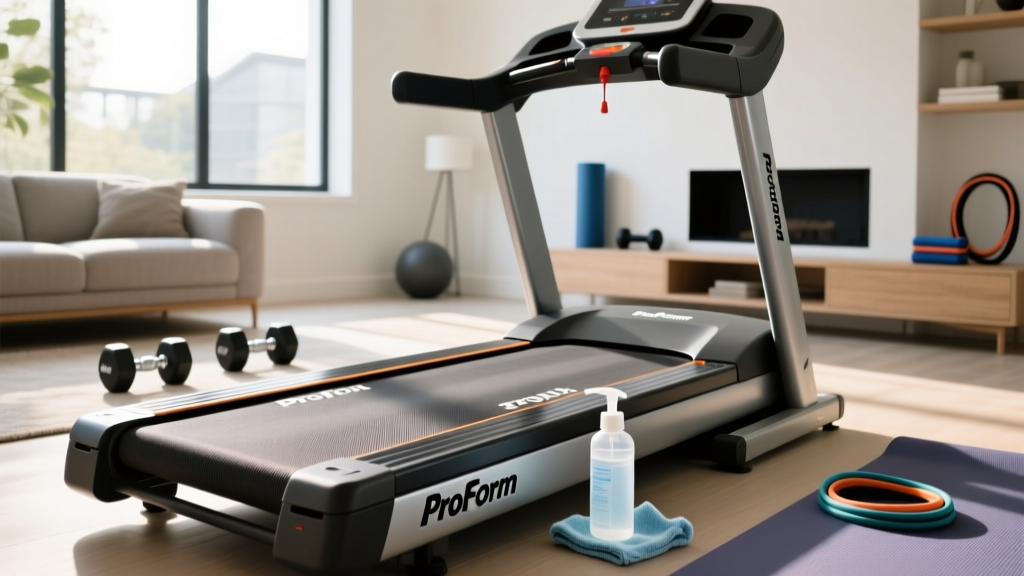
- Apply the Silicone: Lift the center of the belt. Insert the nozzle of your 100% liquid silicone applicator. Squeeze exactly 0.5 oz (15 ml) in a zig-zag pattern from the center to the left edge. Repeat on the right side. Total application: 1.0 oz.
- Redistribute and Re-tension: Lower the belt. Tighten the rear bolts clockwise exactly 3 turns to return to baseline tension.
- Calibration Run: Plug in the machine, stand on the side rails, and start the treadmill at 3.0 MPH. Let it run for 5 minutes. The friction will naturally spread the silicone across the phenolic deck. Walk on the belt for 2 minutes to press the lubricant into the deck pores.
Cost-Benefit Analysis: Maintenance vs. Component Failure
The financial argument for proactive belt maintenance is undeniable. Below is a 2026 market pricing matrix detailing the costs associated with ProForm ProShox component degradation versus preventative care.
| Maintenance / Repair Action | Average 2026 Cost | Frequency / Trigger |
|---|---|---|
| 100% Silicone Lubricant (1 Bottle) | $12 - $18 | Every 3-6 months (Preventative) |
| Replacement Walking Belt (OEM) | $55 - $85 | Every 4-7 years (Wear & Tear) |
| Deck Replacement (Phenolic MDF) | $140 - $190 | Triggered by dry-belt burn-through |
| Motor Control Board (MCB) Swap | $180 - $260 | Triggered by high-amp dry friction |
| Drive Motor Replacement | $280 - $350 | Triggered by thermal overload/shorting |
As the table illustrates, a $15 bottle of silicone effectively insulates the owner from nearly $800 in potential cascading hardware failures. For those consulting the iFIT Support Hub for legacy ProForm error codes, codes like "E1" (Speed Sensor) or "E2" (Motor Overload) are frequently misdiagnosed as electronic failures when they are actually mechanical friction issues stemming from a dry belt.
Troubleshooting Edge Cases and Failure Modes
Even with rigorous lubrication, the ProForm ProShox treadmill may present specific mechanical edge cases that require expert diagnosis.
1. The "Hesitation" or Belt Slip Phenomenon
If the belt hesitates or slips underfoot when you plant your foot, but the motor continues to spin smoothly, the belt is loose. Fix: Tighten both rear adjustment bolts by one-quarter turn. Test. Never tighten more than a half-turn at a time, as over-tensioning will cause the belt to track off-center and shred the edges against the plastic side rails.
2. Asymmetrical Tracking (Belt Drifting Left or Right)
If the belt drifts to the left, the left rear roller is further forward than the right. Fix: Turn the left adjustment bolt clockwise by one-quarter turn, or turn the right bolt counterclockwise by one-quarter turn. Run at 4.0 MPH and observe for 60 seconds. Adjust incrementally.
3. The "Burn-Through" Groove
If you slide your hand under the belt and feel a distinct, physical groove or dip worn into the wooden deck itself, lubrication will no longer save you. The phenolic coating has been breached, exposing raw MDF. Raw MDF acts like sandpaper on the belt underlayer. Fix: Immediate deck and belt replacement is mandatory. Continuing to run the machine will destroy the new belt within 30 days and overheat the motor.
Future Outlook: Predictive Maintenance in Legacy Hardware
Looking ahead through the remainder of 2026, the aftermarket is beginning to introduce inline digital amp-meters that plug between the wall and the treadmill. By monitoring the real-time amperage draw of your ProForm ProShox, you can establish a baseline (e.g., 7 amps at 5 MPH). When your weekly average creeps up to 10 amps, it serves as an empirical, data-driven trigger that the silicone layer has degraded and re-lubrication is required—removing the guesswork from treadmill maintenance entirely.
By treating your ProForm ProShox treadmill not as a disposable consumer good, but as a mechanical system requiring precise tribological care, you align with the most financially sound trend in modern home fitness: radical equipment longevity.
More gear to consider
All reviews
Under Desk Treadmill Office Review: Why My NordicTrack Treadmill Won't Turn On

Spirit 185 Treadmill Setup & Motor Horsepower Guide

Stair Climber vs WalkingPad R1 Pro 2in1 Foldable Treadmill Guide

HydroWorx Underwater Treadmill: Step-by-Step Buying Guide

Why the Treadmill Shocks Me: 2026 Compact Portable Cardio Trends