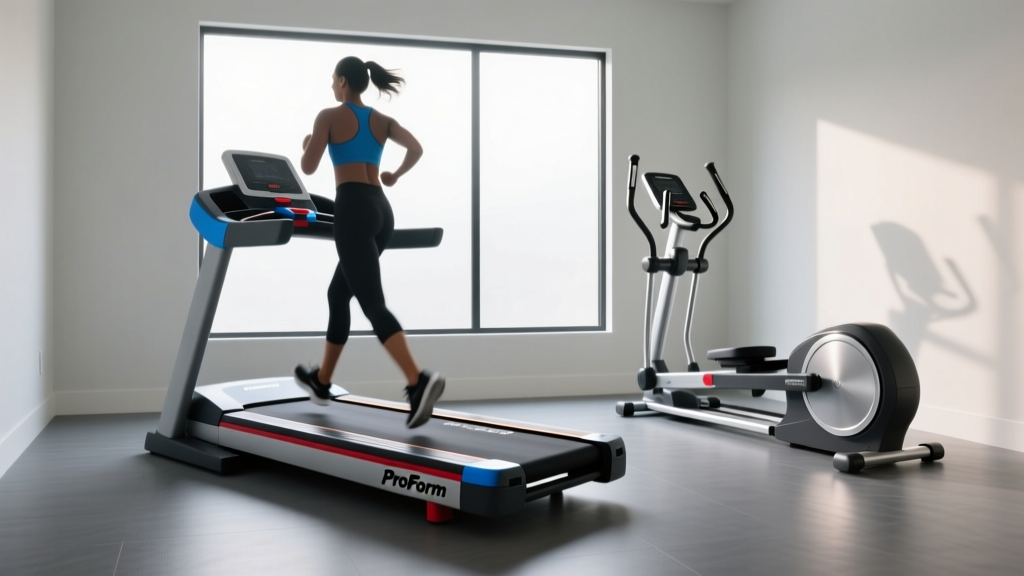
ProForm Pro 2000 Treadmill vs Ellipticals: Value Guide
Is the ProForm Pro 2000 treadmill a better home cardio investment than a premium elliptical? We break down the 5-year costs, ROI, and value.

The $1,500 Home Cardio Dilemma: Treadmill vs. Elliptical
As home fitness budgets tighten and consumers demand higher returns on their equipment investments in 2026, the debate between purchasing a treadmill or an elliptical has shifted from pure biomechanics to hard financial analysis. When buyers allocate $1,200 to $1,500 for a primary cardio machine, they are typically looking at two distinct market leaders: the ProForm Pro 2000 treadmill and premium mid-tier ellipticals like the Sole E35 or NordicTrack SpaceSaver SE7i.
While both machines deliver excellent cardiovascular conditioning, their total cost of ownership (TCO), spatial depreciation, and long-term maintenance profiles are drastically different. This guide provides a forensic budget breakdown to help you determine which machine offers the superior financial and physiological ROI for your specific household.
Upfront Acquisition Costs: The Initial Outlay
The sticker price is only the first hurdle. When comparing the ProForm Pro 2000 treadmill against top-rated ellipticals, we must factor in delivery, assembly, and initial accessories. Treadmills generally incur higher freight costs due to their sheer mass and motorized components.
| Cost Factor | ProForm Pro 2000 Treadmill | Sole E35 Elliptical | NordicTrack SE7i Elliptical |
|---|---|---|---|
| Base MSRP / Street Price | $1,299 | $1,199 | $1,299 |
| Threshold Delivery | $199 (Standard) | Free (Curbside) | $199 (Standard) |
| Professional Assembly | $250 (Recommended) | $150 | $250 |
| Equipment Mat (Required) | $50 (Heavy Duty) | $40 (Standard) | $40 (Standard) |
| Total Day-One Cost | ~$1,798 | ~$1,389 | ~$1,788 |
The ProForm Pro 2000 treadmill demands a slightly higher initial capital outlay, primarily due to the necessity of professional assembly. Weighing in at 185 pounds with a complex folding hinge and a 3.25 CHP Mach Z motor, DIY assembly often leads to misaligned belts or voided warranties if the motor hood is improperly seated. Ellipticals, while bulky, feature simpler mechanical linkages that are more forgiving for home assembly.
Total Cost of Ownership (TCO) Over 5 Years
The true divergence in value appears when we project costs over a 60-month period. Modern cardio equipment is increasingly tied to software ecosystems, and this is where your budget can quietly bleed.
The Hidden Subscription Factor
ProForm’s parent company, iFIT, utilizes a hardware-software tethering model. While the ProForm Pro 2000 treadmill can operate in manual mode without a subscription, doing so locks you out of the 10-inch interactive touchscreen's primary value proposition: automatic trainer-controlled incline (up to 12%) and decline (-3%) adjustments.
💡 Budget Alert: The iFIT MultiplierAn iFIT Family membership costs $396 annually. Over 5 years, that is $1,980 in software fees. When added to the Day-One cost of the ProForm Pro 2000, your 5-year TCO jumps to $3,778. Conversely, the Sole E35 elliptical requires zero subscriptions to access its 20 resistance levels and built-in workout programs, keeping its 5-year TCO near its initial $1,389 price tag.
Maintenance and Energy Consumption
- Electricity: A treadmill motor drawing 15-20 amps under heavy load (e.g., a 220 lb user running at 8 mph) will consume noticeably more kilowatt-hours than an elliptical's 1-2 amp magnetic resistance drive. Over 5 years of daily use, expect to pay roughly $120 more in electricity for the treadmill.
- Physical Maintenance: The ProForm Pro 2000's 20" x 60" tread belt requires 100% silicone lubrication every 6 months or 150 miles ($15 per bottle). Belt tensioning and deck flipping/replacement (approx. $150 after year 4) are inevitable. Ellipticals require only occasional wiping of the aluminum extrusion rails and tightening of pivot bolts.
Biomechanical ROI: Impact vs. Output
Financial value means nothing if the machine causes an injury that leads to physical therapy bills. The physiological return on investment is a critical component of the home cardio equation.
"Treadmill running generates ground reaction forces of roughly 1.5 to 2 times your body weight with each footstrike. Ellipticals eliminate this impact, making them vastly superior for joint preservation, though treadmills offer a slight edge in raw caloric expenditure due to the weight-bearing nature of the movement."
— Adapted from biomechanical analyses by the Mayo Clinic on joint stress and cardio machines.
Caloric Burn and Muscle Activation
According to studies referenced by the American Council on Exercise (ACE), running on a treadmill at a moderate pace (6 mph) burns approximately 10-15% more calories per hour than an elliptical at a comparable perceived exertion level. However, the ProForm Pro 2000's unique -3% decline feature specifically targets the anterior tibialis and quadriceps, offering a muscle-building eccentric load that no standard elliptical can replicate.
Conversely, ellipticals like the Sole E35 feature articulating pedals and moving handlebars that engage the latissimus dorsi and triceps, providing a full-body cardiovascular stimulus that a treadmill completely lacks.
Spatial Footprint and Resale Depreciation
Space is a premium commodity in modern homes. How these machines occupy your floor plan—and how much money you can recoup if you decide to sell them on the secondary market—heavily influences their overall value.
The Footprint Matrix
| Machine | Active Footprint (L x W) | Stored Footprint | Ceiling Clearance Needed |
|---|---|---|---|
| ProForm Pro 2000 | 80" x 32" | 40" x 32" (Folds up) | User Height + 15" (for incline) |
| Sole E35 Elliptical | 82" x 28" | 82" x 28" (Does not fold) | User Height + 12" |
| NordicTrack SE7i | 76" x 30" | 35" x 30" (Vertical fold) | User Height + 10" |
The ProForm Pro 2000 utilizes a hydraulic SoftDrop folding mechanism. While it halves the length of the machine when stored, the folded deck is incredibly heavy and can be dangerous to lower without the hydraulic assist functioning perfectly. Ellipticals generally cannot fold (with the exception of specific SpaceSaver models), meaning they act as permanent furniture. If you live in a multi-use room, the treadmill's ability to fold provides a distinct spatial value.
Depreciation Curves
Data from secondary market aggregators and Consumer Reports indicates that motorized treadmills depreciate faster than mechanical ellipticals. A used ProForm Pro 2000 typically retains about 35-40% of its retail value after 3 years, largely because buyers are wary of inheriting out-of-warranty motor or control board failures. High-end ellipticals, lacking complex drive motors and friction-heavy belts, often retain 50-60% of their value on the used market.
The Final Verdict: Mapping Value to Your Profile
Choosing between the ProForm Pro 2000 treadmill and a premium elliptical is not about which machine is universally "better," but which machine aligns with your financial and physiological parameters.
Buy the ProForm Pro 2000 Treadmill If:
- You are a runner or walk-incline enthusiast: The 12% incline and -3% decline are unmatched in this price tier for lower-body conditioning.
- You value guided coaching: You are willing to pay the $396/year iFIT premium for auto-adjusting terrain and global studio classes.
- You need to reclaim floor space: The folding deck is a non-negotiable requirement for your living space.
- Impact is not a concern: You have healthy knees, hips, and lower back mechanics.
Buy a Premium Elliptical (Sole E35 / NordicTrack SE7i) If:
- You are budget-strict over the long term: You refuse to pay mandatory software subscriptions and want a 5-year TCO under $1,500.
- Joint preservation is paramount: You are managing arthritis, recovering from an injury, or are a heavier user (250+ lbs) where treadmill deck friction and motor strain become failure points.
- You want upper-body engagement: You prefer a dual-action cardio workout without needing separate dumbbells.
- You want higher resale value: You view the equipment as a semi-liquid asset that you might sell in 3-5 years.
Ultimately, the ProForm Pro 2000 treadmill offers an elite, gym-quality running experience that justifies its premium ongoing costs for dedicated runners. However, for the pragmatic home user seeking maximum cardiovascular ROI with minimal long-term financial friction, a high-quality elliptical remains the undisputed champion of the budget breakdown.
More gear to consider
All reviews
Cardio Machine Noise Comparison & Treadmill Incline Percentage

Compact Portable Cardio: Hands-On Johnson Treadmill Review
Compact Incline Treadmill Walking: Maintenance & Longevity Guide
How to Turn On Life Fitness Treadmill vs Portable Cardio Trends

Air Bike vs Assault Bike Guide & How to Lubricate a Treadmill