
ProForm Treadmill 415 Crosswalk & Air vs Assault Bike Guide
Expert review of the ProForm 415 Crosswalk treadmill plus a 2026 comparison guide for Air Bikes vs Assault Bikes to build your ultimate home cardio gym.

The 2026 Home Cardio Dilemma: Steady-State vs. High-Intensity
Building a comprehensive home cardio floor in 2026 requires more than just buying the most expensive machine on the market. It requires a strategic blend of steady-state, full-body coordination work and high-intensity interval training (HIIT). As a senior reviewer for FitGearPulse, I constantly see home gym owners make the mistake of buying redundant equipment—like two standard stationary bikes—while neglecting the biomechanical variety needed for long-term joint health and metabolic adaptation.
To solve this, we are looking at two distinct ends of the cardio spectrum. First, we will conduct a hands-on review of a highly searched budget staple on the secondary market: the ProForm Treadmill 415 Crosswalk. Then, we will transition to the anaerobic heavyweights with a definitive Air Bike vs. Assault Bike comparison guide, pitting the belt-driven Rogue Echo against the chain-driven Assault AirBike Classic. By the end of this guide, you will know exactly how to allocate your equipment budget for maximum cardiovascular ROI.
Hands-On Review: ProForm Treadmill 415 Crosswalk
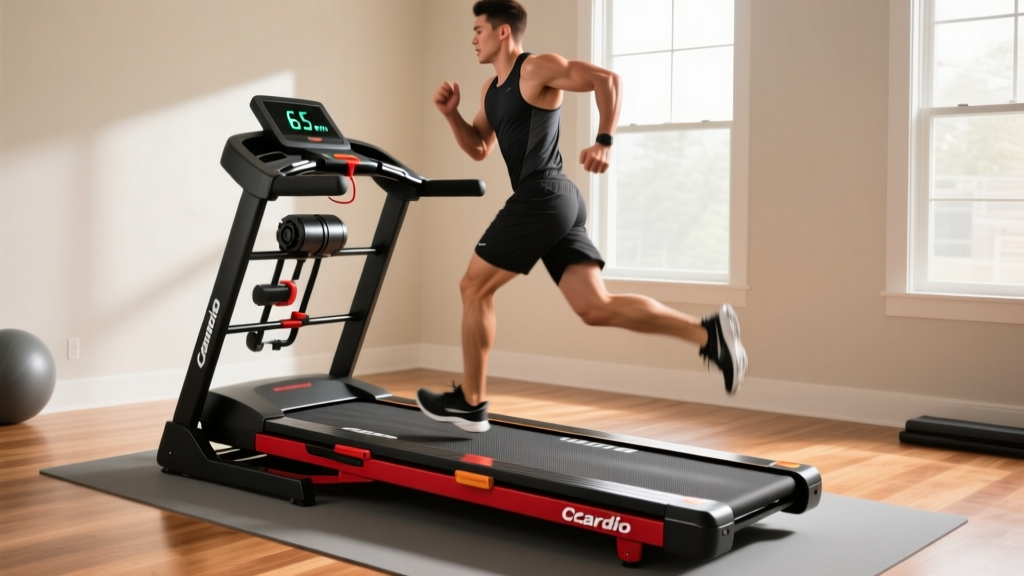
While ProForm has released dozens of new smart-treadmills in recent years, the ProForm 415 Crosswalk (often identified by model series PFTL512) remains a massive search volume driver in 2026 for buyers seeking entry-level, full-body cardio on the refurbished or secondary market. Priced typically between $250 and $400 used, it offers a unique proposition: integrated upper-body resistance arms paired with a standard walking/jogging deck.
Biomechanics of the Crosswalk Arm System
The defining feature of this machine is the Crosswalk arm system. Unlike ellipticals where the arms are mechanically linked to the pedal crank, the 415 Crosswalk utilizes independent, tension-band-assisted arm levers. This forces the user to actively engage the latissimus dorsi and anterior deltoids to pull the levers, rather than just passively holding on.
Expert Warning: A common failure mode we see in user form is leaning heavily onto the arm levers to offset fatigue in the lower body. This disengages the core and places undue shear stress on the lumbar spine. The arms should be used for neuromuscular coordination and light upper-body endurance, not as a crutch.
Motor, Deck, and Real-World Limitations
The 415 Crosswalk is equipped with a 2.0 Continuous Horsepower (CHP) motor. In 2026, a 2.0 CHP motor is considered entry-level. If you weigh under 160 lbs and plan to use this for brisk walking (3.0–4.5 mph) or light jogging, the motor will perform adequately. However, for users over 180 lbs attempting sustained running at 7.0+ mph, the motor will overheat, and the belt will experience micro-stutters.
ProForm 415 Crosswalk: Quick Verdict
- Pros: Excellent budget entry for upper/lower body coordination; compact 65-inch footprint ideal for low-clearance apartments; simple manual 10% incline adjustment.
- Cons: 2.0 CHP motor struggles with heavy runners; arm pivot joints require monthly silicone lubrication to prevent squeaking; narrow 18-inch belt width restricts natural running gait.
The HIIT Heavyweights: Air Bike vs. Assault Bike
If the ProForm 415 Crosswalk is your steady-state, Zone 2 cardio tool, the air bike is your Zone 5, maximum-effort weapon. Air bikes utilize a massive front fan blade; the harder you pedal and push/pull the handles, the exponentially higher the wind resistance becomes. But not all air bikes are built equally. The debate between the Rogue Echo Bike and the Assault AirBike is the most contested topic in garage gyms worldwide.
Drive System Mechanics: Belt vs. Chain
The most critical difference between these two machines lies in how power is transferred from the pedals to the fan.
- Assault AirBike Classic (Chain Drive): The Classic uses a traditional steel chain. While it provides a raw, mechanical feel that many CrossFit athletes love, chains stretch over time. A 114-link chain requires regular cleaning and application of a wet lubricant (like Tri-Flow). If neglected, the chain will skip teeth on the sprocket during max-wattage sprints, a catastrophic failure mode during a timed WOD.
- Rogue Echo Bike Gen 2 (Belt Drive): Rogue engineered the Echo with a Poly-V belt drive system. This eliminates the need for chain lubrication, drastically reduces acoustic noise (making it apartment-friendly), and provides a smoother pedal stroke with zero "dead spots" at the top and bottom of the crank cycle.
Aerodynamics and the "Wind Tunnel" Effect
A frequently overlooked aspect of air bike design is fan blade geometry. The Assault AirBike pushes air directly forward, which creates a massive "wind tunnel" effect that blows sweat directly back into the rider's eyes. Rogue addressed this in the Echo Bike by angling the fan blades to push air laterally. You still get the cooling effect, but without the visual obstruction of high-velocity wind hitting your face.
Head-to-Head Comparison Matrix
| Feature | Rogue Echo Bike Gen 2 | Assault AirBike Classic |
|---|---|---|
| Drive System | Poly-V Belt (Maintenance-Free) | Steel Chain (Requires Lube/Tensioning) |
| Frame Material | Heavy-Duty Steel (330 lb capacity) | High-Strength Steel (350 lb capacity) |
| Fan Airflow | Lateral Exhaust (Less face wind) | Forward Exhaust (High face wind) |
| Console Display | LCD with Bluetooth & App Integration | Basic LCD, Wind/Metric toggles |
| 2026 Street Price | ~$895.00 | ~$699.00 |
| Best For | Home gyms, apartments, low-maintenance users | Commercial boxes, budget-conscious athletes |
Programming Your Cardio: Matching Machine to Metabolism
Owning the right equipment is only 20% of the battle; programming it correctly is the other 80%. According to the Mayo Clinic, High-Intensity Interval Training (HIIT) on machines like the Echo or Assault bike improves aerobic capacity (VO2 Max) in significantly less time than traditional steady-state cardio. However, steady-state work remains vital for capillary density and mitochondrial health.
Furthermore, data published by Harvard Health Publishing indicates that vigorous stationary biking can burn upwards of 391 calories in just 30 minutes for a 155-pound individual, largely due to the compounded effect of upper and lower body engagement and the resulting Excess Post-exercise Oxygen Consumption (EPOC).
The Ultimate Weekly Cardio Split
To leverage both your ProForm 415 Crosswalk and your chosen Air Bike, implement this hybrid weekly split:
- Monday (HIIT - Air Bike): Tabata Protocol. 20 seconds max effort / 10 seconds rest for 8 rounds (4 minutes total). Focus on explosive wattage output.
- Tuesday (Active Recovery - ProForm Crosswalk): 45 minutes at 3.5 mph, 0% incline. Focus on synchronized arm-pulling to promote blood flow and flush lactic acid without taxing the central nervous system.
- Thursday (Threshold - Air Bike): 5 x 1000-meter rows (using the bike's distance tracker). Rest 90 seconds between sets. Maintain a heart rate in Zone 4 (80-90% of max HR).
- Saturday (Endurance - ProForm Crosswalk): 60 minutes at 4.0 mph, 5% manual incline. Drop the arm levers every 15 minutes to isolate the lower body and prevent shoulder fatigue.
Final Verdict: Building Your 2026 Cardio Floor
If you are outfitting a home gym on a strict budget and need a dedicated walking/jogging machine that incorporates upper-body movement, hunting down a well-maintained ProForm Treadmill 415 Crosswalk on the secondary market is a brilliant, space-saving move. Just be prepared to perform routine silicone lubrication on the arm pivots and respect the 2.0 CHP motor's weight and speed limitations.
When it comes to the Air Bike vs. Assault Bike debate, your choice should be dictated by your environment and maintenance tolerance. If you are outfitting a commercial affiliate or a loud garage gym and want to save $200, the Assault AirBike Classic is a proven workhorse. However, for 90% of home gym owners in 2026, the Rogue Echo Bike Gen 2 is the undisputed champion. Its belt-drive silence, lateral airflow design, and zero-maintenance footprint make it the ultimate high-intensity companion to your steady-state treadmill work.
FitGearPulse Pro-Tip: Regardless of which air bike you choose, the factory seats are notoriously uncomfortable for sessions exceeding 20 minutes. Budget an extra $100-$150 for an aftermarket saddle, such as the ISM PN 3.0, which features a split-nose design that relieves perineal pressure during aggressive forward-leaning sprints.
More gear to consider
All reviews
Air Bike vs Assault Bike & Lifespan TR1200i Treadmill Budget

Walking in Place vs Treadmill: 2026 Feature Buying Guide
Max Sprint Speed on Treadmill: Folding Models Reviewed

Treadmill Cardio Workout Noise: 2026 Machine Comparison

Rowing Machine Setup & Buying Guide vs Skating Treadmill Near Me
