Elliptical vs Treadmill: Adapting the 10 3 30 Treadmill Routine
Compare elliptical vs treadmill footprints for home gyms. Learn how to adapt the viral 10 3 30 treadmill workout for compact spaces and low ceilings.

The Space Dilemma: Chasing the 10 3 30 Treadmill Workout at Home
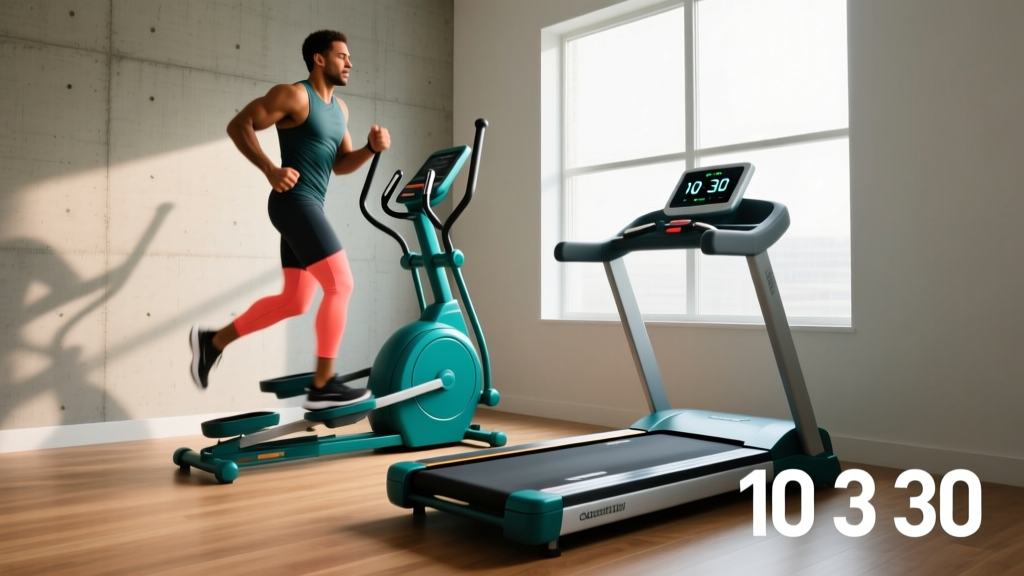
The viral 10 3 30 treadmill routine—walking at a 10% incline, 3.0 mph, for 30 minutes—has become a staple of modern home cardio. It is highly effective for cardiovascular health and lower-body endurance without the high impact of running. However, as urban living spaces shrink and the 2026 home fitness market pivots toward ultra-compact layouts, a major conflict arises: treadmills are notoriously space-hungry. This forces a critical question for home gym designers and fitness enthusiasts alike: Can an elliptical machine replicate the biomechanical benefits of the 10 3 30 treadmill workout while offering a superior spatial footprint?
Choosing between an elliptical and a treadmill is no longer just about joint impact or calorie burn; it is fundamentally an exercise in space optimization, layout design, and structural clearance. In this guide, we break down the exact dimensions, ceiling requirements, and biomechanical translations needed to make the right choice for your home layout.
The Spatial Footprint: Measuring Your Floor Plan
When mapping out a home gym, the manufacturer's stated dimensions only tell half the story. You must account for operational clearance, user stride, and safety zones.
Treadmill Footprint and Safety Zones
A standard home treadmill, such as the popular Horizon T101 or the NordicTrack T Series 10, typically measures around 70 inches long by 30 to 34 inches wide. However, the Mayo Clinic and equipment manufacturers universally mandate a safety clearance zone of at least 24 to 36 inches behind the rear roller to prevent severe friction burns in the event of a fall. This pushes the true operational footprint of a treadmill to roughly 106 inches (nearly 9 feet) in length.
Elliptical Footprint and Pedal Arc
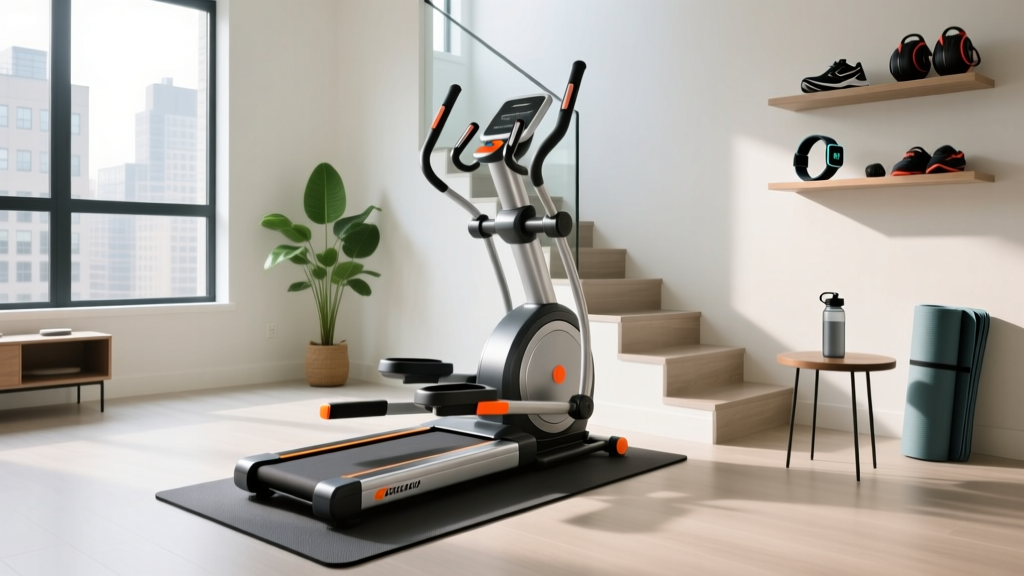
Ellipticals eliminate the need for a rear safety fall zone. A front-drive elliptical like the Sole E35 measures about 76 inches long by 28 inches wide, while ultra-compact cross-trainers like the Bowflex Max Trainer M6 shrink the footprint down to just 49 inches long by 30.5 inches wide. The spatial savings are massive, but they introduce a different spatial constraint: verticality.
Layout Pro-Tip: If your home gym is located in a hallway or a narrow alcove (less than 5 feet wide), a compact elliptical is the only viable option. A treadmill's side-to-side arm swing requires at least 4.5 feet of lateral clearance to feel psychologically comfortable and physically safe.Ceiling Height & The Incline Factor
One of the most overlooked aspects of home cardio layout design is ceiling clearance. Both machines interact with your room's vertical space differently, especially when adapting the 10 3 30 treadmill protocol.
The 10% Incline Elevation
When you raise a treadmill to a 10% incline for your workout, the front of the deck elevates significantly. On a 55-inch running deck, a 10% grade raises the front edge by approximately 5.5 inches. If you are 6 feet tall and your ceiling is the standard 8 feet (96 inches), adding 5.5 inches to your base height leaves you with roughly 14 inches of clearance. This is generally safe, but vaulted ceilings or sloped attic roofs require careful measurement at the exact point where the treadmill's front motor housing will sit.
The Elliptical Pedal Apex
Ellipticals do not tilt the user, but they elevate the user's entire body. At the apex of the pedal stride, an elliptical adds between 10 and 15 inches to your standing height. If you are 6 feet tall, your head will reach 81 to 87 inches at the top of the stride. In a room with standard 8-foot ceilings, taller users will literally hit their heads on an elliptical, making the 10 3 30 treadmill routine the only viable option for low-ceiling spaces like basements.
Clearance Comparison Matrix
| Machine Type | True Floor Footprint (L x W) | Added User Height | Ideal Room Placement |
|---|---|---|---|
| Folding Treadmill | 106" x 34" (with safety zone) | +5.5" (at 10% incline) | Low ceilings, long spare bedrooms |
| Front-Drive Elliptical | 76" x 28" (no rear zone) | +12" to +15" (pedal apex) | High ceilings, tight width spaces |
| Compact Cross-Trainer | 49" x 30" (no rear zone) | +15" to +18" (steep arc) | Apartment corners, high ceilings |
Biomechanics: Replicating the 10 3 30 Treadmill Workout on an Elliptical
The core appeal of the 10 3 30 treadmill routine is the sustained cardiovascular demand and posterior chain activation (glutes, hamstrings, and calves) generated by the steep incline. According to the Cleveland Clinic, walking on an incline significantly increases caloric expenditure and lower-body muscle engagement compared to flat walking, while remaining low-impact.
If your spatial layout dictates that an elliptical is the better choice, you must artificially recreate this 10% grade demand. Here is the exact translation framework:
The Elliptical Translation Protocol
- Incline/Ramp Setting: If your elliptical features an adjustable power ramp (like the Sole E95), set it to its maximum setting (usually 20 degrees, which roughly equates to a 36% grade, so set it to roughly level 5 or 6 to mimic a 10% treadmill grade).
- Resistance Level: Treadmill walking relies on moving your actual body weight against gravity. On an elliptical, the flywheel assists the motion. To mimic the 3.0 mph heavy-push feeling of a 10% incline, set the magnetic resistance between level 8 and 12 (out of 20). You should feel a distinct 'push' required from your glutes on the downstroke.
- Cadence (SPM): A 3.0 mph walk on a treadmill translates to roughly 100 to 110 steps per minute. Aim for 110 to 130 Strides Per Minute (SPM) on the elliptical to match the cardiovascular output.
- Posture: The biggest mistake users make on ellipticals is leaning on the static handrails, which unloads the posterior chain. To replicate the 10 3 30 treadmill core engagement, keep your hands off the rails or lightly rest them on the moving handles, maintaining an upright torso.
"While the elliptical cannot perfectly replicate the exact ground-reaction forces of a treadmill incline walk, manipulating the ramp angle and magnetic resistance provides an equivalent metabolic and muscular stimulus, making it a highly effective substitute for space-constrained environments."
Layout Design: Vibration, Power, and Structural Integrity
Space optimization is not just about what fits on the floor; it is about how the machine interacts with the room's infrastructure.
Impact and Vibration Transfer
Treadmills generate rhythmic, percussive impact. Even at a walking pace of 3.0 mph, the heel strike of a 180 lb user generates a force multiplier that transfers through the deck, into the floor joists, and down to the rooms below. If your home gym is on a second floor or above a living space, a treadmill requires a high-density EVA foam equipment mat (at least 3/8-inch thick) to dampen low-frequency vibration.
Ellipticals, by contrast, are zero-impact. The foot never leaves the pedal, meaning the force transfer is a smooth, continuous downward pressure rather than a percussive strike. If you live in an apartment with downstairs neighbors, an elliptical is vastly superior for maintaining peace, allowing you to complete your 30-minute routines at 5:00 AM without complaint.
Electrical Layout and Cord Management
Both machines require dedicated 120V outlets, but their placement dictates your layout. Treadmills draw significant amperage (often 12 to 15 amps) when the motor drives the belt at an incline. Running an extension cord across a walking path is a severe tripping hazard. When designing your layout, ensure the outlet is within 4 feet of the machine's front motor housing. Ellipticals draw much less current (especially magnetic resistance models), making them more forgiving if you must route a flat-profile cord cover along the baseboard.
Maintenance Space: The Hidden Spatial Cost
Finally, home gym designers must account for maintenance clearance. A treadmill requires periodic belt lubrication and tension adjustment. To access the motor hood and rear roller bolts, you need at least 18 inches of clearance on both sides and the front of the machine. If you push your treadmill flush against a wall or wedge it between heavy furniture, routine maintenance becomes a frustrating chore of moving heavy equipment.
Ellipticals require pivot point lubrication and rail cleaning, but the mechanical components are generally more exposed and accessible from the sides, reducing the need for deep peripheral clearance.
Final Verdict: Designing Your Cardio Zone
If your primary goal is to execute the exact 10 3 30 treadmill protocol with zero biomechanical compromise, and you possess a room that is at least 9 feet long with standard 8-foot ceilings, a folding treadmill remains the gold standard. However, if you are optimizing a compact apartment, dealing with narrow alcoves, or trying to eliminate impact noise for downstairs neighbors, an elliptical is the superior spatial choice. By applying the translation protocol—adjusting the ramp, increasing magnetic resistance, and maintaining strict posture—you can achieve the exact same cardiovascular and glute-building results in half the floor space.
More gear to consider
All reviews
Rowing Guide: Concept2 vs Hydrow & How Often to Lubricate Treadmill

Walking Pad vs Treadmill to Run: Complete Setup Guide

Assault Treadmill Workouts: 2026 Belt Maintenance Trends

Walking Pad Treadmill Comparison: NordicTrack C 990 in 2026

Stair Climber Setup Guide & Garmin Treadmill Calibration