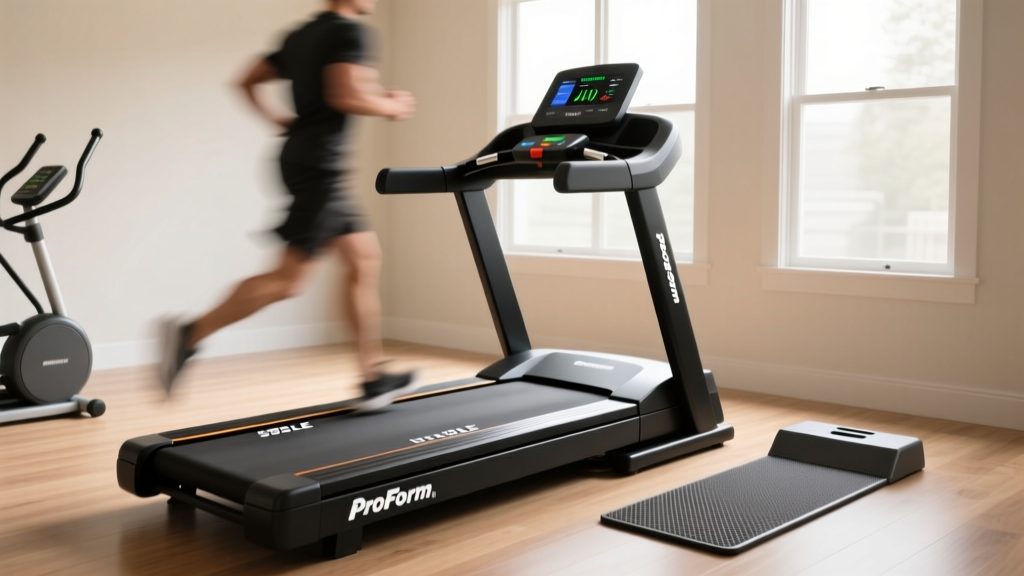
ProForm 595LE Treadmill Troubleshooting & Walking Pad Comparison
Fix common ProForm 595LE treadmill errors and compare its legacy repairability against modern walking pads in our expert troubleshooting guide.

The 2026 Home Cardio Dilemma: Legacy Workhorses vs. Ultra-Compact Pads
In the secondary fitness market, the ProForm 595LE treadmill remains a ubiquitous presence. Originally released as a mid-tier folding model, its robust 2.25 CHP motor and straightforward mechanical design have made it a staple in home gyms, often changing hands on refurbished markets for $200 to $350. However, as these units age, owners inevitably face mechanical quirks that require hands-on troubleshooting.
Simultaneously, the fitness industry has seen a massive pivot toward under-desk and folding walking pads. Consumers are constantly weighing whether to invest time and money into repairing a traditional folding treadmill like the 595LE, or to discard it in favor of a modern, space-saving walking pad. This guide serves as a comprehensive troubleshooting manual for the ProForm 595LE, while providing a critical, data-driven comparison against today's leading walking pads to help you make an informed repair-or-replace decision.
Expert Insight: The ProForm 595LE is highly repairable. Unlike modern walking pads with sealed, proprietary DC motors, the 595LE uses standard, easily sourced replacement parts. Before throwing it away, check the error codes below.ProForm 595LE Treadmill: Critical Troubleshooting & Common Mistakes
Most 595LE owners prematurely scrap their machines due to a misunderstanding of basic error codes and maintenance protocols. Here are the most frequent mistakes and their exact, step-by-step fixes.
1. The Dreaded 'E1' Speed Sensor Error
The Mistake: Assuming an E1 error code means the main drive motor is dead and replacing it unnecessarily.
The Reality: An E1 code indicates that the console is not receiving a signal from the reed switch (speed sensor) located near the front roller. This is almost always a misalignment or dust issue, not a motor failure.
- Unplug the treadmill from the wall and remove the safety key.
- Remove the motor hood (usually 4 to 6 Phillips-head screws).
- Locate the front roller pulley and the adjacent magnetic speed sensor.
- Check the gap between the magnet and the sensor. It must be exactly 1/8 inch.
- If the gap is wider, loosen the sensor mounting screw, slide it closer to the magnet, and retighten.
- Wipe the sensor and magnet with a microfiber cloth to remove metallic dust.
2. Belt Slippage and the 1/4-Turn Rule
The Mistake: Overtightening the running belt when it slips during heavy footfalls, which eventually strips the drive belt or burns out the motor controller.
The Fix: Belt tension must be adjusted symmetrically and incrementally. Locate the two rear roller adjustment bolts at the back of the deck. Using an Allen wrench, turn both bolts clockwise by exactly 1/4 turn. Plug the machine in and test at 3.0 MPH. If it still slips, repeat the 1/4 turn process. Never exceed 2 full turns from the factory baseline, as this will choke the motor.
3. Incline Motor Calibration Failure
The Mistake: Manually forcing the incline lift arm when it gets stuck at 0% or 15%, which strips the plastic gears inside the incline motor.
The Fix: You must force the console into 'CAL' (Calibration) mode to reset the limit switches.
- Remove the safety key from the console.
- Press and hold the Stop and Speed Up buttons simultaneously.
- While holding both buttons, re-insert the safety key, then release the buttons.
- The display should enter calibration mode. Press 'Speed Up' once; the belt will max out and stop.
- Press 'Incline Up'; the deck will raise to maximum, lower to minimum, and return to zero, resetting the internal potentiometer.
Walking Pad Treadmill Comparison: Repair vs. Replace
If your 595LE requires a major component replacement (like a new motor controller, which costs roughly $85), you might wonder if a modern walking pad is a better investment. To evaluate this, we must compare the legacy architecture of the ProForm against top-tier 2026 walking pads like the UREVO Strol 2E and the KingSmith WalkingPad R2.
| Feature | ProForm 595LE (Legacy) | UREVO Strol 2E (Pad) | KingSmith R2 (Pad) |
|---|---|---|---|
| Continuous Motor | 2.25 CHP | 1.0 HP (2.5 Peak) | 1.25 HP |
| Running Surface | 18 x 50 inches | 17.3 x 43.3 inches | 17.3 x 47.2 inches |
| Weight Capacity | 300 lbs | 240 lbs | 240 lbs |
| Top Speed | 10.0 MPH | 7.6 MPH | 7.5 MPH |
| Repairability | High (Standard Parts) | Low (Sealed Deck) | Low (Proprietary) |
| Avg. Cost (2026) | $250 (Refurbished) | $229 (New) | $399 (New) |
The Hidden Costs of Walking Pad Disposability
Walking pads excel in spatial efficiency but fail in long-term serviceability. The UREVO and KingSmith models utilize ultra-thin decks that cannot be easily opened to replace a worn belt or a burnt motor. When a walking pad's internal ribbon cable snaps or the DC motor fails, the entire unit is typically rendered e-waste. In contrast, the ProForm 595LE's modular hood and standard 1-ply or 2-ply belt replacement system (costing about $35) ensures a lifespan that can exceed a decade with basic care.
Walking Pad Mistakes: What New Owners Get Wrong
If you do decide to transition from the 595LE to a walking pad, avoid the critical mistakes that lead to premature failure of these compact machines.
1. Running on Sub-3.0 MPH Motors
Walking pads are engineered for low-torque, steady-state walking. Attempting to jog at 5.0 MPH on a 1.0 HP continuous motor causes rapid thermal throttling. The motor controller will intentionally cut power to prevent a fire hazard, resulting in sudden, dangerous stops. Reserve jogging for traditional treadmills with minimum 2.5 CHP motors and longer decks.
2. Ignoring the 180-Degree Folding Hinge
Models like the KingSmith R2 fold completely in half. The internal wiring harness that connects the front motor housing to the rear control board passes directly through this hinge. Repeatedly folding and unfolding the unit without ensuring the cables are seated properly in their designated channels will cause micro-fractures in the copper wiring, leading to console blackouts.
Warning: Never use aerosol WD-40 or petroleum-based lubricants on any treadmill or walking pad belt. These degrade the PVC and rubber compounds, causing the belt to stretch and delaminate. Always use 100% liquid silicone treadmill lubricant.Biomechanics and Joint Health: 595LE vs. Under-Desk Pads
Beyond mechanical repairability, the physical dimensions of your machine dictate your biomechanical health. The ProForm 595LE offers an 18-inch width and 50-inch length. This allows for a natural arm swing and full stride extension, which is crucial for maintaining proper spinal alignment and engaging the posterior chain.
Walking pads, constrained by their under-desk use cases, often feature 15-inch widths and 43-inch lengths. This forces users into a slightly narrowed, shortened gait. According to research highlighted by Harvard Health Publishing, maintaining a natural, brisk walking pace with full arm engagement is essential for maximizing cardiovascular benefits and caloric expenditure. Furthermore, the American Heart Association emphasizes that consistent, moderate-intensity walking is a cornerstone of heart health, but doing so on a deck that restricts your natural biomechanics can lead to compensatory hip and knee strain over long durations.
If your goal is purely increasing daily NEAT (Non-Exercise Activity Thermogenesis) while answering emails, a walking pad is sufficient. If you are targeting Zone 2 cardio training, power walking, or interval training, the 595LE's larger deck and incline capabilities (0% to 10%) make it vastly superior.
Final Verdict: When to Wrench and When to Upgrade
The decision to repair your ProForm 595LE or purchase a walking pad comes down to your spatial constraints and fitness objectives.
- Repair the 595LE if: You have the floor space, you want to incorporate incline and jogging into your routine, and you prefer a machine that can be maintained with standard tools and $40 replacement parts.
- Switch to a Walking Pad if: You live in a micro-apartment, your primary goal is combating sedentary desk work with low-intensity stepping, and you are willing to accept a 2-to-3-year lifespan before the unit requires total replacement.
Ultimately, the ProForm 595LE treadmill remains a testament to an era of fitness equipment built for repair rather than planned obsolescence. By mastering the simple calibration and tension adjustments outlined above, you can keep this legacy machine running smoothly well into the future.
More gear to consider
All reviews
XTERRA Fitness TRX3500 Treadmill Motor Size & Troubleshooting

Apple Watch Indoor Run Does Not Match Treadmill? 2026 Rowing Guide
Air Bike vs Assault Bike: Budget Breakdown & Shrimp Treadmill Study

AFG Treadmills Review: Budget Folding Picks for Small Spaces 2026

Space-Saving Cardio: Stationary Bike Types & Treadmill Ab Workout Zones
