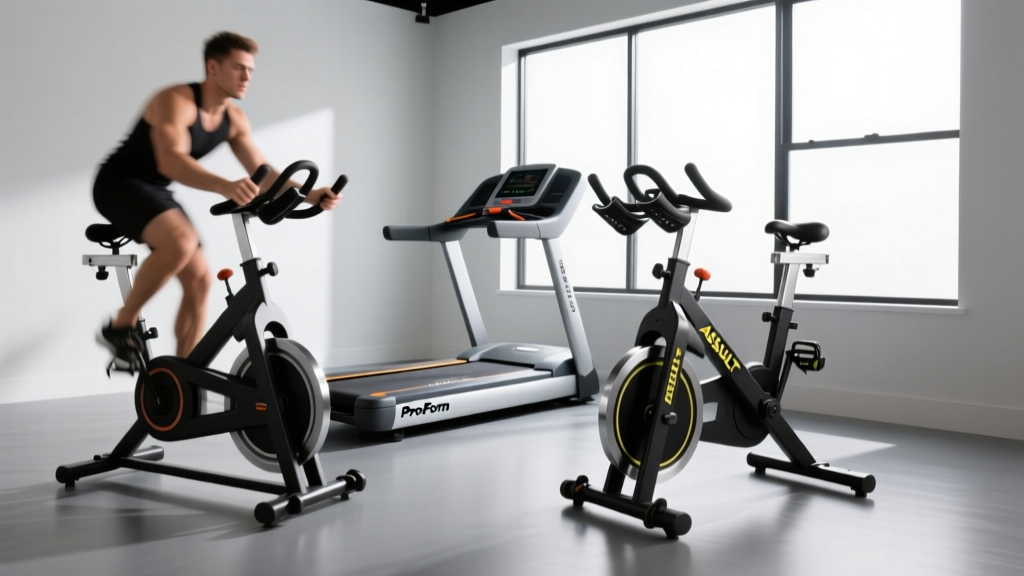
Air Bike vs Assault Bike Care: ProForm 745CS Treadmill Comparisons
Compare maintenance routines for air bikes and Assault Bikes, with cross-training insights for ProForm 745CS treadmill owners seeking cardio longevity.

As home gym enthusiasts in 2026 continue to diversify their cardiovascular setups, the debate between belt-driven air bikes and chain-driven Assault Bikes remains a hot topic. For athletes transitioning from traditional motorized cardio—such as the legacy ProForm 745CS treadmill—the shift to manual fan bikes introduces an entirely new mechanical paradigm. While the ProForm 745CS treadmill requires meticulous walking belt alignment, deck lubrication, and motor hood dusting, fan bikes present their own unique failure modes, primarily centered around drivetrain tension, bottom bracket shear forces, and environmental corrosion.
This comprehensive maintenance guide compares the long-term care requirements of belt-driven air bikes (like the Rogue Echo and Schwinn Airdyne AD7) against chain-driven Assault Bikes. Whether you are a cross-training athlete or a garage gym owner looking to maximize equipment longevity, understanding these mechanical distinctions is critical for minimizing downtime and repair costs.
The Motorized vs. Manual Baseline
If you are currently maintaining a ProForm 745CS treadmill, you are likely familiar with the necessity of applying 100% silicone lubricant beneath the walking belt every 150 miles and adjusting the rear roller bolts to prevent belt drift. Fan bikes eliminate the motor and deck friction entirely, replacing them with high-torque drivetrains that convert human wattage directly into fan resistance. The maintenance focus shifts from electrical and friction management to drivetrain preservation and bearing integrity.
The Mechanical Divide: Chain vs. Belt Drive Systems
The most significant maintenance differentiator between the Assault Bike and standard air bikes lies in the drivetrain. This single component dictates your monthly maintenance schedule, your ambient noise levels, and your long-term replacement costs.
Assault Bike: The Chain-Drive Reality
The Assault Bike Pro and Elite models utilize a heavy-duty, single-speed bicycle chain (typically a 1/8" KMC Z410 or similar variant). While this provides a raw, connected feel and allows for easier, cheaper replacements, it demands regular intervention. According to Park Tool's chain lubrication guidelines, chains exposed to open-air environments and high-torque sprinting require frequent degreasing and re-lubrication to prevent elongation (stretch) and sprocket wear.
- Monthly Task: Wipe down the chain with a citrus degreaser and apply a dry or wax-based bicycle chain lube. Wet lubes attract garage dust and create an abrasive grinding paste.
- Failure Mode: A stretched chain will prematurely wear the front chainring and rear cog. Replacing a $15 chain on time prevents a $75 drivetrain overhaul.
- Tensioning: Unlike the automated belt tracking on a ProForm 745CS treadmill, the Assault Bike chain requires manual rear-wheel axle adjustment to maintain roughly 1/2 inch of vertical play.
Air Bikes (Rogue Echo / Schwinn AD7): The Belt-Drive Advantage
Belt-driven air bikes utilize polyurethane carbon-reinforced belts, such as the Gates Carbon Drive systems. These belts require zero lubrication, do not stretch over time, and operate in near silence. However, they are highly sensitive to improper tension.
- Quarterly Task: Check belt tension using a smartphone frequency app (like the Gates Carbon Drive app). The target frequency is usually between 100Hz and 110Hz when plucked.
- Failure Mode: Over-tensioning the belt places immense lateral stress on the bottom bracket bearings, leading to premature grinding and failure. Under-tensioning causes the belt to skip teeth during high-wattage sprint intervals.
- Cleaning: Simply wipe with a damp cloth. Never use chemical solvents, which can degrade the polyurethane matrix.
Routine Maintenance Matrix
To visualize the ongoing time and financial investment required for these machines, refer to the comparison matrix below. We have also included standard treadmill metrics for context.
| Maintenance Task | Assault Bike (Chain) | Air Bike (Belt) | ProForm 745CS Treadmill |
|---|---|---|---|
| Drivetrain Lubrication | Every 30 days (Bike Lube) | Never | Every 150 miles (Silicone) |
| Tension Adjustment | As needed (Axle bolts) | Quarterly (Frequency app) | As needed (Rear roller) |
| Drivetrain Replacement Cost | $15 - $25 (Chain only) | $60 - $90 (Proprietary Belt) | $40 - $70 (Walking Belt) |
| Bottom Bracket Service | Annually (High failure rate) | Every 2-3 years (Sealed) | N/A (Motorized) |
Bottom Bracket and Bearing Failure Modes
The bottom bracket (BB) is the central bearing assembly that allows the crank arms to spin. In the context of fan bikes, this component endures catastrophic lateral forces, especially when athletes perform out-of-the-saddle max-effort sprints.
The Assault Bike Square-Taper Vulnerability
Older and standard Assault Bike models utilize a square-taper bottom bracket interface. This is a known weak point in the fitness equipment industry. When users fail to torque the crank arm bolts to the manufacturer's specification (typically 35-40 Nm), the microscopic movement during sprinting strips the soft aluminum of the crank arm against the hardened steel spindle. Once the crank arm wallows out, it must be replaced, and the bottom bracket spindle often sustains scoring damage.
Expert Tip: Invest in a calibrated torque wrench. Checking your crank arm bolts to 35 Nm every 60 days is the single most effective way to prevent the dreaded "Assault Bike creak" and avoid catastrophic crank arm failure.
Sealed Cartridge Alternatives on Belt-Drive Bikes
Belt-driven air bikes like the Rogue Echo generally employ heavy-duty sealed cartridge bottom brackets. Because the belt does not require the extreme tension of a chain to avoid skipping, and because the frame designs often incorporate stiffer bearing housings, these BBs last significantly longer. When they do fail, replacement requires specialized bicycle tools, such as a Park Tool CCP-22 crank puller and a standard splined BB removal tool. Sourcing high-quality replacement bearings from brands like SKF or Shimano (often costing between $25 and $45) will outlast the OEM parts installed at the factory.
Environmental Degradation: Sweat, Rust, and the Garage Gym
Human sweat is highly acidic and contains chloride salts that act as a rapid catalyst for oxidation. While a treadmill like the ProForm 745CS features a shrouded motor compartment and a non-porous running belt that can be wiped clean, fan bikes feature exposed steel frames, raw chain links, and intricate seat-post adjustment mechanisms that are highly susceptible to rust.
The Anti-Corrosion Protocol
- Post-Workout Wipe Down: Use a microfiber cloth dampened with a mild, non-bleach antibacterial wipe. Never spray liquid directly onto the console or bearing seals.
- Chain Protection: For Assault Bikes, use a wax-based lubricant (like Squirt or Silca Super Secret). Wax dries hard and does not attract the dust that turns sweat-drip into a corrosive mud.
- Frame Preservation: If your garage gym experiences high humidity, apply a light coating of Boeshield T-9 or Fluid Film to the exposed steel welds and seat post slider. These aerospace-grade protectants displace moisture without leaving a sticky residue that ruins your clothing.
Console and Electronics Preservation
Unlike the ProForm 745CS treadmill, which draws power from a standard 120V AC wall outlet to run its incline motors and display, most fan bikes rely on internal generators powered by the fan wheel, supplemented by AA batteries for memory retention.
The primary failure mode for fan bike consoles is battery acid leakage. Athletes often leave alkaline batteries in the console for years. When the batteries degrade, they leak potassium hydroxide, which corrodes the PCB (printed circuit board) contacts and permanently destroys the monitor. To prevent this, either remove the batteries if you use the bike daily (the generator will power the screen) or swap to Lithium AA batteries, which are virtually immune to leaking. Additionally, ensure the clear plastic sweat-guard over the console display is intact; a single drop of salty sweat bypassing this guard can short-circuit the membrane buttons.
Expert Verdict: Total Cost of Ownership
When evaluating the long-term maintenance care and longevity of these cardio machines, the belt-driven air bike emerges as the clear winner for the "set it and forget it" athlete. The elimination of chain lubrication, combined with superior sealed bottom brackets, drastically reduces the monthly time investment required to keep the machine in peak condition.
However, the chain-driven Assault Bike offers a distinct advantage in repairability. If an Assault Bike chain snaps or a sprocket wears out, any local bike shop can source a replacement for under $20, and the repair requires only basic hand tools. Conversely, a proprietary belt-drive system failure often requires ordering direct from the manufacturer and waiting for shipping.
For owners managing a mixed-modal gym—perhaps splitting time between heavy lifting, fan bike intervals, and steady-state zones on a well-maintained legacy treadmill—understanding these mechanical nuances ensures that your equipment remains an asset, not a liability. By adhering to strict torque specifications, utilizing frequency-based belt tensioning, and implementing a rigorous anti-corrosion protocol, you can easily extend the lifespan of your fan bike well past the 10-year mark.
More gear to consider
All reviews
2026 Techno Treadmill Showdown: Myrun vs. Skillrun

Nordic Track Commercial 2450 Treadmill vs Elliptical Care
Under-Desk Treadmill Review: ATG Backward Treadmill Maintenance

Leveling Treadmill Setups: Beginner's Buying & Feature Guide

Treadmills vs Running Outside: The Ultimate Motor Horsepower Guide
