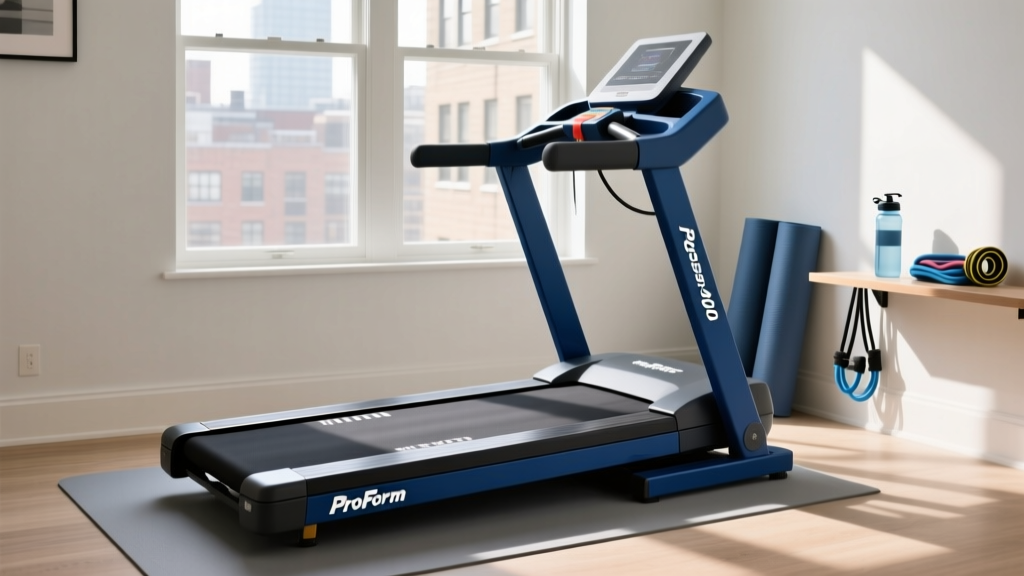
Prevent Sore Knees From Running on Treadmill: Setup & Noise Guide
Learn how proper treadmill installation, noise-reducing mats, and leveling prevent sore knees from running on treadmill while keeping your home gym quiet.

The Hidden Link Between Home Gym Noise and Joint Pain
When outfitting a home gym, most buyers obsess over motor horsepower and interactive screens. However, the two most common complaints that lead to abandoned fitness routines are entirely physical: disruptive structural noise and joint discomfort. If you are experiencing sore knees from running on treadmill workouts, the root cause often traces back to the initial installation, floor coupling, and machine calibration rather than a personal biomechanical flaw.
Structure-borne impact noise—the loud thudding transmitted through your floorboards—is the exact same kinetic energy traveling back up your skeletal structure. By analyzing cardio machine noise levels, we are essentially measuring joint impact forces. This comprehensive setup and installation walkthrough will show you how to mitigate acoustic vibrations, protect your patellofemoral joints, and create a commercial-grade cardio environment at home.
Cardio Machine Noise & Impact Comparison Matrix
Before diving into treadmill-specific installation, it is crucial to understand how different cardio machines generate noise and transfer impact. The decibel (dB) ratings below represent typical operational volumes measured at ear level, while impact noise reflects structure-borne vibration transmitted to the floor.
| Machine Type | Motor Noise (dB) | Impact Noise (dB) | Joint Stress Level | Setup Complexity |
|---|---|---|---|---|
| Motorized Treadmill | 60 - 75 dB | 75 - 90 dB (High) | High (2-3x body weight) | High (Leveling, matting) |
| Elliptical Cross-Trainer | 45 - 55 dB | 30 - 40 dB (Low) | Very Low (Zero impact) | Moderate (Assembly) |
| Rowing Machine (Magnetic) | 40 - 50 dB | 35 - 45 dB (Low) | Low (Seated, horizontal) | Low (Unfold and lock) |
| Air Bike (Assault/Echo) | 65 - 85 dB (Fan) | 40 - 50 dB (Low) | Low (Seated, circular) | Low (Bolts, calibration) |
| Stair Climber | 55 - 65 dB | 50 - 60 dB (Med) | Moderate (Vertical load) | High (Heavy, leveling) |
According to the National Institute of Arthritis and Musculoskeletal and Skin Diseases (NIAMS), repetitive high-impact loading without adequate shock absorption is a primary catalyst for cartilage degradation and patellar tendinopathy. As the table illustrates, treadmills generate the highest impact noise, making proper installation non-negotiable for joint health.
Step-by-Step Treadmill Installation for Joint Protection
To eliminate the kinetic feedback loop that causes sore knees from running on treadmill sessions, follow this exact installation protocol.
Step 1: Subfloor Assessment and Anti-Vibration Matting
Never place a treadmill directly on hardwood, laminate, or tile. Hard surfaces reflect 100% of the kinetic energy back into your joints. However, not all gym mats are created equal.
- Avoid EVA Foam: Cheap interlocking EVA foam tiles compress entirely under the 150+ lbs of a treadmill frame, offering zero shock absorption for the runner.
- Choose Vulcanized Rubber: Invest in a 3/8-inch thick vulcanized rubber mat (often sold as horse stall mats or premium home gym tiles). These cost between $80 and $150 but provide a dense, micro-cellular barrier that absorbs acoustic vibrations and softens footfall impact.
- Dimensions: Ensure the mat extends at least 4 inches beyond the treadmill footprint on all sides to catch any lateral stride deviations.
Step 2: Precision Leveling (The Most Skipped Step)
If your treadmill is laterally tilted by even 1 degree, the running belt will track to one side. To compensate, your body unconsciously alters its gait, placing uneven shear force on the IT band and medial knee joint. This is a massive, hidden cause of asymmetric knee pain.
- Place a 48-inch torpedo level horizontally across the rear deck of the treadmill.
- Adjust the rear leveling feet (usually threaded rubber bolts) until the bubble is perfectly centered.
- Repeat the process vertically (front-to-back). A slight rear-to-front drop (about 1/8 inch over 4 feet) is acceptable, but a front-high tilt forces the motor to work harder and alters your natural heel-strike.
A loud, rhythmic slapping noise during your run is not just annoying; it indicates a loose belt. A loose belt creates micro-stutters in the deck surface, forcing your knee stabilizers to rapidly fire and compensate for the slipping surface. This drastically accelerates patellar fatigue. Ensure your belt has exactly 2 to 3 inches of lift in the center when the machine is off.
Step 3: Deck Lubrication and Motor Strain Reduction
Friction between the belt and the deck generates heat, noise, and motor drag. A dragging motor vibrates the entire chassis. Apply 100% silicone treadmill lubricant (approx. $12 per bottle) under the belt every 150 miles or 3 months. This reduces motor noise by up to 15 dB and ensures a smooth, consistent belt glide that is vital for protecting the patellofemoral joint.
Shock Absorption Systems: Brand Technology Breakdown
Once the machine is leveled and matted, the internal deck suspension takes over. In 2026, leading manufacturers utilize distinct elastomer technologies to reduce impact noise and joint stress.
- SOLE Fitness (Cushion Flex): Found on models like the Sole F80 (approx. $999), this system uses variable-durometer rubber grommets. It is engineered to be firmer at the push-off zone and softer at the heel-strike zone, reducing joint impact by up to 40% compared to outdoor asphalt.
- NordicTrack (FlexSelect): Available on the Commercial 1750 series, this allows users to physically turn cushioning on or off. For runners with sore knees, keeping the cushioning 'ON' reduces acoustic footfall noise from 85 dB down to a muffled 65 dB.
- Woodway (Vulcanized Slat Belts): The gold standard for joint protection. Models like the Woodway 4Front (approx. $6,500+) use individual rubber slats on a ball-bearing track. Impact noise is virtually eliminated, and the running surface mimics a pristine forest trail, making it the ultimate solution for chronic knee issues.
The Biomechanical Hack: The 1% Incline Rule
Even with a perfect installation, running at a 0% incline on a treadmill can cause sore knees. Why? Because the moving belt pulls your leg back, altering your hamstring engagement and placing slightly more load on the quadriceps and knee extensors.
Research highlighted by Harvard Health Publishing confirms that indoor running biomechanics differ subtly from overground running. To equalize the biomechanical load and eliminate the 'downhill' braking effect that occurs on a flat treadmill, always set your treadmill to a 1% or 1.5% incline. This minor adjustment shifts the workload to the glutes and hamstrings, dramatically reducing anterior knee pain and lowering the heavy heel-strike impact noise.
Frequently Asked Questions
Can I use a thick yoga mat under my treadmill to reduce noise and knee pain?
No. Yoga mats (typically 1/4-inch PVC or TPE) are too soft and will compress entirely under the treadmill's static weight. This creates an unstable, wobbly base that forces your knee stabilizers to overwork, leading to rapid fatigue and pain. Always use dense, 3/8-inch vulcanized rubber.
My treadmill is perfectly leveled, but my knees still hurt after 20 minutes. What should I check?
Check your running shoes. Treadmill decks have built-in flex; if you wear highly cushioned 'maximalist' shoes (like Hoka Bondis) on a highly cushioned treadmill deck, the combined instability can cause knee tracking issues. Switch to a moderate-drop (8-10mm), neutral stability shoe for indoor running.
Does a heavier treadmill frame reduce impact noise and joint stress?
Yes. A heavier frame (300+ lbs) acts as a larger mass damper, absorbing kinetic energy that would otherwise travel into your joints or the floor. Budget treadmills under 150 lbs will always transmit more vibration and noise than heavy-duty commercial models.
More gear to consider
All reviews
Sunny Treadmill SF-T4400 Review: Best Folding Pick for 2026

3.5 Horsepower Treadmill Belt Maintenance: 2026 Cost & Value Guide
HIIT Treadmill vs Walking Pad: Top Mistakes & Fixes

High Intensity Cardio Treadmill vs Upright, Recumbent & Spin Bikes
Horizon 7.0 AT Treadmill Specs & Noise Level Setup Guide