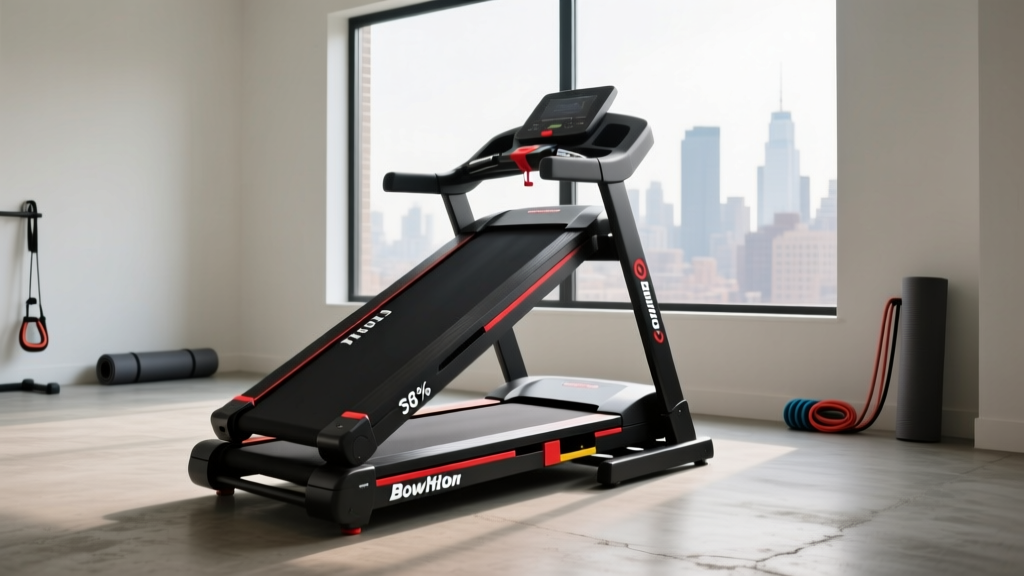
Bowflex Treadmill 56 Review: Small Space Value Breakdown
Is the Bowflex Treadmill 56 worth the price for small apartments? We break down the costs, folding dimensions, and value of this compact cardio machine.

The Small-Space Dilemma: Why the Bowflex Treadmill 56?
As urban living spaces continue to shrink in 2026, the demand for high-performance folding cardio equipment has never been higher. The Bowflex Treadmill 56 was engineered specifically to bridge the gap between premium smart treadmills and the spatial constraints of modern apartments. But does its compact footprint justify its premium price tag? In this comprehensive folding treadmill for small spaces review, we strip away the marketing fluff and perform a rigorous budget breakdown and value analysis of the Bowflex 56. We will examine the true 3-year cost of ownership, spatial clearance requirements, and hardware limitations to determine if this machine is a smart financial investment or a costly spatial compromise.
Quick Specs & Footprint Data
- Unfolded Dimensions: 70" L x 30" W x 65" H
- Folded Dimensions: 30" L x 30" W x 72" H
- Tread Belt: 20" x 55"
- Motor: 2.75 CHP
- Weight Capacity: 400 lbs
- Base MSRP (2026): $1,599
The Spatial Reality: Measuring the Fold
When evaluating a folding treadmill for small spaces, the manufacturer's "folded dimensions" only tell half the story. The Bowflex Treadmill 56 utilizes a vertical hydraulic folding mechanism. While the folded footprint is a highly manageable 30 by 30 inches, the swing radius required to lower and raise the deck is where most small-space buyers make a critical error.
To safely deploy the 185-pound deck, you need a minimum of 85 inches of clear floor space in front of the machine. Furthermore, ceiling height is a major factor. When folded vertically, the rear of the treadmill reaches 72 inches in height. If you have standard 8-foot (96-inch) ceilings, you have only 24 inches of clearance to tilt the machine back into its locked position. For users in older apartments with lower ceilings or overhead light fixtures, this vertical fold can become a daily frustration rather than a space-saving convenience.
Budget Breakdown: 3-Year Cost of Ownership
The upfront MSRP of the Bowflex Treadmill 56 sits at $1,599 as of early 2026. However, analyzing the value of a smart treadmill requires looking at the ecosystem lock-in and ongoing software costs. The Bowflex 56 relies heavily on the JRNY adaptive fitness app for its interactive programming.
| Cost Category | Year 1 | Year 2 | Year 3 |
|---|---|---|---|
| Hardware (Base Price) | $1,599 | $0 | $0 |
| Shipping & Assembly | $199 (Pro Assembly) | $0 | $0 |
| JRNY Subscription ($149/yr) | $149 | $149 | $149 |
| Maintenance (Lubricant/Parts) | $20 | $20 | $20 |
| Cumulative Total | $1,967 | $2,136 | $2,305 |
Compared to a budget-friendly manual folding treadmill (which costs under $400 with zero software fees), the Bowflex 56 is a premium investment. However, when compared to the NordicTrack EXP 7i or the Peloton Tread, the Bowflex offers a slightly lower barrier to entry while maintaining a robust 20-inch HD touchscreen. The value proposition hinges entirely on your utilization of the JRNY software; without the subscription, the 56's screen functionality is severely limited, reducing a $1,600 machine to a basic, overpriced manual treadmill.
Hardware Value: Where the Budget Shows
Motor and Belt Limitations
To achieve a compact footprint and a $1,599 price point, Bowflex made specific hardware compromises. The 2.75 Continuous Horsepower (CHP) motor is adequate for walking, jogging, and light running, but it will struggle with thermal regulation during sustained, high-incline running sessions by users over 200 lbs. According to the American Heart Association, achieving optimal cardiovascular health requires sustained moderate-to-vigorous aerobic activity. If your regimen involves daily 10%+ incline power-walking, the 2.75 CHP motor will run hot, triggering thermal shutdowns over time.
Furthermore, the 20" x 55" tread belt is the most significant spatial compromise. Standard commercial treadmills feature a 22" x 60" belt. As noted by Harvard Health Publishing, maintaining proper biomechanics and stride length is crucial for joint health and injury prevention. If you are taller than 5'10" or have a naturally long running stride, the 55-inch belt will force you to shorten your gait, potentially leading to knee and hip strain. This machine provides exceptional value for walkers and shorter runners, but poor biomechanical value for tall, serious runners.
The JRNY Ecosystem: Value or Trap?
The Bowflex 56's primary selling point is its 20-inch HD touchscreen powered by the JRNY app. JRNY differentiates itself from competitors by offering adaptive workouts that adjust in real-time based on your performance and fatigue levels. From a budget perspective, the $149 annual fee is highly competitive compared to Peloton's $468 annual All-Access membership.
However, the "trap" lies in the hardware integration. Unlike some 2026 smart treadmills that allow you to cast third-party apps (like Netflix or Zwift) to the console, the Bowflex 56 operates in a relatively closed ecosystem. If you decide to cancel your JRNY subscription in Year 2 to save money, you lose access to the vast majority of the screen's interactive features. You are left with a manual interface that could have been achieved with a $300 basic treadmill and a tablet mount.
Maintenance and Failure Points in Small Spaces
Folding treadmills inherently possess more mechanical failure points than fixed-frame models. When analyzing the long-term value of the Bowflex 56, you must account for the maintenance of the folding hinge and the deck latch.
- The Hinge Mechanism: The hydraulic piston that assists in folding the deck requires periodic inspection. In small spaces where the treadmill is folded and unfolded daily, the piston seals can degrade within 18 to 24 months, leading to a deck that drops too quickly—a severe safety hazard.
- Deck Lubrication: The smaller 55-inch belt concentrates user foot-strikes over a smaller surface area, increasing friction. You must apply 100% silicone treadmill lubricant every 130 miles or every 3 months. Failure to do so will accelerate the wear on the 2.75 CHP motor's drive belt.
- Dust Accumulation: In small apartments, treadmills are often pushed into corners or closets when folded. These areas are notorious for dust buildup, which gets sucked into the motor compartment. Vacuuming the motor hood every 90 days is mandatory to prevent motherboard overheating.
Final Verdict: Who Actually Gets Value from the Bowflex 56?
The Bowflex Treadmill 56 is not a universal solution; it is a highly specialized tool for a specific demographic.
High-Value User Profile
You will extract maximum value from this machine if you live in an apartment with at least 8-foot ceilings, are under 5'10" in height, prioritize guided adaptive programming over outdoor running, and primarily engage in walking, jogging, or incline-hiking rather than sprinting.
Conversely, if you are a tall runner, live in a space with low ceilings, or prefer to use third-party fitness apps without a proprietary subscription lock-in, the Bowflex 56 represents a poor allocation of your fitness budget. For those users, a fixed-frame treadmill with a standard 60-inch belt or a high-end folding model like the Sole F63 (which sacrifices the smart screen for a much more robust 3.0 CHP motor and longer belt) will provide vastly superior long-term biomechanical and financial value.
More gear to consider
All reviews
Stair Climber Troubleshooting & Treadmill Skipping Fixes

Rowing Machine Guide & Technique: Skip Lubricating ProForm Treadmills

18 Incline Treadmill Motor Troubleshooting & Horsepower Guide

Escaping treadmill.murder: Stationary Bike Budget Breakdown
Cardio Noise Guide: NordicTrack T Series 5 Treadmill Details & More
